


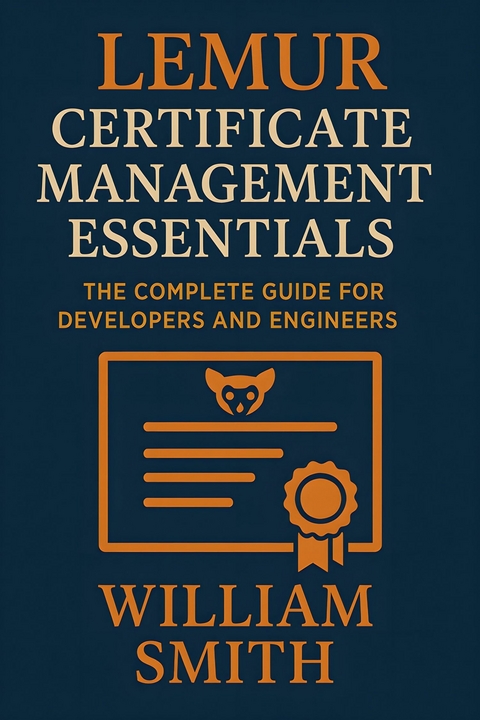
Lemur Certificate Management Essentials (eBook)
250 Seiten
HiTeX Press (Verlag)
978-0-00-097513-3 (ISBN)
'Lemur Certificate Management Essentials'
'Lemur Certificate Management Essentials' is a definitive guide for IT professionals, security architects, and DevOps engineers seeking to master modern certificate lifecycle management using the Lemur platform. This book begins with a thorough exploration of Public Key Infrastructure (PKI) fundamentals, advancing through the intricacies of X.509 certificates, cryptographic key management, and compliance considerations. Readers will gain a practical grounding in the latest threats facing certificate operations and learn industry best practices for lifecycle management, from creation and renewal to robust revocation strategies.
The book delivers a deep technical dive into Lemur's architecture, unveiling its core components, scalable deployment patterns, and extensibility via APIs and plugins. Through step-by-step guidance, it covers installation from source and package managers, automated provisioning with Infrastructure as Code tools, and integration into diverse environments-including multi-cloud, hybrid infrastructures, and modern CI/CD pipelines. Detailed chapters elucidate workflow automation, role-based access control, and seamless connectivity with certificate authorities and enterprise systems, empowering organizations to automate and streamline their certificate management at scale.
Security, compliance, and operational excellence are central themes throughout this guide. Readers will benefit from comprehensive coverage of risk mitigation techniques, secure storage and backup operations, advanced monitoring, and compliance workflows. The book concludes with practical guidance for maintaining and upgrading Lemur, engaging with open source communities, and positioning teams for future enterprise use cases. Packed with actionable solutions and architectural blueprints, 'Lemur Certificate Management Essentials' is an indispensable resource for organizations committed to secure, scalable, and auditable certificate management.
Chapter 1
PKI Fundamentals and Modern Certificate Management
In a world where trust is forged in code and cryptography, understanding the core mechanisms that secure our communications is not just advantageous—it’s essential. This chapter unravels the architectural foundations of Public Key Infrastructure (PKI), illuminating both legacy concepts and their transformation to meet the demands of cloud-native ecosystems, distributed systems, and automated workflows. Readers will discover the hidden complexities and indispensable techniques that set robust certificate management practices apart from traditional security controls.
1.1 Overview of Public Key Infrastructure
Public Key Infrastructure (PKI) constitutes a comprehensive framework designed to enable secure electronic communications and data exchange through cryptographic techniques. The foundation of PKI lies in asymmetric cryptography, but its practical deployment requires coordinated organizational entities, defined trust relationships, and rigorous validation processes. The essential building blocks of PKI encompass Certificate Authorities (CAs), Registration Authorities (RAs), and relying parties, each playing pivotal roles within the ecosystem.
A Certificate Authority serves as a trusted third party responsible for issuing, managing, and revoking digital certificates. These certificates bind public keys to the identity information of entities—individuals, organizations, or devices—thereby facilitating authentication and trust establishment. CAs enforce stringent identity verification processes before certificate issuance to mitigate identity spoofing and unauthorized key binding. Certificates issued by a CA include crucial metadata such as issuer name, subject name, public key, validity period, and cryptographic signatures. The integrity and trustworthiness of the entire PKI system hinge on the security and operational procedures of CAs.
Supporting the CA in verifying identities, the Registration Authority acts as an intermediary entity that accepts registration requests, authenticates the applicants, and forwards validated requests to the CA for certificate issuance. RAs bolster scalability and operational efficiency by decentralizing identity vetting from the certificate issuance itself. In many PKI architectures, RAs enforce multi-factor validation, cross-check identity documents, and coordinate user enrollment workflows. The separation of CA and RA duties enhances security by limiting direct exposure of the CA to identity verification complexities and potential attack surfaces.
Relying parties represent the end-users or systems that depend on digital certificates to make trust decisions. These can include browsers, email clients, network devices, or applications performing secure communications. Relying parties validate certificates presented by peers against defined trust anchors, revocation lists, and policy constraints before establishing secure channels or authorizing transactions. The assurance provided by PKI enables relying parties to detect man-in-the-middle attacks, impersonation, and certificate tampering.
Trust models within PKI define how entities and certificates are interconnected through trust relationships. The hierarchical trust model is the most prevalent, wherein a root CA anchors trust and signs subordinate CA certificates, forming a tree-like structure. Trust flows downward, allowing relying parties to validate certificate chains extending from the root. This model simplifies trust management but introduces single points of failure at the root level.
The mesh trust model abandons strict hierarchy in favor of multiple CAs mutually cross-certifying each other. This peer-to-peer trust fabric offers redundancy and resilience but complicates certificate path validation due to multiple possible trust paths. Mesh models are often applied in environments where multiple organizations maintain autonomy but require interoperation, such as coalition networks.
Bridging different PKI domains, the bridge trust model introduces a Bridge CA that cross-certifies with multiple disparate PKIs, linking their trust anchors without consolidating them into a hierarchical structure. This approach enables interoperability across distinct PKI realms while preserving administrative independence and localized policies.
Certificate path validation is a critical process executed by relying parties to confirm that a certificate chain is trustworthy and compliant with policy rules. This involves verifying signatures on each certificate in the chain, ensuring that each intermediate CA is authorized to issue certificates, checking certificate expiration, and confirming revocation status via Certificate Revocation Lists (CRLs) or Online Certificate Status Protocol (OCSP) responders. Validation also includes adherence to certificate policies and extensions that define permissible uses and constraints.
Integral to PKI governance are the Certificate Policy (CP) and Certification Practice Statement (CPS). A CP specifies the rules, obligations, and criteria under which certificates are issued and managed, effectively setting the security baseline and trust guarantees. The CPS details operational procedures and controls implemented by the CA to fulfill CP mandates. Together, CP and CPS documents establish transparency and accountability, allowing relying parties to assess the level of trust and risk associated with certificates.
The historic motivations for PKI arose from the necessity to establish scalable, automated, and trustworthy mechanisms for key distribution and authentication in increasingly networked environments. Early applications such as securing email, virtual private networks, and electronic commerce demanded robust cryptographic solutions paired with reliable identity binding. Over time, PKI has evolved to accommodate emerging use cases ranging from secure website authentication (TLS/SSL), code signing, smart cards, to digital signatures for legal and governmental processes.
In contemporary distributed and cloud-centric architectures, PKI’s relevance is amplified by the complexity of managing identities and trust relationships across dynamic, multi-tenant environments. Cloud service providers rely heavily on PKI to secure API communications, automate certificate lifecycle management for ephemeral instances, and enforce zero-trust security models. The proliferation of Internet of Things (IoT) devices further underscores the critical importance of scalable PKI frameworks capable of handling massive numbers of certificates with diverse policy requirements.
PKI continues to underpin the confidentiality, integrity, and authenticity assurances that are foundational to trust in digital interactions. Its combination of cryptographic primitives, organizational workflows, and trust frameworks forms an indispensable infrastructure that adapts to evolving technological and operational challenges.
1.2 X.509 Certificate Structures and Extensions
The X.509 certificate, fundamental to public key infrastructure (PKI), encodes identity and cryptographic attributes within a precise ASN.1 (Abstract Syntax Notation One) structure. This encoding leverages DER (Distinguished Encoding Rules), a subset of BER (Basic Encoding Rules), ensuring a canonical byte-level representation for unambiguous parsing. The certificate’s composition is fundamentally hierarchical and modular: starting from the Certificate sequence, down to a series of nested fields and extensions, each with well-defined tags, lengths, and values.
At the byte level, every ASN.1 element consists of a tripartite structure: a tag byte, which identifies the data type and class; a length byte (or multiple bytes for lengths exceeding 127); and the value bytes, which represent the actual data. For example, the top-level Certificate is a constructed sequence (tag 0x30) containing three primary components: tbsCertificate, signatureAlgorithm, and signatureValue. The tbsCertificate is itself a sequence that embeds the core semantic fields such as Version, Serial Number, Signature Algorithm, Issuer, Validity, Subject, Subject Public Key Info, and optional fields including issuer unique ID, subject unique ID, and extensions.
Key fields in the tbsCertificate merit detailed consideration. The Version field, typically explicitly encoded (as a context-specific tag [0]), governs the presence of extensions and additional fields. The Serial Number is a positive integer uniquely identifying the certificate within the issuing CA’s domain; it appears as an INTEGER type with strict byte encoding to avoid leading zero ambiguities. Both Issuer and Subject fields use the X.501 Distinguished Name (DN) syntax, encoded as sequences of relative distinguished names (RDNs), themselves sets of type-value pairs. This hierarchical DN encoding includes attribute types identified by object identifiers (OIDs), for example, commonName (2.5.4.3) or organizationName (2.5.4.10), followed by the corresponding UTF8String or PrintableString...
| Erscheint lt. Verlag | 24.7.2025 |
|---|---|
| Sprache | englisch |
| Themenwelt | Mathematik / Informatik ► Informatik ► Programmiersprachen / -werkzeuge |
| ISBN-10 | 0-00-097513-3 / 0000975133 |
| ISBN-13 | 978-0-00-097513-3 / 9780000975133 |
| Informationen gemäß Produktsicherheitsverordnung (GPSR) | |
| Haben Sie eine Frage zum Produkt? |
 EPUB (Adobe DRM)
Kopierschutz: Adobe-DRM
Adobe-DRM ist ein Kopierschutz, der das eBook vor Mißbrauch schützen soll. Dabei wird das eBook bereits beim Download auf Ihre persönliche Adobe-ID autorisiert. Lesen können Sie das eBook dann nur auf den Geräten, welche ebenfalls auf Ihre Adobe-ID registriert sind.
Details zum Adobe-DRM
Dateiformat: EPUB (Electronic Publication)
EPUB ist ein offener Standard für eBooks und eignet sich besonders zur Darstellung von Belletristik und Sachbüchern. Der Fließtext wird dynamisch an die Display- und Schriftgröße angepasst. Auch für mobile Lesegeräte ist EPUB daher gut geeignet.
Systemvoraussetzungen:
PC/Mac: Mit einem PC oder Mac können Sie dieses eBook lesen. Sie benötigen eine
eReader: Dieses eBook kann mit (fast) allen eBook-Readern gelesen werden. Mit dem amazon-Kindle ist es aber nicht kompatibel.
Smartphone/Tablet: Egal ob Apple oder Android, dieses eBook können Sie lesen. Sie benötigen eine
Geräteliste und zusätzliche Hinweise
Buying eBooks from abroad
For tax law reasons we can sell eBooks just within Germany and Switzerland. Regrettably we cannot fulfill eBook-orders from other countries.
aus dem Bereich


