


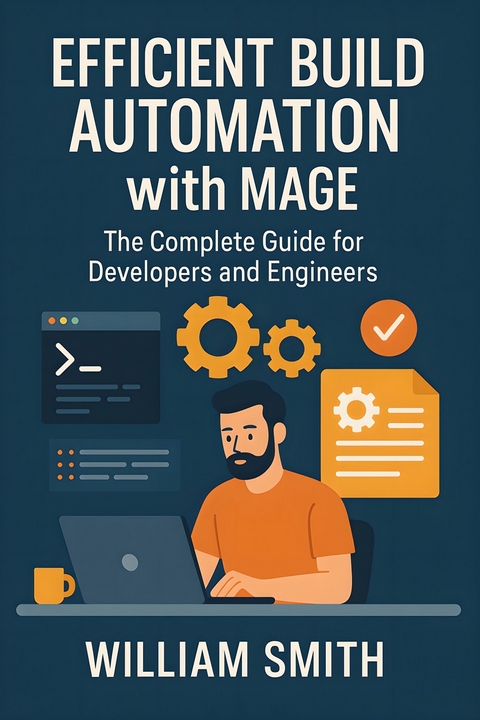
Efficient Build Automation with Mage (eBook)
250 Seiten
HiTeX Press (Verlag)
978-0-00-097506-5 (ISBN)
'Efficient Build Automation with Mage'
In 'Efficient Build Automation with Mage,' readers are guided through the evolving landscape of build systems, from foundational tools like Make to the advanced scripting and declarative frameworks shaping today's automation strategies. The book lays a thorough groundwork in the principles of modern build processes-such as reproducibility, determinism, and caching-while critically examining the architectural choices, ecosystem, and challenges confronting contemporary development teams. By situating Mage among established tools and exploring Go's increasing role in automation, this volume offers both newcomers and experienced engineers a nuanced understanding of today's build automation paradigms.
At the heart of the book lies a deep dive into Mage itself: its execution model, syntax, and unique utilization of Go for defining robust, reliable, and highly extensible build logic. Through practical examples and comprehensive coverage-from building maintainable Magefiles and handling complex dependencies, to orchestrating parallel builds and integrating third-party libraries-readers gain hands-on expertise in creating scalable, collaborative build scripts. Advanced patterns in task orchestration, dynamic behavior, and rigorous testing practices are explored to ensure automation remains both efficient and resilient in demanding environments.
Beyond technical mastery, 'Efficient Build Automation with Mage' addresses the broader DevOps lifecycle: embedding Mage in CI/CD pipelines, automating release and deployment workflows, and enforcing security, compliance, and auditability throughout the build process. Coverage extends to cutting-edge use cases, including containerized and serverless environments, cloud-native platforms, and complex monorepo structures. With a strong emphasis on observability, performance optimization, and secure automation, this book empowers teams and individuals to confidently adopt Mage and elevate their automation pipelines to meet the demands of modern software delivery.
Chapter 2
Mage: Concepts, Architecture, and Design
Mage redefines build automation by fusing the discipline of modern source code management with the flexibility of Go programming. In this chapter, we unravel the architecture and core concepts behind Mage’s innovative approach—empowering you to craft expressive, deterministic, and maintainable automation workflows. Whether you are seeking fine-grained control or robust collaboration, this deep dive reveals why Mage is a disruptive force among build tools, and how its design choices radically shift what’s possible in build engineering.
2.1 Mage’s Execution Model
Mage adopts an execution model that diverges markedly from traditional build automation tools by embracing the Go programming language as the native environment for defining build tasks. Unlike declarative or domain-specific configuration files characteristic of tools such as Make or Ant, Mage harnesses the full expressive power of Go functions in standard source files. These functions represent the individual build tasks, enabling task orchestration through familiar programming constructs without the impedance mismatch commonly encountered when switching between separate configuration DSLs and general-purpose programming languages.
Central to Mage’s design is the approach to task discovery. Mage identifies build tasks by parsing all Go source files in the designated build directory-typically the root of the project-looking for exported functions that satisfy specific criteria: namely, those with no parameters and either no return value or a single error return type. This set of constraints ensures that tasks are self-contained units of work that can be cleanly executed or skipped, and simplifies the task reflection process. Internally, Mage utilizes Go’s go/parser and go/ast standard packages to analyze the source code abstract syntax trees and extract a map of available tasks keyed by function names, which are exposed to the end-user as command-line commands.
Command-line invocation in Mage is tightly coupled with the Go symbol table derived from the build source files. After the initial enumeration of task functions, Mage generates a transient main package programmatically, embedding code to invoke the user-selected task based on CLI arguments. This generated main program is then compiled into a standalone binary executable by invoking the Go toolchain. Thus, running any Mage task is equivalent to invoking the compiled executable with the target task name as an argument, triggering the corresponding function call inside the built binary.
This compilation step confers several advantages. First, by compiling the build logic into a native executable, Mage leverages the full speed and optimization benefits of the Go compiler, significantly reducing start-up time compared to interpreted scripting languages or heavier runtimes. The binary nature also provides process-level isolation, as each invocation executes as a fresh process independent from a persistent runtime environment. This isolation eliminates issues related to stale in-memory state or side-effects persisting between runs, which can plague stateful build systems or those relying on long-running daemons.
Moreover, the use of compiled Go binaries fosters cross-platform consistency. Since Go supports easy cross-compilation, Mage build scripts can produce executables tailored to the target operating system and architecture without requiring runtime dependencies or compatibility layers. This aspect simplifies continuous integration workflows and deployment pipelines, where uniform build behavior across diverse environments is critical.
However, the reliance on compiled executables introduces certain constraints. Each run of a Mage task requires recompilation of the build script code whenever source modifications are detected, potentially lengthening the iteration cycle compared to interpreted alternatives. While Go’s incremental compilation and caching mitigate this overhead, large or complex build files may still experience perceptible delays. Furthermore, the static typing and compilation model restrict dynamic task generation or runtime introspection that would be straightforward in interpreted languages. Although Go’s reflection capabilities exist, they are deliberately conservative, and Mage enforces explicit function definitions as tasks rather than dynamic dispatch.
Additionally, the compilation-based model implies that build logic is constrained by the Go runtime and its concurrency model. While Go’s goroutines simplify parallel task execution, tasks must explicitly implement their own concurrency control and synchronization, as Mage does not provide a declarative dependency graph or built-in scheduler. Hence, task dependencies and execution order require explicit coding patterns, relinquishing some of the implicit orchestration found in traditional build tools.
Mage’s execution model represents a paradigm shift by transforming build scripts into idiomatic Go code compiled into self-contained executables. This alignment with a popular, statically typed programming language delivers high performance, isolation, and platform uniformity, while imposing trade-offs in dynamic expressiveness and requiring explicit authoring of task control flow. For users embedding complex logic in their build processes or seeking to leverage Go’s rich ecosystem directly, Mage offers an elegant and robust solution that integrates development and build automation in a seamless, native environment.
2.2 Magefile Structure and Syntax
Mage leverages the full power of Go to define build automation scripts in a format colloquially known as the Magefile. Unlike declarative YAML or JSON build configurations, Magefiles are Go source files, compiled and executed as ordinary Go programs. This duality affords tremendous flexibility, permitting imperative logic alongside declarative task definitions. Understanding the Magefile’s structure, language idioms, and variable scoping is vital for crafting scalable, maintainable automation workflows.
A Magefile conventionally resides in the project root as magefile.go, although any *.go file under the mageroot directory is valid. This Go file must declare package main and import "github.com/magefile/mage/mg", which provides runtime facilities and task registration mechanisms. The entry points are exported functions, i.e., functions with capitalized names and no parameters, which Mage interprets as individual tasks. Each exported function represents a discrete unit of work—compilation, testing, packaging—invokable via the Mage CLI. For example:
import (
"fmt"
"github.com/magefile/mage/mg"
)
func Build() error {
fmt.Println("Building the project...")
// Imperative build logic here
return nil
}
...
| Erscheint lt. Verlag | 24.7.2025 |
|---|---|
| Sprache | englisch |
| Themenwelt | Mathematik / Informatik ► Informatik ► Programmiersprachen / -werkzeuge |
| ISBN-10 | 0-00-097506-0 / 0000975060 |
| ISBN-13 | 978-0-00-097506-5 / 9780000975065 |
| Informationen gemäß Produktsicherheitsverordnung (GPSR) | |
| Haben Sie eine Frage zum Produkt? |
 EPUB (Adobe DRM)
Kopierschutz: Adobe-DRM
Adobe-DRM ist ein Kopierschutz, der das eBook vor Mißbrauch schützen soll. Dabei wird das eBook bereits beim Download auf Ihre persönliche Adobe-ID autorisiert. Lesen können Sie das eBook dann nur auf den Geräten, welche ebenfalls auf Ihre Adobe-ID registriert sind.
Details zum Adobe-DRM
Dateiformat: EPUB (Electronic Publication)
EPUB ist ein offener Standard für eBooks und eignet sich besonders zur Darstellung von Belletristik und Sachbüchern. Der Fließtext wird dynamisch an die Display- und Schriftgröße angepasst. Auch für mobile Lesegeräte ist EPUB daher gut geeignet.
Systemvoraussetzungen:
PC/Mac: Mit einem PC oder Mac können Sie dieses eBook lesen. Sie benötigen eine
eReader: Dieses eBook kann mit (fast) allen eBook-Readern gelesen werden. Mit dem amazon-Kindle ist es aber nicht kompatibel.
Smartphone/Tablet: Egal ob Apple oder Android, dieses eBook können Sie lesen. Sie benötigen eine
Geräteliste und zusätzliche Hinweise
Buying eBooks from abroad
For tax law reasons we can sell eBooks just within Germany and Switzerland. Regrettably we cannot fulfill eBook-orders from other countries.
aus dem Bereich


