


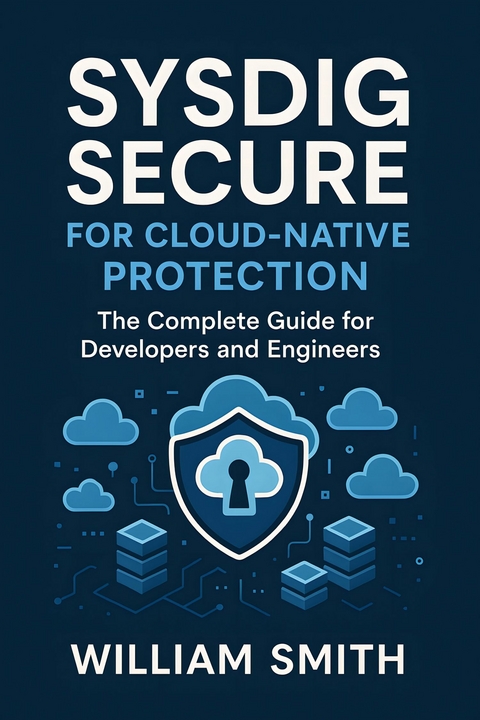
Sysdig Secure for Cloud-Native Protection (eBook)
250 Seiten
HiTeX Press (Verlag)
978-0-00-097444-0 (ISBN)
'Sysdig Secure for Cloud-Native Protection'
In an era where cloud-native architectures are redefining the security landscape, 'Sysdig Secure for Cloud-Native Protection' serves as a definitive guide to understanding and mastering modern cloud security challenges. This book provides an in-depth examination of the unique threats, adversary tactics, and security imperatives found in containerized and orchestrated environments such as Kubernetes. It lays a solid conceptual foundation with discussions on zero trust, defense-in-depth, and the shared responsibility models of leading cloud service paradigms, while positioning Sysdig Secure within the evolving ecosystem of open-source and commercial security platforms.
Moving from theory to implementation, the book delivers practical insights into deploying, integrating, and managing Sysdig Secure across multi-cloud and hybrid infrastructures. Readers are guided through architectural fundamentals, agent deployment strategies, and the intricacies of ensuring high availability and performance at scale. Dedicated chapters walk practitioners through installation best practices, versioning, secure configuration management, and policy-as-code approaches for consistency and compliance. Real-world integration scenarios with CI/CD ecosystems, cloud provider services, and organizational overlays are thoroughly addressed to empower security teams operating in dynamic development environments.
A core strength of this volume lies in its hands-on approach to runtime security, vulnerability management, and audit readiness. Leveraging powerful tools such as Falco for behavioral detection, the book illustrates advanced policy creation, incident response playbooks, and the application of machine learning for threat analytics. In addition to comprehensive coverage of Kubernetes security-including control plane protection, workload isolation, and advanced auditing-the book explores extensibility via APIs, automation, and cloud-native best practices. Concluding with forward-looking analysis on serverless protection, APTs, forensics, and the critical role of open-source collaborations, 'Sysdig Secure for Cloud-Native Protection' is an indispensable resource for professionals safeguarding the future of cloud-native applications.
Chapter 1
Cloud-Native Security Landscape and Sysdig Secure Overview
Cloud-native adoption has unlocked astonishing agility and scale, yet it has also exposed a rapidly evolving and often misunderstood attack surface. This chapter explores the security transformations demanded by containers and orchestration, deciphers adversarial tactics unique to cloud-native, and charts the path from foundational principles to advanced defense. Discover how Sysdig Secure emerges as a pivotal platform, threading together visibility, detection, and response across the tangled ecosystem of cloud-native threats.
1.1 Evolving Threats in Cloud-Native Environments
The advent of cloud-native technologies has transformed application deployment and infrastructure management, yet it has concurrently introduced distinct and evolving security challenges. Central to these challenges is the dynamic and ephemeral nature of cloud-native components, including containers, Kubernetes orchestrators, and microservice-driven architectures. These elements alter not only the traditional attack surface but also adversarial tactics, enabling novel methods of exploitation that require advanced detection and mitigation strategies.
Containers encapsulate applications along with their dependencies, offering portability and consistency across infrastructures. However, containers share a common kernel with the host operating system, which creates a critical vector for attacks known as container escapes. In such scenarios, an attacker breaks out of the isolated container environment to gain unauthorized access to the host system. This typically exploits vulnerabilities in container runtimes or misconfigurations in namespace and cgroup isolation, undermining the assumed security boundary. Attackers may leverage low-level exploits or hijack privileged container capabilities to escalate privileges, thus extending their control beyond the container scope.
Kubernetes as a container orchestration platform introduces another layer of complexity and risk. Credential management and role-based access control (RBAC) play pivotal roles in securing the orchestrator; however, misconfigurations or vulnerable components offer fertile ground for orchestrator privilege abuse. Attackers who compromise service accounts or kubelet endpoints can manipulate cluster state, deploy rogue workloads, or exfiltrate sensitive information. Privilege escalation within Kubernetes clusters enables adversaries to move laterally across namespaces or access host nodes, amplifying the potential impact of a breach. The frequently evolving Kubernetes ecosystem, coupled with its many extensions and admission controllers, can introduce unknown vulnerabilities that threat actors rapidly exploit.
Supply chain attacks have surged in prominence within cloud-native environments due to the extensive use of third-party container images, code repositories, and Continuous Integration/Continuous Deployment (CI/CD) pipelines. Attackers focus on compromising code repositories, injecting malicious artifacts into container images, or modifying deployment scripts to introduce backdoors and malware. Given that container images are often pulled from public registries or automated build systems, trust boundaries become blurred. This attack vector leverages the inherently automated and interconnected nature of cloud-native development, allowing adversaries to infiltrate early in the software delivery lifecycle and propagate malicious payloads extensively before detection.
A critical dimension of cloud-native security is the dynamic expansion and contraction of the attack surface dictated by ephemeral infrastructure. Containers and microservices instantiate and terminate rapidly, generating transient endpoints and volatile network topologies. This ephemeral behavior complicates traditional defensive approaches such as static perimeter firewalls and endpoint protection, which rely on fixed assets and persistent IP addresses. The evolving attack surface continuously presents short-lived but high-value opportunities for compromise. For example, an adversary may exploit timing windows during container startup or deployment phases when security configurations are incomplete or inconsistent. Moreover, the vast number of microservices interacting over internal networks heightens the complexity of monitoring and anomaly detection, as adversaries may conduct lateral movements through trusted service-to-service communication channels.
The increased automation inherent in cloud-native operations further augments adversarial capabilities. Attackers frequently employ automated tools and scripts to scan for misconfigurations, exploit vulnerabilities, and escalate privileges at scale. Automation enables rapid enumeration of clusters, identification of credential leaks, and exploitation of vulnerable components across heterogeneous environments. Concurrently, defenders utilize automated policy enforcement, runtime security agents, and continuous compliance scanning, driving an ongoing arms race centered on speed and accuracy. The scale and velocity of cloud-native deployments necessitate security models that are adaptive and capable of leveraging telemetry data in near real-time to reduce the dwell time of threats.
Finally, the microservice architecture itself amplifies complexity by decomposing monolithic applications into many independently deployable services. This decomposition expands the number of attack vectors and complicates the establishment of a unified security perimeter. Each microservice introduces unique dependencies, communication patterns, and data handling practices, creating a mosaic of potential vulnerabilities. Attackers exploit inter-service communication protocols, misconfigured APIs, or inadequate mutual TLS enforcement to intercept or manipulate data flows. The design principle of minimal functionality per microservice, while promoting agility, can inadvertently lead to privileged microservices with access to sensitive resources, thus becoming prime targets for attackers aiming to escalate privileges within the cluster.
Evolving threats in cloud-native environments exploit the inherent flexibility, automation, and complexity of these platforms. Container escapes, orchestrator privilege abuse, and supply chain poisoning represent key methodologies in the adversary toolkit. The transient nature of cloud-native components enlarges the attack surface while compressing the window for detection and response. An effective security posture demands robust mechanisms for continuous visibility, rigorous configuration management, and automated anomaly detection tailored to the unique architectural characteristics of containerized, orchestrated, and microservice-based systems.
1.2 Security Principles for Modern Infrastructure
Modern infrastructure, characterized by distributed architectures, API-driven services, and dynamic cloud-native environments, demands a comprehensive and rigorous security posture rooted in foundational principles. Among these, zero trust, defense-in-depth, immutability, and least privilege form the doctrinal backbone essential for robust defense mechanisms. This section explores these principles in technical depth, elucidating their implementations and the nuanced trade-offs in practice, particularly within the context of contemporary infrastructure paradigms.
Zero Trust Architecture fundamentally challenges the traditional perimeter-based security model by eliminating implicit trust within the network. It predicates that no entity—be it user, device, or service—is trusted by default, regardless of network location. Instead, continuous verification of identity and strict access controls are mandated. Implementation in a cloud-native ecosystem leverages mutual Transport Layer Security (mTLS) for API communications, identity-aware proxies, and adaptive authentication mechanisms integrating behavioral analytics. A typical deployment enforces granular policy engines at API gateways, coupled with continuous telemetry to validate every transaction. The trade-offs involve increased complexity in identity lifecycle management and performance considerations due to frequent cryptographic operations. Furthermore, comprehensive zero trust requires pervasive observability and real-time policy evaluation, often leveraging service mesh frameworks like Istio or Linkerd to automate policy enforcement and telemetry gathering.
Defense-in-Depth prescribes layered protective controls spanning network, host, application, and data layers, thereby ensuring that a single compromised element does not result in a catastrophic breach. In distributed systems, this entails embedding security controls across multiple strata: network segmentation via virtual private clouds (VPCs) and microsegmentation; container runtime security through mandatory access control (e.g., AppArmor, SELinux); application-layer filtering via Web Application Firewalls (WAFs); and cryptographic data protections such as envelope encryption for databases and object storage. Each layer is augmented with monitoring and anomaly detection to alert on policy violations. The principal challenge is balancing operational overhead and latency introduced by multiple inspection points with the increased...
| Erscheint lt. Verlag | 24.7.2025 |
|---|---|
| Sprache | englisch |
| Themenwelt | Mathematik / Informatik ► Informatik ► Programmiersprachen / -werkzeuge |
| ISBN-10 | 0-00-097444-7 / 0000974447 |
| ISBN-13 | 978-0-00-097444-0 / 9780000974440 |
| Informationen gemäß Produktsicherheitsverordnung (GPSR) | |
| Haben Sie eine Frage zum Produkt? |
 EPUB (Adobe DRM)
Größe: 572 KB
Kopierschutz: Adobe-DRM
Adobe-DRM ist ein Kopierschutz, der das eBook vor Mißbrauch schützen soll. Dabei wird das eBook bereits beim Download auf Ihre persönliche Adobe-ID autorisiert. Lesen können Sie das eBook dann nur auf den Geräten, welche ebenfalls auf Ihre Adobe-ID registriert sind.
Details zum Adobe-DRM
Dateiformat: EPUB (Electronic Publication)
EPUB ist ein offener Standard für eBooks und eignet sich besonders zur Darstellung von Belletristik und Sachbüchern. Der Fließtext wird dynamisch an die Display- und Schriftgröße angepasst. Auch für mobile Lesegeräte ist EPUB daher gut geeignet.
Systemvoraussetzungen:
PC/Mac: Mit einem PC oder Mac können Sie dieses eBook lesen. Sie benötigen eine
eReader: Dieses eBook kann mit (fast) allen eBook-Readern gelesen werden. Mit dem amazon-Kindle ist es aber nicht kompatibel.
Smartphone/Tablet: Egal ob Apple oder Android, dieses eBook können Sie lesen. Sie benötigen eine
Geräteliste und zusätzliche Hinweise
Buying eBooks from abroad
For tax law reasons we can sell eBooks just within Germany and Switzerland. Regrettably we cannot fulfill eBook-orders from other countries.
aus dem Bereich


