


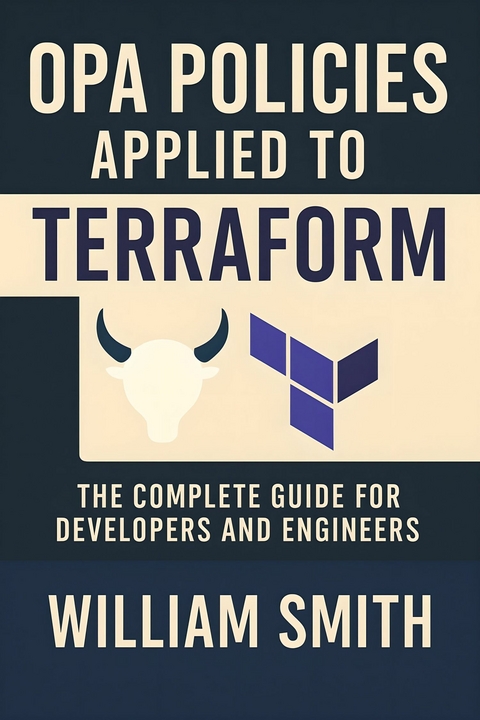
OPA Policies Applied to Terraform (eBook)
250 Seiten
HiTeX Press (Verlag)
978-0-00-097440-2 (ISBN)
'OPA Policies Applied to Terraform'
'OPA Policies Applied to Terraform' is a comprehensive guide that bridges the world of policy-as-code with modern infrastructure management, focusing on integrating the Open Policy Agent (OPA) with Terraform workflows. Beginning with an essential foundation, the book explores the evolution of policy-as-code, the core architecture of OPA, and its declarative Rego language. Readers are introduced to the broader ecosystem of policy enforcement in DevOps, comparing OPA's strengths in both Kubernetes and infrastructure-as-code (IaC) domains, and examining its vital role in security, compliance, and governance.
As the narrative advances, the book provides an authoritative treatment of Terraform's architecture, workflows, and common security pitfalls, paving the way for practical integration scenarios. Step-by-step, it details how to embed OPA policy checks at critical points in the Terraform pipeline-from pre-commit to post-apply-delving into data transformation, horizontal scaling, and comparative analyses with tools like Conftest and Sentinel. Through real-world examples and best practices, it instructs readers on authoring reusable, modular Rego policies tailored to enforce organizational standards, while maintaining performance and adaptability in dynamic environments.
With a strong emphasis on quality assurance, governance, and operationalization, 'OPA Policies Applied to Terraform' ensures practitioners are equipped with methods for policy testing, CI integration, auditing, and incident response. The book concludes by examining emerging trends, including policy-driven automation, machine learning applications, and next-generation security practices-making it an indispensable reference for engineers, security professionals, and platform teams navigating the future of compliant, automated, and resilient cloud infrastructure.
Chapter 1
Foundations of Policy-as-Code and OPA
From ad-hoc governance to codified control, the landscape of policy enforcement in modern cloud-native systems has been transformed by Policy-as-Code. This chapter unveils the motivations for this shift, the principles underpinning the Open Policy Agent (OPA), and the architectural and linguistic advances powering reliable, programmable compliance. Readers will discover how OPA’s flexibility and extensibility position it as a linchpin for secure and automated decision-making across complex environments.
1.1 The Evolution of Policy-as-Code
Policy enforcement in information technology has undergone a profound transformation over the past two decades, driven primarily by the transition from monolithic architectures to distributed, cloud-native environments. Initially, organizational policies-whether related to security, compliance, or operational controls-were implemented through manual and ad-hoc processes. These early methods relied heavily on static documentation, manual inspections, and isolated configuration settings spread across diverse system components. While effective in relatively static and centralized systems, such approaches proved inadequate as complexity and scale intensified.
In traditional IT environments, policy enforcement depended on human expertise and procedural rigor. System administrators and security teams were responsible for applying guidelines to servers, networks, and applications through direct manipulation and scripted workflows. This manual governance approach introduced several critical limitations:
- High latency in policy enforcement,
- Lack of standardized implementations,
- Significant risk of human error.
Moreover, auditability was often retrospective and fragmented, leading to compliance gaps that were difficult to identify and remediate promptly.
The advent of cloud computing and the subsequent rise of cloud-native paradigms such as microservices and container orchestration fundamentally altered the infrastructure landscape. Infrastructure resources became highly ephemeral, dynamic, and distributed across multiple geographic regions and cloud providers. Under these conditions, traditional manual controls could no longer scale or adapt effectively. Policy enforcement needed to evolve into an automated, consistent, and verifiable discipline to manage infrastructure at cloud scale.
Concurrent with these infrastructure shifts, the emergence of DevOps culture catalyzed a new approach to software delivery and operations. DevOps emphasizes automation, continuous integration and delivery (CI/CD), and cross-functional collaboration. Within this context, infrastructure management transformed from static provisioning to declarative, code-driven processes, often encapsulated in Infrastructure-as-Code (IaC) frameworks such as Terraform, Ansible, and Kubernetes manifests. However, while IaC brought repeatability to resource deployment, policy enforcement remained largely external and disconnected, frequently implemented as after-the-fact manual checks or point-in-time scanning tools.
The need for seamless integration of policy controls into automated workflows generated the conceptual foundation for Policy-as-Code-an approach where organizational policies are expressed explicitly and programmatically as code artifacts. This paradigm enables policies to be embedded directly within deployment pipelines, evaluated continuously, and enforced in real time. By unifying infrastructure orchestration and policy verification in a single automated system, Policy-as-Code addresses the shortcomings of earlier approaches, providing consistent, proactive compliance aligned with rapid delivery cycles.
Two principal features underline the power of Policy-as-Code: automation and auditable compliance. Automated policy evaluation eliminates reliance on manual enforcement, reducing latency and operational overhead while improving accuracy and coverage. Policy decisions become deterministic and reproducible, which is essential for scaling governance across large, complex environments. Additionally, policies expressed in code are inherently versioned, testable, and traceable, facilitating detailed audit trails and simplifying regulatory compliance. Organizations can demonstrate adherence to internal or external standards by generating evidence directly from policy execution logs and source repositories.
The rise of multi-cloud and hybrid environments introduced further impetus for Policy-as-Code. Heterogeneous infrastructure ecosystems, characterized by disparate cloud providers, APIs, and service models, exacerbate governance complexity. Policy frameworks now must accommodate diverse platforms while maintaining uniform enforcement criteria. This multiplicity necessitates policy programmability that is platform-agnostic yet extensible, enabling organizations to implement consistent controls regardless of deployment targets. Consequently, standards and tools supporting declarative, language-agnostic policy definitions-such as Open Policy Agent (OPA) and related frameworks-have become foundational in realizing Policy-as-Code at scale.
Critical turning points in the evolution of Policy-as-Code also parallel advancements in policy specification languages and enforcement architectures. Early rule engines and configuration management tools provided prototype capabilities but often lacked the expressiveness or integration necessary for dynamic cloud environments. The advent of domain-specific languages (DSLs) for policy, augmented by general-purpose languages with embedded policy frameworks, expanded the ability to codify complex business logic and compliance requirements. Modern policy engines apply these languages in real time, integrating natively with CI/CD pipelines, Kubernetes admission controllers, or cloud-native orchestration layers to provide near-instantaneous feedback loops.
In essence, the trajectory from manual controls to Policy-as-Code reflects a broader shift toward embedding governance within the operational fabric of modern IT. As infrastructure management matured to embrace software-defined principles and continuous delivery, the imperative to codify policy as executable artifacts became unavoidable. Policy-as-Code embodies a synthesis of automation, repeatability, and traceability, enabling organizations to adapt governance to the velocity and scale of cloud-native environments while ensuring security, compliance, and operational integrity.
1.2 OPA Fundamentals and Architecture
Open Policy Agent (OPA) is a general-purpose policy engine designed to enforce fine-grained, context-aware policies across a wide variety of software systems. It achieves versatility through fundamental design principles that enable the decoupling of policy logic from application code, allowing policies to evolve independently and promoting reusability across different components. This section elucidates the foundational concepts underpinning OPA, the decision model guiding its evaluations, and the architectural composition that facilitates its integration into complex environments.
At its core, OPA embodies the principle of policy decoupling, which segregates policy decisions from the service logic they govern. This separation permits policies to be authored as standalone, declarative modules, typically written in the Rego language, enabling centralized management, auditability, and expressive power without modifying the underlying applications. The application forwards relevant contextual data to OPA, which evaluates policies against this input and returns authorization decisions or configurations accordingly.
The policy evaluation lifecycle orchestrates the transformation from raw input to a final decision. This lifecycle begins with receiving an input document, a JSON-encoded representation of the request or context, encapsulating attributes such as user identity, resource identifiers, action types, and environment metadata. Alongside the input, OPA leverages a data document-a collection of static or dynamically updated contextual information like user roles, resource hierarchies, or external metadata-to augment decision-making. During evaluation, Rego policies query and process both input and data to produce structured Boolean, string, or object outputs representing decisions.
OPA’s decision model is expressive and declarative, centered on defining a set of named rules that compute one or more decision documents. Each rule comprises a head (the rule name and optional keys) and a body containing logical predicates. Unlike imperative programming, Rego evaluates rules by attempting to satisfy their bodies using logic programming techniques akin to Datalog, enabling concise representation of complex policy logic including recursion and negation. A canonical decision document conforms to a JSON structure, supporting hierarchical results and multiple decisions per query, catering to diverse use cases like access control, configuration validation, or admission control.
The OPA architecture is composed of several tightly integrated components that collectively support scalable and high-performance policy evaluation:
- Policy Engine: This is the deterministic core responsible for...
| Erscheint lt. Verlag | 24.7.2025 |
|---|---|
| Sprache | englisch |
| Themenwelt | Mathematik / Informatik ► Informatik ► Programmiersprachen / -werkzeuge |
| ISBN-10 | 0-00-097440-4 / 0000974404 |
| ISBN-13 | 978-0-00-097440-2 / 9780000974402 |
| Informationen gemäß Produktsicherheitsverordnung (GPSR) | |
| Haben Sie eine Frage zum Produkt? |
 EPUB (Adobe DRM)
Größe: 585 KB
Kopierschutz: Adobe-DRM
Adobe-DRM ist ein Kopierschutz, der das eBook vor Mißbrauch schützen soll. Dabei wird das eBook bereits beim Download auf Ihre persönliche Adobe-ID autorisiert. Lesen können Sie das eBook dann nur auf den Geräten, welche ebenfalls auf Ihre Adobe-ID registriert sind.
Details zum Adobe-DRM
Dateiformat: EPUB (Electronic Publication)
EPUB ist ein offener Standard für eBooks und eignet sich besonders zur Darstellung von Belletristik und Sachbüchern. Der Fließtext wird dynamisch an die Display- und Schriftgröße angepasst. Auch für mobile Lesegeräte ist EPUB daher gut geeignet.
Systemvoraussetzungen:
PC/Mac: Mit einem PC oder Mac können Sie dieses eBook lesen. Sie benötigen eine
eReader: Dieses eBook kann mit (fast) allen eBook-Readern gelesen werden. Mit dem amazon-Kindle ist es aber nicht kompatibel.
Smartphone/Tablet: Egal ob Apple oder Android, dieses eBook können Sie lesen. Sie benötigen eine
Geräteliste und zusätzliche Hinweise
Buying eBooks from abroad
For tax law reasons we can sell eBooks just within Germany and Switzerland. Regrettably we cannot fulfill eBook-orders from other countries.
aus dem Bereich


