


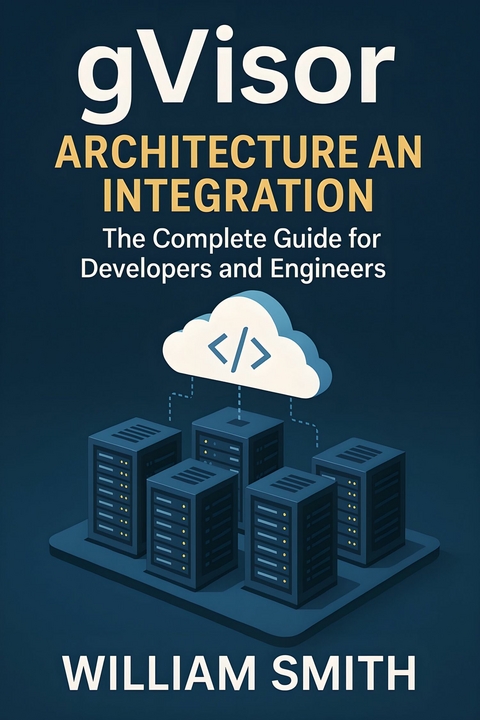
gVisor Architecture and Integration (eBook)
250 Seiten
HiTeX Press (Verlag)
978-0-00-097437-2 (ISBN)
'gVisor Architecture and Integration'
'gVisor Architecture and Integration' delivers a comprehensive, technical exploration of gVisor's unique approach to container isolation within cloud-native environments. The book opens by contextualizing modern container security challenges, tracing the genesis of gVisor as a robust, open-source project tailored to address industry demands for stronger multi-tenancy and workload containment. It contrasts gVisor's user-space kernel model against alternative technologies-such as runc, Kata Containers, and Firecracker-clarifying its distinct position in the ecosystem and its isolation guarantees across typical deployment scenarios, from the cloud to the edge.
At its core, the text meticulously examines gVisor's internal architecture, illuminating critical components like the Sentry user-space kernel, Gofer file and network mediator, syscall interception mechanisms, and their interplay in sandboxing containerized workloads. Readers gain an in-depth understanding of gVisor's strategies for emulating kernel constructs-spanning process namespaces, virtual memory, filesystem mediation, and a full user-space TCP/IP stack-alongside performance optimization, observability, and real-world security hardening. The book demystifies the challenges of device emulation, syscall coverage, and the need for careful attack surface reduction, detailing both limitations and robust mitigations.
Designed as both a practical integration guide and technical reference, the book moves seamlessly from first principles to advanced operationalization. It outlines the integration of gVisor with major orchestration tools like Kubernetes and Docker, explores continuous deployment and DevOps workflows, and provides actionable case studies from production deployments. Dedicated chapters on performance tuning, cluster-wide monitoring, and community-driven development empower readers to troubleshoot, extend, and contribute to gVisor's ongoing evolution-making this essential reading for cloud architects, security engineers, system developers, and anyone invested in the future of secure, scalable container infrastructure.
Chapter 2
gVisor Architecture: Core Components and Processes
gVisor’s architecture breaks with tradition, introducing a sophisticated set of user-space mechanisms to achieve security without the heavyweight cost of full virtualization. This chapter explores the technical heart of gVisor: its Sentry kernel, mediation processes, and system abstractions. We will uncover how these components collaborate to enforce strong isolation, map system calls, and orchestrate entire container lifecycles—providing a blueprint for modern container security.
2.1 Sentry: The User-space Kernel Core
The Sentry embodies the architectural centerpiece of gVisor, acting as a fully user-space Linux kernel that mediates all interactions between containerized applications and the host kernel. Uniquely positioned to enforce security boundaries and provide comprehensive kernel abstractions, the Sentry effectively replaces the traditional kernel role within containers without sacrificing compatibility or performance. This design affords enhanced container isolation by intercepting and interpreting syscalls, managing processes and resources, and enforcing kernel policies-all within user space.
At the core of the Sentry’s architecture lies a syscall interception and interpretation layer. When a containerized application issues a syscall, it does not interact directly with the host kernel; instead, it issues calls that traverse an underlying communication channel to the Sentry, implemented via an extended ptrace-like mechanism or through communication with a small shim process. The Sentry then decodes each syscall number and parameters, leveraging a comprehensive internal syscall table modeled closely after the Linux kernel’s ABI. This table maps syscall identifiers to the corresponding user-space handlers within the Sentry, enabling fine-grained control over each function’s behavior.
Each syscall handler within the Sentry performs several critical duties. Initially, the handler validates the arguments to ensure security and correctness, often sanitizing inputs to prevent exploitation. It then invokes kernel-like abstractions modeled to mirror those in Linux, such as file descriptors, virtual memory areas, and process identifiers. These abstractions are implemented as data structures within the Sentry and are isolated from the host kernel’s state. Importantly, the Sentry maintains its own state for crucial kernel objects, so that process scheduling, file system access, and network operations are confined to this user-space kernel environment. This architectural isolation prevents container escapes by ensuring that malicious or errant container processes cannot directly manipulate host kernel state.
Process management within the Sentry is organized around a sophisticated task model that replicates Linux’s process and thread semantics. Each containerized process is represented as a Task object encapsulating its registers, signal state, file descriptors, and memory maps. The Sentry schedules these Task objects cooperatively, supporting multithreading and concurrency internally while maintaining a controlled execution environment. Process creation syscalls like clone, fork, and execve are simulated by the Sentry’s task manager rather than being directly invoked on the host kernel. This allows the Sentry to enforce namespaces and capability restrictions finely, maintaining container-level isolation guarantees.
Resource management is another fundamental responsibility of the Sentry. Instead of relying on the host kernel’s cgroups and quota mechanisms, the Sentry manages resources such as CPU time, memory allocation, and file descriptors within its own domain. It holds virtual representations of these resources and applies limits at the user-space boundary, preventing resource exhaustion and denial-of-service attacks within containers. For file system operations, the Sentry uses an internal VFS-like layer that maps file descriptors and paths to sandboxed underlying implementations, often backed by overlay or virtualized file systems. This virtual file system enforces strict access controls, restricting the container’s view of files and devices.
A critical element of kernel-like enforcement in the Sentry stems from its implementation of signal handling, security policies, and namespace isolation. Signal delivery is fully simulated, with the Sentry intercepting signal-related syscalls and managing signal queues per Task. The signals are dispatched according to Linux semantics, allowing containerized applications to behave as expected while ensuring signals cannot disrupt the host environment. Security policies-implemented via seccomp-style filters, capability limitations, and access control lists-are embedded in the Sentry syscall handlers, enabling fine-grained syscall whitelisting and parameter validation. Namespace isolation is realized by intercepting calls related to UTS, IPC, mount, and user namespaces, with the Sentry providing independent namespace state representations, thus preventing container processes from affecting or querying host or other container namespaces.
The Sentry also abstracts advanced kernel features such as epoll, timerfd, and eventfd, providing applications with asynchronous I/O and event notification capabilities consistent with Linux. These kernel-like primitives are critical for supporting modern event-driven workloads. Furthermore, the Sentry implements its own pseudo-random number generator, network stack elements, and time subsystem, effectively virtualizing system time to mitigate timing-based side-channel attacks.
Overall, the Sentry forms a complete user-space kernel that balances fidelity to Linux semantics with robust security boundaries. By re-implementing essential kernel functionalities in user space, it achieves container isolation that is both flexible and significantly hardened against host kernel vulnerabilities. The design allows seamless compatibility for containerized applications with minimal kernel ABI modifications, while empowering gVisor to act as an effective sandbox for untrusted workloads.
2.2 Gofer: Bridging the Kernel-Host Divide
The Gofer process serves as an indispensable component in the architecture by acting as a dedicated intermediary between the Sentry, which operates within the isolated microkernel environment, and the underlying host system. Its design and operation address the fundamental challenge of securely and efficiently managing file system and network interactions across the kernel-host boundary, ensuring that critical isolation guarantees are upheld without sacrificing necessary functionality.
At its core, Gofer encapsulates access control and data mediation responsibilities by implementing the 9P protocol, a well-established, minimalist network file system protocol originally developed for Plan 9 operating systems. This protocol facilitates transparent, fine-grained communication of file and network operations while maintaining a low-overhead and composable approach to inter-process cooperation. Gofer’s exclusive use of 9P enables a uniform abstraction to represent and manipulate host resources such as files and sockets within the Sentry environment, which only interacts via the protocol interface.
From a functional standpoint, Gofer maintains persistent connections with both the Sentry kernel and the underlying host kernel components. Incoming requests from the Sentry specify file or network resources via 9P messages, and Gofer translates these requests into host-native system calls or actions. Results from the host are then marshaled back through the 9P channel to the Sentry, thereby closing the loop on the request-response cycle. This design isolates all host interaction inside Gofer’s controlled domain, effectively decoupling Sentry’s security-sensitive logic from direct host system call exposure.
File operations managed by Gofer include not only classical open, read, write, and stat system calls but extended features like directory traversal, metadata querying, and file control commands. To minimize the attack surface exposed by these operations, Gofer employs strict namespace filtering and permission checks, enforcing policies that constrain which parts of the host filesystem are visible and accessible. These policies prevent Sentry from arbitrarily accessing sensitive host files or directories, a critical security consideration given the asymmetry of privilege levels.
Network operations similarly leverage the 9P abstraction to proxy socket creation, connection establishment, data transmission, and reception. Gofer’s role in managing network communication is pivotal in preventing unintended leakage or escalation of privileges. By funneling all socket-level interactions through a unifying protocol handler, Gofer enables granular inspection and restriction of allowed network endpoints and protocols. This selective exposure reduces the potential vectors for network-based attacks originating from within the isolated environment.
The data flow architecture between Sentry and Gofer exemplifies a rigorous boundary mediation pattern. Requests are serialized into discrete 9P messages encapsulating resource identifiers and operation parameters. Upon receipt, Gofer executes equivalent host...
| Erscheint lt. Verlag | 24.7.2025 |
|---|---|
| Sprache | englisch |
| Themenwelt | Mathematik / Informatik ► Informatik ► Programmiersprachen / -werkzeuge |
| ISBN-10 | 0-00-097437-4 / 0000974374 |
| ISBN-13 | 978-0-00-097437-2 / 9780000974372 |
| Informationen gemäß Produktsicherheitsverordnung (GPSR) | |
| Haben Sie eine Frage zum Produkt? |
 EPUB (Adobe DRM)
Größe: 691 KB
Kopierschutz: Adobe-DRM
Adobe-DRM ist ein Kopierschutz, der das eBook vor Mißbrauch schützen soll. Dabei wird das eBook bereits beim Download auf Ihre persönliche Adobe-ID autorisiert. Lesen können Sie das eBook dann nur auf den Geräten, welche ebenfalls auf Ihre Adobe-ID registriert sind.
Details zum Adobe-DRM
Dateiformat: EPUB (Electronic Publication)
EPUB ist ein offener Standard für eBooks und eignet sich besonders zur Darstellung von Belletristik und Sachbüchern. Der Fließtext wird dynamisch an die Display- und Schriftgröße angepasst. Auch für mobile Lesegeräte ist EPUB daher gut geeignet.
Systemvoraussetzungen:
PC/Mac: Mit einem PC oder Mac können Sie dieses eBook lesen. Sie benötigen eine
eReader: Dieses eBook kann mit (fast) allen eBook-Readern gelesen werden. Mit dem amazon-Kindle ist es aber nicht kompatibel.
Smartphone/Tablet: Egal ob Apple oder Android, dieses eBook können Sie lesen. Sie benötigen eine
Geräteliste und zusätzliche Hinweise
Buying eBooks from abroad
For tax law reasons we can sell eBooks just within Germany and Switzerland. Regrettably we cannot fulfill eBook-orders from other countries.
aus dem Bereich


