


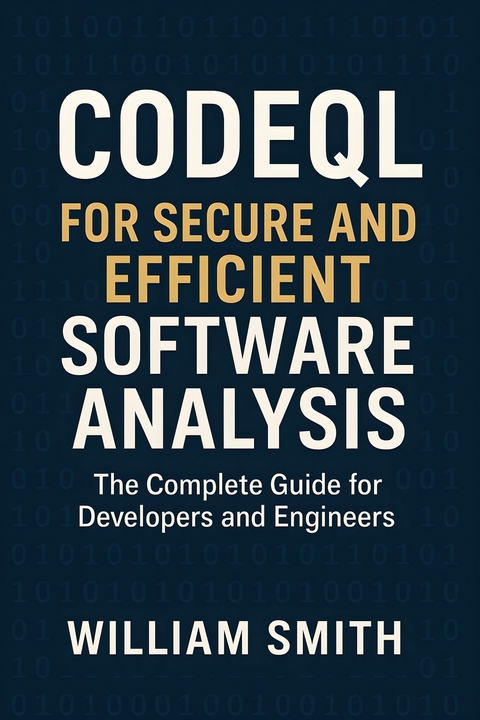
CodeQL for Secure and Efficient Software Analysis (eBook)
250 Seiten
HiTeX Press (Verlag)
978-0-00-097430-3 (ISBN)
'CodeQL for Secure and Efficient Software Analysis'
'CodeQL for Secure and Efficient Software Analysis' is an authoritative and comprehensive guide for software engineers, security practitioners, and advanced developers seeking to master CodeQL-a groundbreaking static analysis engine that treats code as data. Beginning with a thorough foundation in CodeQL's architecture and its essential place within modern security workflows, the book examines the principles of static code analysis, the nuances of supported programming languages, and the robust database mechanisms that drive scalable, query-based inspection. Readers are seamlessly introduced to both local and cloud-based environments, enriched by critical comparisons with alternative analysis tools to facilitate informed decision-making.
Delving deeper, the book provides a meticulous exploration of QL, CodeQL's powerful query language. From foundational syntax and logical structures to advanced topics such as dataflow analysis, taint tracking, modular query design, and performance optimization, it equips readers with practical skills for constructing high-performance, reusable queries. The chapters address real-world needs, including vulnerability identification and remediation, automated discovery of code quality issues, and continuous integration within secure development pipelines. Case studies and best practices illustrate how CodeQL uncovers significant bugs and inefficiencies, offering actionable insights at every turn.
Beyond fundamental techniques, this volume caters to enterprise-scale application-with topics ranging from distributed query execution and business intelligence integration, to governance, compliance, and incident response. It empowers organizations to operationalize CodeQL in diverse, decentralized, and regulated development ecosystems. Capping off with a forward-looking analysis of emerging trends-such as the convergence of machine learning and program analysis, automated query synthesis, and the future landscape of secure software-this book stands as an indispensable resource for anyone committed to advancing software security and quality through programmatic analysis.
Chapter 1
CodeQL Foundations and Architecture
Imagine a world where codebases become searchable terrains—where software’s hidden vulnerabilities and inefficiencies are surfaced through elegant, precise queries. This chapter invites you to uncover how CodeQL transforms source code into rich databases, introduces a new way of reasoning about programs, and forms the cornerstone of next-generation static analysis. Here, we journey from the philosophical underpinnings to practical workflows, revealing why CodeQL is redefining how secure and efficient software is engineered.
1.1 Origins and Evolution of CodeQL
CodeQL’s origins are deeply embedded in the broader domain of static program analysis, a field that rigorously investigates methods for understanding source code without executing it. The seminal insight that catalyzed CodeQL’s development was the realization that source code could be effectively represented as richly structured data, enabling the application of database query techniques to interrogate codebases. This paradigm shift departed from traditional line-by-line syntactic inspections, instead treating programs as graphs or relational datasets composed of entities such as syntax nodes, control flow constructs, and semantic annotations.
The conceptual foundations of CodeQL trace back to research initiatives in the early 2000s that sought to leverage database query languages for software analysis. Notably, the adoption of Datalog, a declarative logic programming language, facilitated expressive yet concise queries over program facts derived from code parsing and semantic modeling. These pioneering efforts laid the groundwork for querying code properties, patterns, and potential vulnerabilities in a manner akin to querying relational databases. This approach offered unmatched flexibility over rigid pattern-matching or heuristic-based analyzers, as the query language could encode complex semantic conditions and traversals.
A pivotal milestone in CodeQL’s trajectory was its incubation at Semmle, a company driven by the ambition to bridge the gap between academic language-based analysis and practical tooling for global software engineering challenges. Semmle’s team engineered an extensible system that aggregates vast codebases into comprehensive relational databases, encoding rich semantic information about structure, types, and control flow. Developers and researchers could then author queries using CodeQL to detect bugs, security flaws, or code quality issues across millions of lines of code with unprecedented precision.
The evolutionary advancement from experimental academic prototypes to industrial-strength platforms coincided with a growing demand for scalable, automated code audit solutions amid increasingly complex and interconnected software ecosystems. CodeQL’s ability to express cross-file, cross-language queries allowed it to adapt to heterogeneous software environments, addressing multiple languages such as C, C++, Java, JavaScript, Python, and more. This cross-language capability was a significant development, reflecting the diversified technological stacks common in modern software projects.
Integration into the mainstream software assurance landscape intensified following GitHub’s acquisition of Semmle in 2019. This strategic realignment made CodeQL publicly accessible within GitHub’s security ecosystem, embedding it into automated workflows for continuous code analysis. Through GitHub Actions and advanced pull request scanning, CodeQL queries are executed routinely on source changes, enabling proactive identification of vulnerabilities and policy violations before code merges. This integration marked a crucial shift from ad hoc or periodic code reviews toward continuous, query-driven assurance embedded directly within development pipelines.
The broad adoption by global security and software engineering communities has stimulated an ever-growing ecosystem of CodeQL queries, shared libraries, and best practices. Security researchers contribute complex, domain-specific queries that hunt for subtle vulnerabilities such as injection flaws, insecure cryptographic practices, and access control misconfigurations. Likewise, engineering teams craft custom queries tailored to their coding standards and architecture guidelines, transforming CodeQL into a versatile tool for policy enforcement and technical debt reduction beyond pure security use cases.
Notably, CodeQL’s architecture supports incremental and modular analysis, where derived query results scale gracefully with codebase evolution rather than recomputing from scratch. This design consideration is critical for enterprise environments managing massive code repositories under frequent change. Combined with visualization tools and semantic code browsing capabilities, this transforms CodeQL from a mere vulnerability scanner into an interactive platform for deep code understanding.
Within the broader constellation of software assurance tools, CodeQL represents a qualitative evolution moving toward declarative, data-driven analysis models. Unlike conventional static analyzers that rely on embedded heuristics and binary pass/fail outcomes, CodeQL exposes the codebase’s internal structure as queryable facts, empowering analysts to define precise detection criteria and rapidly adapt workflows to emerging threat landscapes. This extensibility and transparency align with modern DevSecOps philosophies, facilitating collaboration between security experts, developers, and QA teams.
The trajectory of CodeQL underscores a recurring theme in software engineering research: the power of reconceptualizing existing artifacts-in this case, source code-as structured data amenable to rigorous, composable querying and analysis. This foundation not only underpins CodeQL’s current capabilities but also positions it to evolve alongside emerging technologies such as AI-assisted code synthesis, formal verification augmentations, and multi-modal vulnerability intelligence.
CodeQL’s genesis from academic static analysis research through its maturation as a scalable, query-driven security framework embodies a significant advancement in software assurance tooling. By treating code as structured, queryable data and integrating deeply into modern development workflows, it has reshaped how vulnerabilities and code quality issues are detected, enabling more precise, scalable, and continuous security practices across the software industry.
1.2 Principles of Static Code Analysis
Static code analysis comprises a class of techniques designed to examine software artifacts without executing the underlying program. Fundamentally distinct from dynamic analysis—which evaluates program behavior at runtime using actual or synthetic inputs—static analysis operates solely on the program’s source code or intermediate representations. This distinction underpins specific theoretical and practical implications regarding soundness, completeness, scalability, and precision.
At the core of static analysis lies the abstraction of program semantics. Conventional static analyzers approximate program behavior by constructing mathematical models, such as control-flow graphs (CFGs), data-flow facts, and abstract domains. These models reconcile the undecidability of many program analyses by trading perfect accuracy for tractability, a trade-off manifesting primarily in the notions of soundness and precision. A sound analyzer guarantees that no true issues are omitted at the cost of potential false positives, whereas a precise—but potentially unsound—analyzer limits false alarms yet risks missing defects.
The challenges in static analysis prominently revolve around three intertwined dimensions: scalability, precision, and soundness. Scalability addresses the feasibility of analyzing large codebases within reasonable time and resource constraints. Precision pertains to the accuracy of the results, minimizing both false positives and false negatives. Soundness ensures that no real issue escapes detection, an attribute critical in safety- and security-sensitive contexts but often compromised for performance or usability.
Traditional static analyzers frequently balance these dimensions through heuristic and domain-specific optimizations. For example, pattern-based linters or rule-driven bug-finders trade generality for simplicity and scalability by focusing on common bug idioms. Alternatively, abstract interpretation frameworks strive for soundness but often struggle to scale or produce many false positives, requiring significant manual tuning.
CodeQL introduces a paradigm shift by leveraging a query-based representation founded on declarative logic programming integrated with an expressive knowledge graph of the program’s semantics. The CodeQL engine transforms source code into a relational database capturing intricate syntactic and semantic details, including control flow, data flow, and type hierarchies. Queries, expressed in CodeQL’s own declarative language, navigate and infer properties over this semantic representation, enabling sophisticated program analyses that transcend traditional pattern matching.
This architecture directly addresses the aforementioned core challenges:
- Scalability: By compiling the program...
| Erscheint lt. Verlag | 24.7.2025 |
|---|---|
| Sprache | englisch |
| Themenwelt | Mathematik / Informatik ► Informatik ► Programmiersprachen / -werkzeuge |
| ISBN-10 | 0-00-097430-7 / 0000974307 |
| ISBN-13 | 978-0-00-097430-3 / 9780000974303 |
| Informationen gemäß Produktsicherheitsverordnung (GPSR) | |
| Haben Sie eine Frage zum Produkt? |
 EPUB (Adobe DRM)
Größe: 647 KB
Kopierschutz: Adobe-DRM
Adobe-DRM ist ein Kopierschutz, der das eBook vor Mißbrauch schützen soll. Dabei wird das eBook bereits beim Download auf Ihre persönliche Adobe-ID autorisiert. Lesen können Sie das eBook dann nur auf den Geräten, welche ebenfalls auf Ihre Adobe-ID registriert sind.
Details zum Adobe-DRM
Dateiformat: EPUB (Electronic Publication)
EPUB ist ein offener Standard für eBooks und eignet sich besonders zur Darstellung von Belletristik und Sachbüchern. Der Fließtext wird dynamisch an die Display- und Schriftgröße angepasst. Auch für mobile Lesegeräte ist EPUB daher gut geeignet.
Systemvoraussetzungen:
PC/Mac: Mit einem PC oder Mac können Sie dieses eBook lesen. Sie benötigen eine
eReader: Dieses eBook kann mit (fast) allen eBook-Readern gelesen werden. Mit dem amazon-Kindle ist es aber nicht kompatibel.
Smartphone/Tablet: Egal ob Apple oder Android, dieses eBook können Sie lesen. Sie benötigen eine
Geräteliste und zusätzliche Hinweise
Buying eBooks from abroad
For tax law reasons we can sell eBooks just within Germany and Switzerland. Regrettably we cannot fulfill eBook-orders from other countries.
aus dem Bereich


