


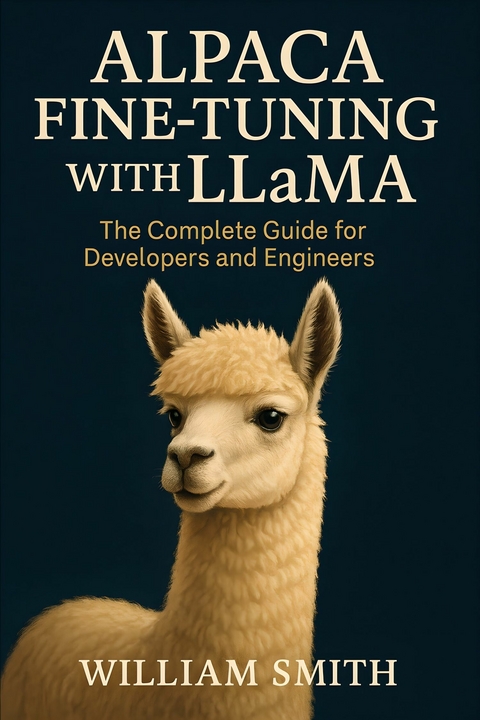
Alpaca Fine-Tuning with LLaMA (eBook)
250 Seiten
HiTeX Press (Verlag)
978-0-00-097427-3 (ISBN)
'Alpaca Fine-Tuning with LLaMA'
'Alpaca Fine-Tuning with LLaMA' is a comprehensive, expert-level exploration of the mechanics and methodology behind instruction-tuned large language models, with a particular focus on the foundational LLaMA architecture and its influential Alpaca variant. The book begins by guiding readers through the evolution and engineering innovations of LLaMA, situating it within the competitive LLM landscape through rigorous technical comparisons to models like GPT and Vicuna. Foundational concepts such as pretraining regimes, scaling laws, and the theory and practicalities of instruction tuning are elucidated alongside a detailed examination of emergent model capabilities and contemporary alignment challenges.
Progressing beyond theory, the book offers practical, scalable recipes for infrastructure setup, data engineering, and end-to-end fine-tuning pipelines. Readers gain actionable expertise in advanced hardware design, distributed cluster orchestration, and optimized throughput, all while balancing costs and environmental impacts. Thorough coverage of data sourcing, quality assurance, synthetic data generation, and robust metadata tracking is complemented by hands-on instruction for supervised fine-tuning workflows, parameter-efficient techniques like LoRA, multi-domain adaptation, and distributed training strategies tailored for both cloud-scale and federated deployments.
Recognizing the complexities of putting fine-tuned models into responsible production, the book closes with authoritative chapters on evaluation methodology, alignment via human feedback and RLHF, ethical considerations, and lifecycle management. It provides practical insights on real-time inference, monitoring, security, feedback loops, and safe continuous improvement, concluding with a forward-looking survey of continual learning, cross-lingual and multimodal innovations, and the collaborative open-source ecosystem driving the field forward. 'Alpaca Fine-Tuning with LLaMA' is an indispensable technical guide and visionary resource for machine learning practitioners, researchers, and architects shaping the next wave of instruction-following AI.
Chapter 2
Setting Up Fine-Tuning Infrastructure
The journey from groundbreaking language model research to practical deployment relies on robust, scalable, and meticulously engineered infrastructure. This chapter unveils the technical backbone required for advanced Alpaca fine-tuning—spanning hardware, distributed orchestration, data movement, and sustainability. Explore how the right infrastructure choices unlock new frontiers in model capability, efficiency, and responsible AI at scale.
2.1 Advanced Hardware Requirements
Fine-tuning large language models (LLMs) imposes stringent demands on hardware architectures, necessitating an informed balance between computational throughput, memory capacity, and data transfer efficiency. Selecting appropriate hardware must inherently consider the underlying architecture-whether GPU- or TPU-based-while addressing the heterogeneous nature of modern training workloads, ranging from dense tensor operations to sparse matrix computations.
Graphics Processing Units (GPUs) remain predominant in LLM fine-tuning due to their high floating-point performance and extensive software ecosystem. Modern GPUs, such as NVIDIA’s A100 and H100 series, employ tensor cores optimized for mixed precision arithmetic, accelerating matrix multiplications central to transformer architectures. Memory bandwidth, often ranging between 1.5 TB/s and 3 TB/s, serves as a critical bottleneck; it determines the rate at which model parameters, gradients, and activations are fed into compute units. Large memory pools, typically 40 to 80 GiB per GPU, enable holding substantial model shards or entire models in memory, reducing off-chip data transfers that degrade scaling efficiency.
Tensor Processing Units (TPUs), designed specifically for machine learning workloads, offer an alternative with custom systolic arrays optimized for dense matrix multiplications and lower-precision formats like bfloat16. TPUv4 pods provide up to 1.1 EFLOPS of computational power and feature high on-chip memory bandwidth, which translates into competitive throughput for LLM fine-tuning tasks. Unlike GPUs, TPUs integrate tightly with Google’s Cloud infrastructure and are typically accessed as a managed service rather than through on-premises deployment, impacting resource provisioning strategies.
A major constraint in fine-tuning LLMs is memory access patterns and bandwidth. Transformer models involve considerable weight reuse but also periodic tensor reshaping and softmax operations, which stress memory subsystems differently than pure dense matrix multiplications. To optimize, hardware configurations often incorporate high-bandwidth memory (HBM) stacks, minimizing latency and enabling higher operational intensity. Bandwidth limitations prompt the use of gradient checkpointing or activation recomputation techniques, which trade computational cycles for reduced memory footprint, but these techniques interact sensitively with hardware characteristics.
Modern workloads frequently exhibit heterogeneous demands-ranging from dense GEMM (general matrix multiply) to sparse attention mechanisms and dynamic batching. Hardware accelerators with native support for sparsity can yield efficiency gains; however, their benefits depend on model sparsification patterns and software stack maturity. Programmable tensor cores and vector processing units offer flexibility but require optimized kernels and compiler support to fully harness heterogeneous workloads.
When scaling fine-tuning across multiple nodes, interconnect architecture plays a pivotal role. NVIDIA’s NVLink and NVSwitch technologies provide high-bandwidth, low-latency inter-GPU communication essential for synchronous gradient updates and sharded parameter models. TPUs utilize custom high-speed mesh networks to facilitate all-reduce operations across TPU pods. The topology and bandwidth of these interconnects directly influence effective batch sizes, convergence rates, and overall throughput.
Resource provisioning decisions also involve the choice between on-premise clusters and cloud-based solutions. On-premise deployments offer control over hardware lifecycle and data governance but require upfront capital expenditure, cooling infrastructure, and specialized operational expertise. Cloud environments provide elasticity, enabling burst scaling and experimentation without fixed investment but can introduce variability in performance due to noisy neighbors and cloud-specific networking constraints. Additionally, managed cloud services simplify resource orchestration but often at higher operational cost.
Trade-offs among hardware configurations figure prominently in fine-tuning strategy formulations. Systems emphasizing maximal GPU memory aid larger batch sizes and longer context windows, reducing communication overhead but at increased hardware cost. Conversely, smaller but more numerous GPUs may enhance parallelism but incur higher synchronization latency. TPUs, optimized for throughput with lower latency interconnects, excel in sustained training regimes but may lack flexibility for custom training loops or heterogeneous accelerator integration.
Efficient hardware utilization further hinges on sophisticated scheduling to match workload characteristics with resource capabilities. Multi-instance GPU capabilities allow partitioning a single physical device into several logical GPUs, enabling concurrent fine-tuning or mixed workloads. Conversely, pipelines relying on tensor model parallelism demand careful partitioning of model layers to balance memory use and minimize inter-device communication.
The empirical tuning of hardware selection and configuration must also consider thermal design power (TDP) and energy consumption, which are critical for large-scale deployments. High-performance GPUs can demand up to 400 W per device, with cooling costs substantial in dense cluster environments. TPUs achieve energy efficiency through domain-specific hardware design, yet infrastructure must still address power provisioning and thermal management at scale.
Effective fine-tuning of large language models necessitates nuanced consideration of hardware architecture, memory bandwidth, workload heterogeneity, and resource deployment strategies. Achieving optimal performance involves carefully balancing computational capabilities, memory capacity, interconnect efficiency, and operational constraints within both on-premise and cloud paradigms. The continuous evolution of accelerator technologies and interconnect fabrics will further expand the frontier of feasible model sizes and fine-tuning complexity.
2.2 Cluster Management and Orchestration
Modern large-scale machine learning workloads and scientific computations demand sophisticated cluster management and orchestration systems to efficiently administer distributed compute resources. Such systems automate resource allocation, workload scheduling, fault tolerance, and scalability, ensuring optimal utilization and robustness under dynamic conditions. Among the most prominent frameworks addressing these challenges are Kubernetes, Slurm, and Ray. Each offers distinct capabilities and design philosophies that cater to different operational contexts and requirements.
Kubernetes has emerged as the de facto industry standard for container orchestration. Based on a declarative configuration model, it provides powerful abstractions for managing containerized applications across diverse environments ranging from on-premises data centers to public clouds. Kubernetes orchestrates the deployment, scaling, and maintenance of containerized workloads using a control plane that continuously reconciles the desired and current state of the system. Its key components include the API server, scheduler, controller manager, and etcd for state persistence. The scheduler plays a central role in assigning pods to nodes based on resource requirements, affinity rules, and available capacity, thereby optimizing cluster utilization. Kubernetes also integrates fault tolerance mechanisms such as automated pod restarts, replication controllers, and self-healing capabilities via health probes.
From a practical perspective, Kubernetes excels in managing microservice architectures and stateless or stateful applications that can be containerized with relative ease. Fine-tuning operations in machine learning can leverage Kubernetes through custom resource definitions (CRDs) and operators, enabling automation of complex workflows such as hyperparameter search or distributed training jobs. For example, Kubeflow introduces Kubernetes-native abstractions tailored for ML pipelines and model management. However, Kubernetes’ complexity and operational overhead require careful cluster design, particularly regarding networking, storage provisioning, and security policies, to maintain resilient and reproducible execution environments.
Slurm (Simple Linux Utility for Resource Management), by contrast, is a workload manager designed primarily for high-performance computing (HPC) clusters. It provides batch scheduling capabilities with sophisticated policies for job prioritization, fair-share allocation, and advanced reservation. Slurm’s architecture comprises a central controller (slurmctld), multiple compute nodes (slurmd), and optional database...
| Erscheint lt. Verlag | 24.7.2025 |
|---|---|
| Sprache | englisch |
| Themenwelt | Mathematik / Informatik ► Informatik ► Programmiersprachen / -werkzeuge |
| ISBN-10 | 0-00-097427-7 / 0000974277 |
| ISBN-13 | 978-0-00-097427-3 / 9780000974273 |
| Informationen gemäß Produktsicherheitsverordnung (GPSR) | |
| Haben Sie eine Frage zum Produkt? |
 EPUB (Adobe DRM)
Größe: 1,1 MB
Kopierschutz: Adobe-DRM
Adobe-DRM ist ein Kopierschutz, der das eBook vor Mißbrauch schützen soll. Dabei wird das eBook bereits beim Download auf Ihre persönliche Adobe-ID autorisiert. Lesen können Sie das eBook dann nur auf den Geräten, welche ebenfalls auf Ihre Adobe-ID registriert sind.
Details zum Adobe-DRM
Dateiformat: EPUB (Electronic Publication)
EPUB ist ein offener Standard für eBooks und eignet sich besonders zur Darstellung von Belletristik und Sachbüchern. Der Fließtext wird dynamisch an die Display- und Schriftgröße angepasst. Auch für mobile Lesegeräte ist EPUB daher gut geeignet.
Systemvoraussetzungen:
PC/Mac: Mit einem PC oder Mac können Sie dieses eBook lesen. Sie benötigen eine
eReader: Dieses eBook kann mit (fast) allen eBook-Readern gelesen werden. Mit dem amazon-Kindle ist es aber nicht kompatibel.
Smartphone/Tablet: Egal ob Apple oder Android, dieses eBook können Sie lesen. Sie benötigen eine
Geräteliste und zusätzliche Hinweise
Buying eBooks from abroad
For tax law reasons we can sell eBooks just within Germany and Switzerland. Regrettably we cannot fulfill eBook-orders from other countries.
aus dem Bereich


