


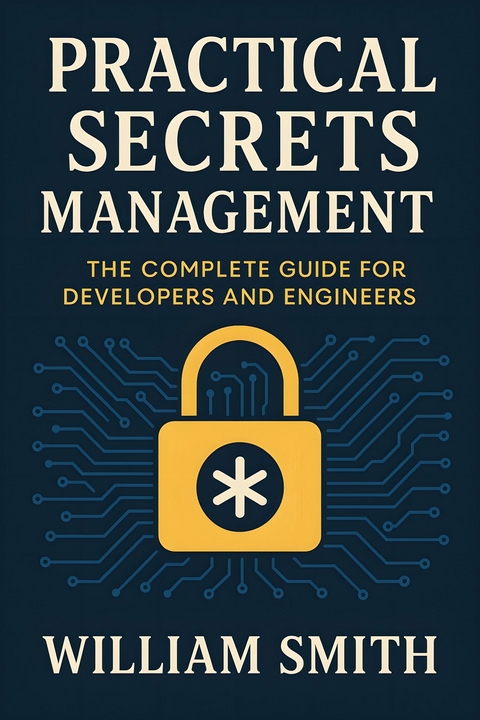
Practical SOPS Secrets Management (eBook)
250 Seiten
HiTeX Press (Verlag)
978-0-00-097426-6 (ISBN)
'Practical SOPS Secrets Management'
'Practical SOPS Secrets Management' is a comprehensive guide that demystifies the principles, challenges, and solutions surrounding secure secrets management in cloud-native and enterprise environments. Drawing from real-world incidents and best practices, the book begins by establishing a solid foundation in security principles, threat modeling, and the lifecycle of secrets. It analyzes common pitfalls in secret handling and provides a detailed comparison of secrets management systems, culminating in an authoritative introduction to SOPS as a modern, versatile solution.
The book delves deeply into the architecture and internal mechanics of SOPS, illuminating its cryptographic foundations, supported file formats, and extensibility through pluggable backends. Readers are guided through practical usage patterns, from command-line automation and batch processing to advanced techniques such as field-level encryption, auditing, and seamless integration with DevOps and GitOps pipelines. Special sections are devoted to cloud-native workflows, Kubernetes integration, and secure distribution of secrets in multi-cloud, multi-tenant environments, ensuring applicability across a diverse range of operational contexts.
As organizations face increasing compliance requirements and operational scale, this book addresses advanced key management, policy enforcement, automated compliance, and large-scale enterprise deployments. It also explores the future trajectory of secrets management, covering emerging trends like quantum-safe cryptography, confidential computing, and robust disaster recovery. With insights from real-world case studies and contributions from the SOPS community, 'Practical SOPS Secrets Management' is an indispensable resource for security engineers, DevOps teams, and organizational leaders seeking resilient, scalable, and auditable secrets management.
Chapter 1
Foundations of Secure Secret Management
Secrets are the cryptographic lifeblood of every modern application, yet their management is fraught with invisible hazards and escalating stakes. This chapter goes far beyond the basics, unraveling how advanced adversaries, evolving regulations, and operational complexity conspire to make secret handling a potent risk—and a profound engineering responsibility. Discover why mastering secret management is not just a technical duty but a strategic imperative for defending cloud-native and distributed architectures.
1.1 Security Principles and Threat Models
The security of secret management systems fundamentally relies on four primary tenets: confidentiality, integrity, availability, and auditability. Each plays a critical role in ensuring that sensitive information such as cryptographic keys, credentials, and tokens are rigorously protected throughout their lifecycle. Understanding these principles provides a foundation upon which threat models can be constructed and effective defenses can be designed.
Confidentiality mandates that secrets remain accessible only to authorized entities. In the context of secret management, this means tightly controlling access so that neither unauthorized users nor adversarial processes can exfiltrate or view the secrets. Techniques such as encryption at rest and in transit, strong authentication controls, and granular access policies reinforce confidentiality. However, enforcing confidentiality requires a clear definition of the trust boundaries within the system and prudent key distribution mechanisms.
Integrity ensures that secret data remains unaltered except through authorized processes. This property guards against tampering attacks where adversaries may attempt to inject or modify secrets to subvert security controls or gain elevated privileges. Message authentication codes (MACs), digital signatures, and trusted execution environments (TEEs) are typical mechanisms employed to maintain integrity. In secret management, integrity protects both the stored secrets and mediation layers that handle secret access and provisioning.
Availability addresses the continuous accessibility of secrets to legitimate users and processes. Downtime or loss of secret availability can cripple dependent systems, disrupt applications, or cause denial-of-service conditions. Redundancy, fault-tolerant architectures, and resilient key recovery schemes contribute to sustaining availability. The design must balance availability with confidentiality to avoid exposing secrets through over-available interfaces or lax controls.
Auditability refers to the ability to trace and verify all accesses, modifications, and management activities pertaining to secrets. Comprehensive audit trails facilitate forensic analysis, compliance enforcement, and anomaly detection. Logging mechanisms must capture sufficient detail while maintaining integrity and confidentiality of audit data itself, often by employing secure append-only storage or tamper-evident logs.
While these tenets establish what properties secret management systems must uphold, rigorous threat modeling elucidates the adversaries’ capabilities, objectives, and attack surfaces to be defended. Threat models classify attackers by their position relative to the organization, technical resources, and intent, shaping the protections required for secrets.
Insider threats present a particularly challenging attacker class since they operate within the organization’s trusted boundaries. These individuals may have legitimate access to certain systems but abuse privileges to extract secrets or manipulate configurations. Insider threats exploit weak role separation, inadequate logging, or poorly enforced least privilege principles. Insider scenarios underscore the necessity of strict access controls, continuous behavioral monitoring, and zero-trust architectures that minimize implicit trust.
Supply chain attacks leverage compromise or tampering of third-party components involved in secret provisioning or management. These attacks aim to insert backdoors, malicious code, or weak cryptographic parameters during the software build, firmware update, or hardware manufacturing stages. Supply chain risks require validation of component integrity, secure build pipelines, code audits, and provenance verification to ensure that secrets are not exposed or weakened before deployment.
Environment-specific risks depend on where and how secrets are stored and used. For instance, secrets maintained in cloud environments face additional threats such as hypervisor escape, virtual machine introspection, or cross-tenant attacks. Embedded systems may suffer from physical tampering or side-channel leaks. Network-exposed secret caches must defend against interception or man-in-the-middle exploits. Each environment mandates tailored protections informed by its unique threat landscape.
Advanced adversaries aim not only to obtain secrets but to exploit minimal weaknesses to persist undetected and escalate control. They often combine multiple attack vectors such as credential theft via social engineering followed by lateral movement enabled by privilege escalation using compromised secrets. Real-world examples include attacks where adversaries exfiltrate signing keys to forge code or acquire database credentials to access sensitive customer data. These scenarios emphasize that protecting secrets cannot rely solely on perimeter defense but must incorporate multi-layered controls, continuous verification, and least-privilege practices.
System assumptions critically influence the required level of secret protection. For example, a system assuming that hardware roots of trust are uncompromised can rely on TEEs to secure secrets, whereas environments exposed to hardware-level adversaries must incorporate additional cryptographic protections and monitoring. Similarly, assumptions about network segmentation, user trustworthiness, or operational procedures guide the threat mitigation strategies.
The rigorous application of confidentiality, integrity, availability, and auditability principles must be informed by comprehensive threat models encompassing insider threats, supply chain compromises, and environment-specific vulnerabilities. Realistic attack scenarios provide insight into adversary aims, revealing the system components most in need of protection and the critical nature of assumptions that underpin the security posture. This integrated understanding ensures that secret management systems are designed to withstand sophisticated threats and safeguard organizational assets effectively.
1.2 Secret Lifecycle: Generation, Distribution, Rotation, and Revocation
The lifecycle of secrets encompasses a series of critical stages designed to maintain confidentiality, integrity, and availability while minimizing the risk of unauthorized exposure. Each stage—generation, secure provisioning, distribution, rotation, and revocation—demands rigorous architectural considerations and precise operational controls to uphold a robust security posture across heterogeneous environments.
Secret Generation
Secret generation is the foundational stage where cryptographic keys, passwords, tokens, or other sensitive material are created. The security and entropy quality of the generated secrets are paramount, as weak or predictable secrets compromise all subsequent protections. Modern best practices dictate the use of hardware-based cryptographic modules or cryptographically secure pseudo-random number generators (CSPRNGs) compliant with standards such as NIST SP 800-90A for entropy sources. For example, generating a 256-bit symmetric key requires a secure random byte stream extraction to ensure resistance against guessing and brute-force attacks.
def generate_symmetric_key(byte_length=32):
return os.urandom(byte_length)
key = generate_symmetric_key()
...
| Erscheint lt. Verlag | 24.7.2025 |
|---|---|
| Sprache | englisch |
| Themenwelt | Mathematik / Informatik ► Informatik ► Programmiersprachen / -werkzeuge |
| ISBN-10 | 0-00-097426-9 / 0000974269 |
| ISBN-13 | 978-0-00-097426-6 / 9780000974266 |
| Informationen gemäß Produktsicherheitsverordnung (GPSR) | |
| Haben Sie eine Frage zum Produkt? |
 EPUB (Adobe DRM)
Größe: 781 KB
Kopierschutz: Adobe-DRM
Adobe-DRM ist ein Kopierschutz, der das eBook vor Mißbrauch schützen soll. Dabei wird das eBook bereits beim Download auf Ihre persönliche Adobe-ID autorisiert. Lesen können Sie das eBook dann nur auf den Geräten, welche ebenfalls auf Ihre Adobe-ID registriert sind.
Details zum Adobe-DRM
Dateiformat: EPUB (Electronic Publication)
EPUB ist ein offener Standard für eBooks und eignet sich besonders zur Darstellung von Belletristik und Sachbüchern. Der Fließtext wird dynamisch an die Display- und Schriftgröße angepasst. Auch für mobile Lesegeräte ist EPUB daher gut geeignet.
Systemvoraussetzungen:
PC/Mac: Mit einem PC oder Mac können Sie dieses eBook lesen. Sie benötigen eine
eReader: Dieses eBook kann mit (fast) allen eBook-Readern gelesen werden. Mit dem amazon-Kindle ist es aber nicht kompatibel.
Smartphone/Tablet: Egal ob Apple oder Android, dieses eBook können Sie lesen. Sie benötigen eine
Geräteliste und zusätzliche Hinweise
Buying eBooks from abroad
For tax law reasons we can sell eBooks just within Germany and Switzerland. Regrettably we cannot fulfill eBook-orders from other countries.
aus dem Bereich


