


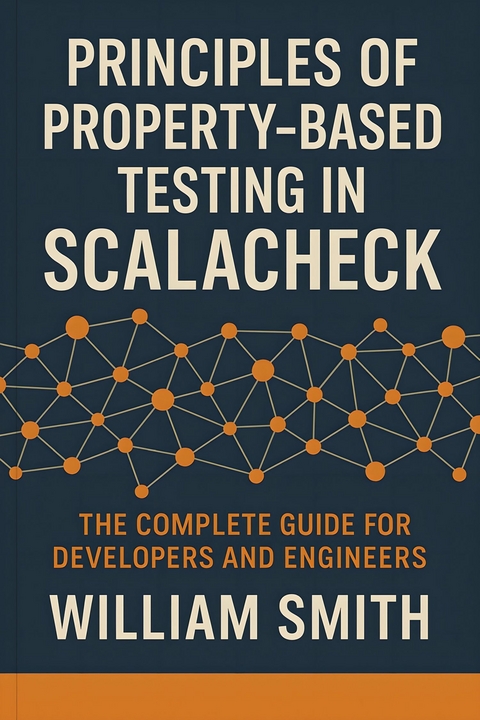
Principles of Property-Based Testing in ScalaCheck (eBook)
250 Seiten
HiTeX Press (Verlag)
978-0-00-097425-9 (ISBN)
'Principles of Property-Based Testing in ScalaCheck'
'Principles of Property-Based Testing in ScalaCheck' offers a comprehensive and rigorous exploration of property-based testing, starting from its theoretical foundations to advanced applications within the Scala ecosystem. The book methodically distinguishes property-based testing from conventional example-based approaches, with a clear focus on the benefits, misconceptions, and transformative impact such techniques have on software design and maintainability. By grounding its approach in formal specification, it equips readers with the conceptual tools to define, compose, and reason about robust software properties and invariants.
Central to the book is a deep dive into ScalaCheck, illuminating its core abstractions-such as generators, properties, and shrinkers-and providing practical guidance on architecting expressive, reusable properties. The text addresses complex challenges in testing stateful, effectful, concurrent, and asynchronous systems, while delivering actionable strategies for diagnosing failures through effective shrinking and analysis of counterexamples. Developers will also find thorough discussions on integrating property-based testing with existing Scala-based and JVM testing tools, continuous integration environments, and heterogenous codebases.
Advanced chapters expand the reader's horizon with innovative topics like metaprogramming, formal verification, machine learning integration, and security testing through fuzzing. Best practices, design patterns, and anti-patterns are systematically surveyed to foster maintainable and deterministic test suites, showcasing real-world successes and guiding teams toward successful adoption. Whether you are a practitioner, educator, or tool builder, this book is an indispensable reference for mastering modern property-based testing in Scala.
Chapter 1
The Theory and Rationale of Property-Based Testing
Before mastering property-based testing in practice, it is essential to understand the motivations, theories, and misconceptions at its foundation. This chapter embarks on an intellectual journey through the principles, promises, and practical impacts of property-based testing—revealing why this testing paradigm fundamentally transforms both how we write tests and how we perceive software correctness.
1.1 Foundations of Property-Based Testing
Property-based testing (PBT) emerged at the confluence of mathematical logic, formal methods, and the evolving paradigms of functional programming. Unlike traditional testing methodologies, which predominantly rely on example-driven or scenario-based verification, PBT emphasizes the specification of general, declarative properties that a system under test (SUT) must satisfy. This approach shifts the focal point from enumerating concrete test cases to articulating invariant properties and systematically exploring the input space to uncover violations.
The conceptual roots of property-based testing can be traced back to formal logic and the quest for rigor in software correctness. Early formal methods sought to prove that programs conformed to logical specifications, often expressed in first-order logic or higher-order logics. Such proofs aimed at mathematical certainty but were difficult to scale and integrate into everyday development workflows. Functional programming languages, with their strong mathematical foundations and emphasis on pure functions, provided fertile ground for realizing these verification concepts in practice. The declarative nature of functional programming languages such as Haskell aligns neatly with specifying properties as logical predicates over inputs and outputs.
A pivotal milestone in the history of PBT was the creation of QuickCheck, introduced by Koen Claessen and John Hughes in 2000. QuickCheck operationalized the concept by allowing programmers to specify properties as Haskell functions returning Boolean values, accompanied by automatically generated random input data to test these properties. This innovation radically departed from conventional testing, where test authors manually enumerate input-output pairs or scenarios. Instead, QuickCheck leverages random sampling guided by the property definitions to systematically search for counterexamples that falsify the properties.
The key terminology of property-based testing revolves around properties, generators, shrinking, and test oracles.
- A property is a logical statement about the expected behavior of the system, often phrased as a predicate on inputs and outputs. For example, a property might assert that sorting a list preserves its length or that the output of a parser, when re-serialized, yields an equivalent text.
- Generators produce a potentially infinite stream of input values, often randomly but constrained by user-defined conditions to ensure meaningful test cases.
- Shrinking is an automated reduction process that, upon encountering a failing input, attempts to produce a simpler failing case to aid debugging.
- The test oracle is the function that determines whether the property holds for given inputs, typically implemented as Boolean predicates or equivalently assertions within the property.
Fundamentally, PBT reframes software verification as a problem of falsification, inspired by the principles of formal logic and the philosophy of scientific inquiry. Karl Popper’s principle of falsifiability underlines that no finite number of successful tests can prove a property true universally, but discovering a single counterexample definitively disproves it. Therefore, property-based testing seeks to maximize the likelihood of finding such counterexamples by exhaustively and randomly exploring the input domain rather than attempting to prove correctness inductively through case enumeration.
This contrasts strongly with traditional example-driven testing, which is guided primarily by known or anticipated edge cases and usage scenarios. While example-based tests offer precision and clarity, they suffer from limited coverage and often require substantial manual effort to identify critical test inputs. Property-based testing automates and generalizes this process, enabling discovery of subtle bugs that were previously obscured by incomplete manual test suites. In effect, PBT raises the abstraction level of testing from specific cases to universally quantified properties, bringing the power of mathematical abstraction into practical software verification.
Another crucial departure lies in the way PBT handles nondeterminism in test generation. Since generators provide a diverse and rapidly varying set of inputs, they inherently explore unexpected interactions and corner cases, potentially uncovering defects that evade traditional testing methods. This stochastic nature of input generation, coupled with a systematic shrinking process, enhances the debugging workflow by isolating minimal failing cases that pinpoint the root causes with a direct causal link.
The theoretical underpinnings of property-based testing also resonate with the principles of algebraic specification and formal semantics as developed in the 1970s and 1980s. Specifying properties as algebraic laws or equational theories aligns well with the declarative nature of modern functional programs. Through these properties, PBT operationalizes specification-based testing-that is, testing that is derived directly from formal specifications rather than informal requirements or implementations. This tight nexus between specification and testing fosters a seamless integration of verification into the software development lifecycle, promoting correctness by design.
The foundations of property-based testing represent a significant paradigm shift in software verification. Originating from the confluence of mathematical logic, formal methods, and functional programming, PBT replaces discrete, example-driven tests with broad, universally quantified properties. With automated generation, randomization, and shrinking to pinpoint minimal counterexamples, property-based testing operationalizes formal correctness concepts within accessible practical tools, enabling more robust and reliable software systems.
1.2 Formal Specification of Software Properties
Formal specification of software properties is a rigorous methodology used to define the expected behavior and constraints of software systems using mathematical logic. These specifications provide unambiguous descriptions of properties, such as invariants, preconditions, postconditions, and temporal constraints, enabling precise reasoning about software correctness. The most prevalent logical frameworks for expressing software properties are first-order logic (FOL) and higher-order logic (HOL), each offering distinct advantages in expressiveness and applicability.
First-order logic serves as a foundational logical system characterized by quantification over individual elements of a domain. It comprises variables, predicates, functions, logical connectives, and quantifiers ∀ (for all) and ∃ (there exists). Properties specified in FOL are often declarative statements about program states or data structures. For example, the invariant of a sorted list data structure can be articulated as
where a is the list array and n its length. This expresses the property that every pair of elements satisfies the sorting order relation. Such formalization eliminates ambiguity inherent in natural language descriptions, forming a precise semantic model for verification frameworks.
Higher-order logic extends the capabilities of FOL by permitting quantification not only over individual variables but also over predicates and functions. This extension enables the specification of more complex properties, including those involving sets of functions or relations, and allows abstraction over behavioral aspects of software components. For example, the property of function monotonicity can be expressed as
where f itself is a variable quantified over all real-valued functions. HOL is particularly valuable in specifying software with higher-order components or employing rich type systems, such as functional programming languages.
Formal properties expressed in logical form serve as the ground truth in software testing and verification. In property-based testing, these logical specifications define the conditions against which system executions are evaluated. Property-based testing frameworks generate a wide range of input cases and check that the software satisfies the stated property for each input. Crucially, the formal specification acts as an oracle, enabling automated verification of program outputs against the desired properties. For example, using a property tester to validate the sorting invariant involves generating random lists and verifying that the output list conforms to the FOL expression of sortedness.
While property-based testing leverages formal specifications as...
| Erscheint lt. Verlag | 24.7.2025 |
|---|---|
| Sprache | englisch |
| Themenwelt | Mathematik / Informatik ► Informatik ► Programmiersprachen / -werkzeuge |
| ISBN-10 | 0-00-097425-0 / 0000974250 |
| ISBN-13 | 978-0-00-097425-9 / 9780000974259 |
| Informationen gemäß Produktsicherheitsverordnung (GPSR) | |
| Haben Sie eine Frage zum Produkt? |
 EPUB (Adobe DRM)
Größe: 935 KB
Kopierschutz: Adobe-DRM
Adobe-DRM ist ein Kopierschutz, der das eBook vor Mißbrauch schützen soll. Dabei wird das eBook bereits beim Download auf Ihre persönliche Adobe-ID autorisiert. Lesen können Sie das eBook dann nur auf den Geräten, welche ebenfalls auf Ihre Adobe-ID registriert sind.
Details zum Adobe-DRM
Dateiformat: EPUB (Electronic Publication)
EPUB ist ein offener Standard für eBooks und eignet sich besonders zur Darstellung von Belletristik und Sachbüchern. Der Fließtext wird dynamisch an die Display- und Schriftgröße angepasst. Auch für mobile Lesegeräte ist EPUB daher gut geeignet.
Systemvoraussetzungen:
PC/Mac: Mit einem PC oder Mac können Sie dieses eBook lesen. Sie benötigen eine
eReader: Dieses eBook kann mit (fast) allen eBook-Readern gelesen werden. Mit dem amazon-Kindle ist es aber nicht kompatibel.
Smartphone/Tablet: Egal ob Apple oder Android, dieses eBook können Sie lesen. Sie benötigen eine
Geräteliste und zusätzliche Hinweise
Buying eBooks from abroad
For tax law reasons we can sell eBooks just within Germany and Switzerland. Regrettably we cannot fulfill eBook-orders from other countries.
aus dem Bereich


