


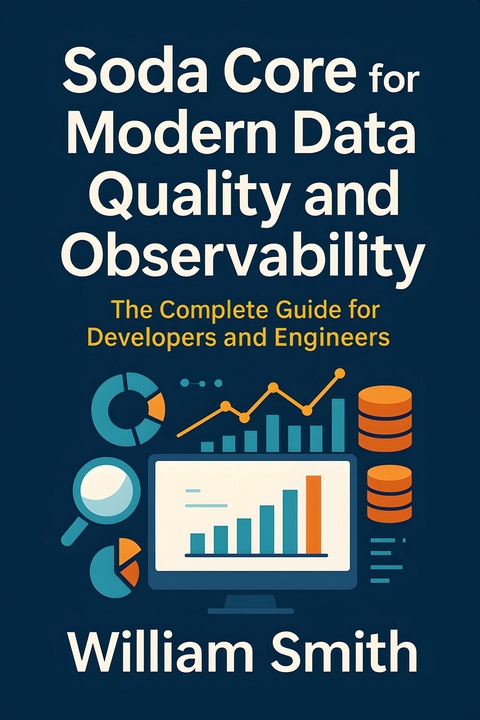
Soda Core for Modern Data Quality and Observability (eBook)
250 Seiten
HiTeX Press (Verlag)
978-0-00-097418-1 (ISBN)
'Soda Core for Modern Data Quality and Observability'
In 'Soda Core for Modern Data Quality and Observability,' readers are expertly guided through the intricate landscape of data quality management and observability in today's dynamic data environments. The book delivers a thorough introduction to the key dimensions of data quality-including accuracy, completeness, timeliness, and consistency-and explores the rise of modern data observability. With careful attention to architectural challenges in distributed data systems and the growing need for quantifiable data quality metrics, it provides a robust foundation for organizations seeking proactive assurance in their data operations.
The heart of the book is a comprehensive examination of Soda Core-an advanced, open-source platform for data quality monitoring. Detailed chapters unveil Soda Core's flexible architecture, deployment strategies, and integration capabilities, equipping professionals to define, automate, and manage complex data quality checks at scale. Practical guidance on YAML-driven configuration, dynamic anomaly detection, and seamless integration with orchestration frameworks such as Airflow and dbt empowers teams to implement continuous data assurance across diverse environments, from on-premises infrastructure to the cloud.
Beyond technical implementation, this authoritative resource addresses the broader enterprise context, including the operationalization of end-to-end observability, security, compliance automation, and the extensibility of Soda Core through custom plugins and APIs. Real-world industry use cases highlight successful deployments in regulated sectors, modernization projects, and real-time streaming scenarios, while expert insights reveal best practices, anti-patterns, and future trends in data quality engineering. With clear explanations and actionable strategies, this book becomes indispensable for data engineers, architects, and leaders aiming to build resilient, reliable, and trustworthy data ecosystems.
Chapter 1
Core Concepts in Data Quality and Observability
In today’s data-driven enterprises, the distinction between reliable insights and costly errors hinges on a deep understanding of data quality and observability. This chapter goes beyond surface definitions to dissect the building blocks of trustworthy data—elucidating hidden interdependencies, trade-offs, and emergent challenges in decentralized architectures. Readers who master these concepts will be equipped to anticipate issues, select meaningful metrics, and lay the foundations for scalable, proactive data quality assurance in complex environments.
1.1 Dimensions of Data Quality
Data quality is a multifaceted construct that governs the efficacy of advanced data ecosystems, particularly under the strain of high-volume, high-velocity data environments. The classical six dimensions—accuracy, completeness, consistency, timeliness, uniqueness, and validity—remain foundational, yet their practical interpretation and interdependencies evolve significantly in contemporary settings. This section scrutinizes each dimension, emphasizing their adaptation to large-scale, heterogeneous data landscapes and the consequential dynamics when one or more dimensions are compromised.
Accuracy denotes the degree to which data correctly represents the real-world entities or events to which it refers. In traditional contexts, accuracy is binary or scalar, often assessed via simple validation against trusted sources. However, advanced ecosystems must grapple with data sourced from disparate streams-sensor networks, transactional systems, social media feeds-where noise, transient faults, and systemic biases complicate accuracy assessments. For example, location tracking data from mobile devices may exhibit inherent spatial and temporal inaccuracies that require probabilistic modeling rather than deterministic validation. Techniques involving statistical inference and machine learning algorithms can estimate error bounds, enabling systems to quantify and compensate for inaccuracies dynamically.
Completeness refers to the extent to which required data attributes or records are present in a dataset. In high-volume systems, completeness is often partial and temporally variable. Data lakes or streaming architectures may introduce schema variability and intermittent attribute availability, challenging traditional binary completeness measurements. For instance, a customer record in a CRM system may lack certain demographic attributes, yet still be analytically valuable. Hence, completeness must be contextualized with a notion of fit-for-purpose: completeness is not absolute but relative to the analytical intent or downstream use case. Adaptive frameworks employ metadata-driven policies and impact analysis to prioritize completeness levels, focusing remediation efforts where missing data is most consequential.
Consistency signifies the absence of conflicting data within or across sources. As data ecosystems become distributed and federated, ensuring consistency transcends simple referential integrity checks. Eventual consistency models, common in NoSQL and distributed databases, deliberately relax strict consistency guarantees to achieve higher availability and partition tolerance (per the CAP theorem). Thus, consistency management shifts towards reconciliation mechanisms and conflict resolution policies employing automated record linkage, version control, and provenance metadata. For example, in healthcare information systems aggregating patient data from multiple providers, reconciling divergent medical codes or conflicting lab results requires domain-specific business rules and expert-in-the-loop strategies.
Timeliness captures the degree to which data is available when needed and reflects the relevant time frame of the underlying phenomena. In low-latency applications such as fraud detection or autonomous vehicle control, timeliness is a critical dimension that directly affects decision quality and system safety. Conversely, in strategic analytics, lagged data may suffice. The measurement of timeliness thus becomes application-specific, hinging on data freshness, latency thresholds, and update frequencies. Sophisticated data pipelines incorporate streaming architectures, real-time monitoring, and temporal data validation to ensure adherence to timeliness SLAs (Service Level Agreements). Moreover, timeliness interacts critically with other dimensions; delayed data may degrade accuracy and consistency over time due to stale snapshots or missed updates.
Uniqueness ensures that each entity or event is captured once and only once, preventing duplication that can distort analysis and decision-making. In large-scale data environments, duplicates arise through data ingestion from multiple sources, data entry errors, or system integrations. Deduplication mechanisms employ a mixture of deterministic keys, fuzzy matching algorithms, and entity resolution methodologies scalable to billions of records. For example, e-commerce platforms consolidate customer profiles using hybrid probabilistic matching and supervised learning to identify duplicates while minimizing false positives. The complexity increases when identifiers are incomplete or inconsistent; thus, uniqueness is often achieved as a probabilistic guarantee rather than an absolute state.
Validity reflects whether data conforms to the syntactic and semantic rules predefined for its domain. This encompasses data type constraints, permissible value ranges, format specifications, and domain-specific business logic. Contemporary data systems incorporate dynamic schema evolution and schema-on-read paradigms, complicating validity enforcement. For example, JSON or XML data streams may admit flexible schemas, necessitating runtime validation with adaptive rule engines. Validity checks thus extend beyond static schema conformance to include contextual integrity constraints and cross-field validations. Automated testing frameworks integrated within data ingestion pipelines ensure that validity violations are detected early and tracked for remediation.
The interplay among these dimensions is complex and often nonlinear. For instance, strict enforcement of uniqueness can indirectly improve accuracy by removing conflicting records, yet aggressively pruning data may reduce completeness. Similarly, enhancing timeliness through rapid data ingestion increases the risk of compromising accuracy or consistency if validation steps are truncated to meet latency requirements. These trade-offs necessitate frameworks that prioritize dimensions contextually, guided by domain impact, regulatory compliance, and user requirements.
Case studies illustrate cascading repercussions stemming from quality lapses. In financial trading systems, incomplete or untimely data feeds can trigger erroneous trades, causing significant economic loss, highlighting the primacy of timeliness intertwined with accuracy. In healthcare analytics, inconsistent coding schemas across hospitals impede patient outcome analysis, reinforcing the criticality of consistency and validity. In retail, duplicate customer records inflate marketing metrics and resource allocation inefficiencies, underscoring uniqueness’s operational importance.
Robust methodologies to measure and prioritize data quality dimensions involve composite metrics and scoring systems that combine quantitative indicators-such as error rates, completeness percentages, latency distributions-with qualitative assessments from domain experts. Machine learning models can forecast downstream impacts of various quality defects, aiding strategic remediation decisions. Emerging frameworks advocate continuous, automated monitoring embedded within data infrastructure, facilitating real-time alerts and adaptive controls.
The classical six dimensions of data quality provide a comprehensive foundation but require nuanced adaptation for advanced data ecosystems characterized by volume, velocity, and variety. Their interdependencies present practical challenges and necessitate integrated, context-aware frameworks to sustain data integrity and analytic value at scale.
1.2 The Evolution of Data Observability
The concept of data observability has undergone a significant transformation, paralleling the evolution of data ecosystems from simple, centralized repositories to complex, distributed platforms. Initially, data monitoring was confined to rudimentary health checks, tracking basic metrics such as data freshness, batch job success rates, or system uptime. These early practices, while foundational, were inherently reactive, alerting teams only after issues manifested, often with limited context for diagnosis.
As data infrastructures expanded in scale and complexity, the inadequacies of conventional monitoring became apparent. Data environments evolved into multi-cloud and hybrid architectures, orchestrated by complex pipelines spanning heterogeneous technologies. This complexity demanded a paradigm shift towards a more holistic approach: data observability. Unlike monitoring, which focuses primarily on detecting anomalies or failures, observability emphasizes the system’s overall transparency and the ability to infer its internal state through ...
| Erscheint lt. Verlag | 24.7.2025 |
|---|---|
| Sprache | englisch |
| Themenwelt | Mathematik / Informatik ► Informatik ► Programmiersprachen / -werkzeuge |
| ISBN-10 | 0-00-097418-8 / 0000974188 |
| ISBN-13 | 978-0-00-097418-1 / 9780000974181 |
| Informationen gemäß Produktsicherheitsverordnung (GPSR) | |
| Haben Sie eine Frage zum Produkt? |
 EPUB (Adobe DRM)
Größe: 943 KB
Kopierschutz: Adobe-DRM
Adobe-DRM ist ein Kopierschutz, der das eBook vor Mißbrauch schützen soll. Dabei wird das eBook bereits beim Download auf Ihre persönliche Adobe-ID autorisiert. Lesen können Sie das eBook dann nur auf den Geräten, welche ebenfalls auf Ihre Adobe-ID registriert sind.
Details zum Adobe-DRM
Dateiformat: EPUB (Electronic Publication)
EPUB ist ein offener Standard für eBooks und eignet sich besonders zur Darstellung von Belletristik und Sachbüchern. Der Fließtext wird dynamisch an die Display- und Schriftgröße angepasst. Auch für mobile Lesegeräte ist EPUB daher gut geeignet.
Systemvoraussetzungen:
PC/Mac: Mit einem PC oder Mac können Sie dieses eBook lesen. Sie benötigen eine
eReader: Dieses eBook kann mit (fast) allen eBook-Readern gelesen werden. Mit dem amazon-Kindle ist es aber nicht kompatibel.
Smartphone/Tablet: Egal ob Apple oder Android, dieses eBook können Sie lesen. Sie benötigen eine
Geräteliste und zusätzliche Hinweise
Buying eBooks from abroad
For tax law reasons we can sell eBooks just within Germany and Switzerland. Regrettably we cannot fulfill eBook-orders from other countries.
aus dem Bereich


