


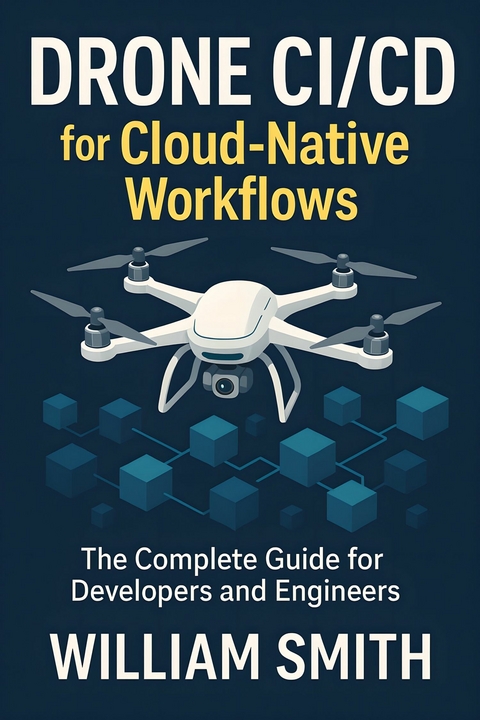
Drone CI/CD for Cloud-Native Workflows (eBook)
250 Seiten
HiTeX Press (Verlag)
978-0-00-097417-4 (ISBN)
'Drone CI/CD for Cloud-Native Workflows'
'Drone CI/CD for Cloud-Native Workflows' is a comprehensive guide that delves deeply into the modern evolution of Continuous Integration and Continuous Delivery (CI/CD) in cloud-native environments. Through a clear exploration of core CI/CD concepts, the book establishes the importance of streamlined pipelines amidst the paradigm shifts brought by microservices, containers, and orchestration technologies. Readers are guided through the rapidly changing tools landscape, comparing Drone to other leading platforms, and are introduced to best practices for cloud-native DevOps, security, compliance, and continuous feedback essential for today's high-velocity teams.
Moving beyond the fundamentals, the book offers a meticulous breakdown of the Drone platform's architecture, extensibility, and operational design. From defining robust, YAML-driven pipelines to orchestrating complex workflows that scale across cloud providers, each chapter is structured to provide actionable guidance and architectural insight. Topics such as secure identity management, container sandboxing, plugin development, threat modeling, observability, and performance optimization are treated in depth, catering to practitioners aiming to build resilient, maintainable, and secure delivery systems.
As organizations face increasing complexity in enterprise and multi-cloud operations, the book addresses advanced strategies for scalability, governance, cost control, and disaster recovery, all while surveying the horizon for upcoming innovations. Future-forward chapters examine AI-driven optimization, serverless and zero-trust architectures, and the next generation of GitOps and event-driven automation. Whether you are a platform engineer, DevOps practitioner, or an architect shaping CI/CD at scale, this book equips you with both the technical foundations and visionary knowledge needed to unlock the full potential of Drone in the cloud-native era.
Chapter 2
Architecting Drone: Deep Dive into Platform Design
At the heart of Drone’s flexibility and power lies an elegantly modular architecture—purpose-built for cloud-native automation. This chapter peels back the layers of Drone’s internal design, exposing the distinct components, workflows, and extensibility mechanisms that enable reliable, secure, and highly customizable CI/CD pipelines. Whether optimizing for performance, isolation, or rapid scaling, you’ll gain a nuanced understanding of how each architectural decision drives real-world engineering outcomes.
2.1 Drone Core Architecture
The core architecture of Drone CI is designed around modularity and scalability, integrating distinct components that collaboratively enable continuous integration and delivery workflows. At its foundation lie three principal elements: the core server, runner agents, and the plugin system. These components communicate through well-defined interfaces under an event-driven execution model, fostering a loosely coupled environment that supports efficiency, extensibility, and robustness.
The core server acts as the authoritative conductor of the system, orchestrating pipeline execution by receiving webhook events from version control systems and managing pipeline state transitions. It is responsible for authentication, user management, and storing pipeline configurations and build metadata. Internally, it leverages a lightweight REST API to expose control endpoints, which runners and plugins subsequently consume. This central server maintains a persistent key-value store of all build state data, coordinating concurrent builds while ensuring that job dependencies and pipeline stages are satisfied in proper order.
The runner agents serve as lightweight, disposable workers that execute discrete pipeline steps. Runners can be deployed on various infrastructures-ranging from bare-metal servers to container orchestration platforms-ensuring flexibility in resource allocation and workload distribution. Each runner polls the core server for pending jobs, obtains a job specification, and executes it in a self-contained environment, often leveraging container technologies such as Docker. Runners isolate the execution environment to maintain security and reproducibility. After job completion, runners report status updates and logs back to the core server, closing the feedback loop for build tracking and result aggregation.
Key to the runner architecture is its support for a polymorphic execution environment achieved through plugins. Rather than embedding all functionality within runners, Drone offloads job-specific operations to independently developed and deployable plugins. Plugins are stateless, containerized executables that implement discrete tasks, such as compiling code, running tests, or publishing artifacts. The plugin system enforces a strict contract between runners and plugins, using environment variables and filesystem conventions to pass parameters and capture outputs. This decoupling enables a broad ecosystem of plugins that can be arbitrarily composed to form complex pipelines.
Drone’s adherence to an event-driven execution model is foundational to its responsiveness and scalability. Upon receipt of a webhook event signaling a code push or pull request, the core server evaluates the pipeline configuration and enqueues jobs in a directed acyclic graph (DAG) representing job dependencies. This design ensures that jobs execute only when their prerequisite tasks have succeeded, enabling conditional logic and parallelism. Events propagate in real-time, triggering state transitions and job dispatches without polling overhead.
Authentication and security are intrinsic to the architecture. The core server implements OAuth2-based authentication and integrates with identity providers via standard protocols such as LDAP, SAML, or OpenID Connect. This facilitates role-based access control (RBAC), restricting pipeline execution and resource usage according to organizational policies. Communication among core, runners, and plugins employs encrypted channels-often TLS-and tokens scoped per session, minimizing attack vectors and establishing trust boundaries within the system.
The architectural choice to maintain a loosely coupled, scalable pipeline environment manifests through asynchronous messaging and stateless design principles. The core server, runners, and plugins are each independent units of deployment and operation. This separation of concerns supports horizontal scaling: additional runners can be added transparently to handle increased load, while plugin updates occur independently without disrupting overall system availability. Moreover, the pipeline declarative syntax expresses workflows declaratively, allowing the core to optimize execution scheduling dynamically.
To illustrate the interaction between these components, consider a pipeline triggered by a push event. The core parses the pipeline configuration, determines the execution graph, and dispatches jobs to available runners. Each runner initializes the containerized environment, executes the relevant plugin, and streams build logs back to the core. The core monitors job success and failure states, propagating event notifications and reflecting statuses on project dashboards.
An example of runner job dispatch logic is represented as follows:
job <- coreServer.fetchNextJob(runnerID)
if job is not null then
containerEnv <- setupContainer(job.environment)
result <- executePlugin(containerEnv, job.steps)
coreServer.reportJobResult(job.id, result)
end if
wait(pollInterval)
end while
The Drone core architecture exemplifies a mature integration of event-driven orchestration, plugin extensibility, and robust authentication schemes within a distributed CI/CD environment. Its design principles optimize for scalability, modularity, and security, enabling complex pipeline workflows to be defined, executed, and managed in heterogeneous infrastructure landscapes with minimal friction.
...| Erscheint lt. Verlag | 24.7.2025 |
|---|---|
| Sprache | englisch |
| Themenwelt | Mathematik / Informatik ► Informatik ► Programmiersprachen / -werkzeuge |
| ISBN-10 | 0-00-097417-X / 000097417X |
| ISBN-13 | 978-0-00-097417-4 / 9780000974174 |
| Informationen gemäß Produktsicherheitsverordnung (GPSR) | |
| Haben Sie eine Frage zum Produkt? |
 EPUB (Adobe DRM)
Größe: 738 KB
Kopierschutz: Adobe-DRM
Adobe-DRM ist ein Kopierschutz, der das eBook vor Mißbrauch schützen soll. Dabei wird das eBook bereits beim Download auf Ihre persönliche Adobe-ID autorisiert. Lesen können Sie das eBook dann nur auf den Geräten, welche ebenfalls auf Ihre Adobe-ID registriert sind.
Details zum Adobe-DRM
Dateiformat: EPUB (Electronic Publication)
EPUB ist ein offener Standard für eBooks und eignet sich besonders zur Darstellung von Belletristik und Sachbüchern. Der Fließtext wird dynamisch an die Display- und Schriftgröße angepasst. Auch für mobile Lesegeräte ist EPUB daher gut geeignet.
Systemvoraussetzungen:
PC/Mac: Mit einem PC oder Mac können Sie dieses eBook lesen. Sie benötigen eine
eReader: Dieses eBook kann mit (fast) allen eBook-Readern gelesen werden. Mit dem amazon-Kindle ist es aber nicht kompatibel.
Smartphone/Tablet: Egal ob Apple oder Android, dieses eBook können Sie lesen. Sie benötigen eine
Geräteliste und zusätzliche Hinweise
Buying eBooks from abroad
For tax law reasons we can sell eBooks just within Germany and Switzerland. Regrettably we cannot fulfill eBook-orders from other countries.
aus dem Bereich


