


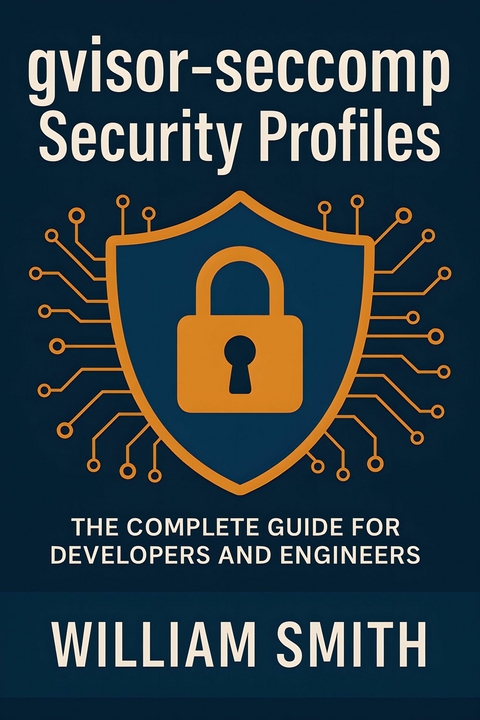
Gvisor-seccomp Security Profiles (eBook)
250 Seiten
HiTeX Press (Verlag)
978-0-00-097412-9 (ISBN)
'Gvisor-seccomp Security Profiles'
'Gvisor-seccomp Security Profiles' is an authoritative guide for practitioners, architects, and engineers seeking to master the intricate art of securing Linux containers using gVisor and seccomp policies. Beginning with the foundational elements of container and sandbox security, the book examines the theory and practice behind Linux namespaces, cgroups, and capabilities, then moves into the emergence of application-aware sandboxes and the technical underpinnings of gVisor's user-space kernel. Readers gain a thorough understanding of the system call attack surface, security boundary design in multi-tenant environments, and the layered roles of tools such as SELinux and AppArmor.
Delving into both the mechanics of seccomp in Linux and the distinct features of gVisor, the book offers detailed discussions of syscall filtering, policy grammar, performance implications, and the architectural philosophy driving gVisor's approach to isolation and compatibility. Each chapter is meticulously structured to cover practical aspects-such as authoring, deploying, and maintaining robust security profiles for dynamic workloads-while also addressing advanced engineering concerns, including policy chaining, contextual filtering, and seamless orchestration with complementary security modules. Real-world vulnerabilities, evasion techniques, threat modeling, and defensive architectures are contextualized with case studies, formal verification strategies, and incident response playbooks tailored for sandboxed environments.
Moving beyond technical implementation, 'Gvisor-seccomp Security Profiles' addresses the challenges of operationalizing and scaling security policy in production. Through guidance on automation, integration with CI/CD pipelines, observability, and multi-tenancy governance, it arms readers with actionable insights for policy management at enterprise and hyperscaler scale. The book concludes by surveying future trends and research in the field-such as kernel evolution, automated policy synthesis, hardware-assisted isolation, and community-driven benchmarks-making it a comprehensive and indispensable resource for anyone invested in the security of modern containerized workloads.
Chapter 2
Mechanics of Seccomp in Linux
The seccomp facility in Linux grants practitioners fine-grained control over what applications can ask of the kernel—making it the linchpin of modern container defense. But mastering seccomp means much more than toggling a handful of system calls: it requires a deep understanding of the kernel’s filtering machinery, performance tradeoffs, and real-world limitations. This chapter lifts the hood on seccomp, showing you how to craft precise sandboxes, optimize for both safety and speed, and avoid subtle but catastrophic misconfigurations.
2.1 Historical Evolution and Motivation of seccomp
The inception of seccomp (secure computing mode) traces back to the evolving demands of UNIX-like system security, particularly the necessity to mitigate kernel-level attack vectors by narrowing the scope of permissible system calls. Originally introduced by the Linux kernel in version 2.6.12, seccomp began as a minimalist yet effective security primitive focused on a strictly restrictive execution mode. This initial implementation, often referred to as “strict mode,” permitted processes to invoke only a very limited set of system calls: read(), write(), exit(), and sigreturn(). Any attempt to invoke system calls outside this predefined set resulted in the kernel immediately terminating the offending task.
The motivation for this starkly minimalistic design emerged from a recognition of the kernel’s exposure to user-space initiated system calls as a broad attack surface. System calls serve as the fundamental interface between user applications and kernel-space services; however, they also represent a critical security boundary. Kernel vulnerabilities exploitable through malicious or malformed system calls became apparent in the early 2000s, driving the need to limit such interactions for untrusted or semi-trusted code—especially in environments where explicit trust assumptions could not be guaranteed.
The UNIX security tradition provided a conceptual framework underpinning the origins of seccomp. Historically, UNIX-based operating systems emphasized discretionary access control and privilege separation achieved through user and group permissions. However, with the growing complexity of applications and the increasing deployment of untrusted third-party code, traditional security boundaries proved insufficient. The exploitation of system call interfaces to escalate privileges or execute arbitrary kernel code necessitated more granular and enforceable restrictions on syscall invocation.
One illustrative real-world exploit involved the use of heap-based buffer overruns combined with system call misuse to execute arbitrary kernel code with root privileges. In such attacks, an adversary would manipulate a process’s memory to overwrite function pointers or system call parameters, leading to unintended kernel behavior. This highlighted a dire need for runtime syscall filtering mechanisms that could prevent unexpected syscalls rather than relying solely on code correctness or static analyses.
Despite the effectiveness of strict mode in severely limiting the attack surface, its design was too inflexible for general-purpose use. The rigid whitelist of four system calls hindered legitimate application functionality, making seccomp unsuitable for most real-world applications that required more diverse kernel interactions. To address this limitation, significant evolution followed, culminating in the introduction of seccomp-BPF in Linux kernel version 3.5.
seccomp-BPF integrates Berkeley Packet Filter (BPF) technology to allow fine-grained, programmable syscall filtering within the kernel. Instead of a fixed, all-or-nothing approach, seccomp-BPF enables developers to install custom filters composed of BPF programs that inspect each syscall’s number, arguments, and metadata before permitting, denying, or otherwise handling the request. This advancement achieved a balance between strong security guarantees and operational flexibility—a critical feature for modern containerized and sandboxed environments where untrusted code must run efficiently but safely.
The containerization paradigm, popularized by technologies such as Docker and Kubernetes, provided significant impetus for the rapid adoption and enhancement of seccomp-BPF. Containers, designed to isolate applications and minimize overhead compared to virtual machines, nonetheless require robust defense mechanisms against privilege escalation and kernel exploitation. Given that containers share the host kernel, vulnerabilities in containerized processes or their management layers could compromise the entire system. By utilizing seccomp-BPF, container runtimes could enforce tailored syscall filters that adhere strictly to the expected behavior of containerized applications, thus mitigating the risk of compromise through syscall abuse.
Furthermore, seccomp’s evolution aligns with emerging threat models wherein zero-day kernel vulnerabilities and complicated attack chains exploit syscall interfaces to compromise integrity and data confidentiality. Notably, sandboxed web browsers and isolated execution environments leverage seccomp-BPF filters to constrain the system call surface exposed to potentially hostile web content and plugins. This reduces the risk of privilege escalation or data leakage stemming from exploitation of less secure libraries or JIT-compiled code.
Ultimately, the progression from strict mode to seccomp-BPF represents a paradigm shift in kernel security architecture. It has transitioned from a blunt instrument with impractical rigidity to an extensible and refined mechanism capable of enforcing bespoke security policies at runtime. This evolution reflects a broader trend within operating system design, embracing dynamic, context-sensitive enforcement of security policies rather than relying solely on static configurations or coarse-grained access controls.
#include <linux/filter.h>
#include <linux/audit.h>
#include <sys/prctl.h>
#include <sys/syscall.h>
#include <unistd.h>
int install_filter() {
struct sock_filter filter[] = {
/* Load syscall number into accumulator */
...
| Erscheint lt. Verlag | 24.7.2025 |
|---|---|
| Sprache | englisch |
| Themenwelt | Mathematik / Informatik ► Informatik ► Programmiersprachen / -werkzeuge |
| ISBN-10 | 0-00-097412-9 / 0000974129 |
| ISBN-13 | 978-0-00-097412-9 / 9780000974129 |
| Informationen gemäß Produktsicherheitsverordnung (GPSR) | |
| Haben Sie eine Frage zum Produkt? |
 EPUB (Adobe DRM)
Größe: 675 KB
Kopierschutz: Adobe-DRM
Adobe-DRM ist ein Kopierschutz, der das eBook vor Mißbrauch schützen soll. Dabei wird das eBook bereits beim Download auf Ihre persönliche Adobe-ID autorisiert. Lesen können Sie das eBook dann nur auf den Geräten, welche ebenfalls auf Ihre Adobe-ID registriert sind.
Details zum Adobe-DRM
Dateiformat: EPUB (Electronic Publication)
EPUB ist ein offener Standard für eBooks und eignet sich besonders zur Darstellung von Belletristik und Sachbüchern. Der Fließtext wird dynamisch an die Display- und Schriftgröße angepasst. Auch für mobile Lesegeräte ist EPUB daher gut geeignet.
Systemvoraussetzungen:
PC/Mac: Mit einem PC oder Mac können Sie dieses eBook lesen. Sie benötigen eine
eReader: Dieses eBook kann mit (fast) allen eBook-Readern gelesen werden. Mit dem amazon-Kindle ist es aber nicht kompatibel.
Smartphone/Tablet: Egal ob Apple oder Android, dieses eBook können Sie lesen. Sie benötigen eine
Geräteliste und zusätzliche Hinweise
Buying eBooks from abroad
For tax law reasons we can sell eBooks just within Germany and Switzerland. Regrettably we cannot fulfill eBook-orders from other countries.
aus dem Bereich


