


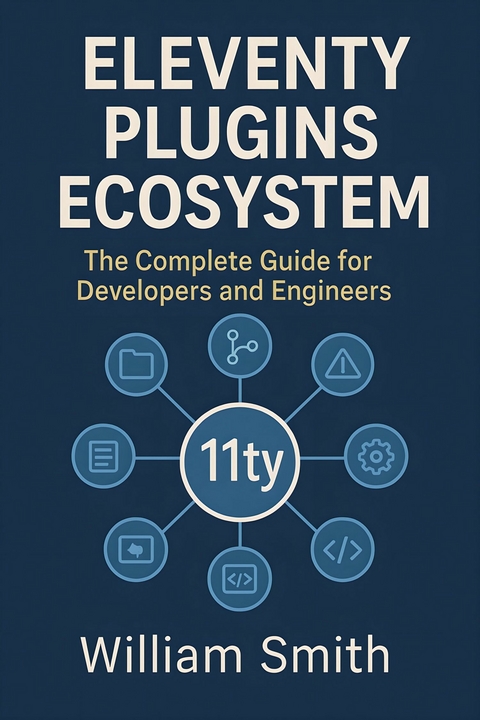
Eleventy Plugins Ecosystem (eBook)
250 Seiten
HiTeX Press (Verlag)
978-0-00-097411-2 (ISBN)
'Eleventy Plugins Ecosystem'
'Eleventy Plugins Ecosystem' is a comprehensive and authoritative guide to mastering plugin development within the Eleventy static site generator. This book meticulously breaks down Eleventy's core architecture, offering deep insights into its extensibility, plugin system, and lifecycle. Readers will gain a foundational understanding of how plugins interact with the Eleventy build pipeline, how to ensure secure interoperability, and how to harness advanced features like event handling and middleware integration for bespoke site workflows.
Moving beyond the fundamentals, the book equips developers to engineer sophisticated, production-ready plugins. It tackles advanced authoring patterns using modern JavaScript and TypeScript, robust testing and mocking methodologies, and integration with custom data sources or third-party services. Extensive coverage is provided for building plugins that extend content processing, asset management, automation, and syndication-empowering readers to address real-world challenges, such as image optimization, SEO automation, and dynamic content transformation through reusable solutions.
Boasting a dedicated focus on code quality, security, performance, and ecosystem best practices, 'Eleventy Plugins Ecosystem' also explores testing paradigms, continuous integration workflows, and strategies for plugin distribution and community sustainability. Real-world case studies, in-depth analyses of community-driven innovations, and forward-looking discussions make this work an invaluable resource-for both new and experienced developers-seeking to contribute to or lead in the vibrant Eleventy plugin ecosystem.
Chapter 2
Authoring Advanced Eleventy Plugins
Unlocking the full potential of Eleventy requires venturing beyond basic plugins and mastering patterns for building complex, maintainable, and scalable extensions. This chapter reveals the architectural techniques and engineering practices that distinguish advanced plugin development. Readers will discover how to architect production-grade plugins, orchestrate asynchronous data flows, leverage modern tooling, and engineer resilient solutions to challenging integration scenarios.
2.1 Boilerplate and Advanced Setup
Efficiently structuring plugin repositories necessitates applying rigorous discipline to maximize composability, testability, and reuse across evolving project requirements. This section elucidates advanced project layouts and infrastructure techniques, emphasizing TypeScript’s static typing benefits, monorepo architectures, modularization, and code-splitting strategies. It also addresses dependency management and collaboration models critical to maintaining large-scale plugin ecosystems.
Organizing Plugin Repositories for Composability and Reuse
A modular structure directs code organization around discrete, loosely coupled components or features. In TypeScript-based plugin development, this entails encapsulating functionality such that interfaces expose only well-defined APIs while implementation details remain private. A proven pattern is to segment repositories into:
- Core modules: Provide base abstractions and shared utilities.
- Feature plugins: Independently deliver domain-specific functionality.
- Adapters or bridges: Integrate core and plugin features with external systems or APIs.
This partitioning enables individual plugin modules to be developed, tested, and versioned autonomously, fostering maximal reuse. Each module maintains a canonical entry point, typically an index.ts file exporting public types and functions. Internal code utilizes descriptive folder structures mirroring domain boundaries, supporting intuitive navigation and maintainability.
Leveraging TypeScript for Robustness and Maintainability
TypeScript’s type system is foundational to managing complex plugin codebases. Explicit typing affords:
- Early error detection.
- Clear contractual APIs between modules.
- Enhanced IDE support, including autocompletion and refactoring safety.
Advanced usage involves defining strict tsconfig.json settings, such as noImplicitAny, strictNullChecks, and forceConsistentCasingInFileNames, to enforce consistency. Employing interfaces and abstract classes formalizes extensibility points and plugin contracts, while generics increase flexibility.
configure(config: TConfig): void;
execute(): Promise<TResult>;
}
This pattern enables authoring plugins that can operate over different data shapes without sacrificing type safety, supporting composability through well-defined extension points.
Monorepo Architectures for Large-Scale Development
Maintaining multiple closely related plugins typically benefits from a monorepo layout managed through tooling such as pnpm, Lerna, or Nx. A monorepo provides:
- Atomic commits spanning multiple modules.
- Simplified dependency version alignment.
- Coordinated build, test, and release processes.
A canonical monorepo directory layout:
/repo-root /packages /plugin-core /plugin-feature1 /plugin-feature2 /tools /configs package.json tsconfig.jsonEach package maintains its own package.json detailing dependencies, scripts, and versioning, while a top-level configuration orchestrates shared settings and dependency hoisting. Cross-package dependencies reference internal packages via workspace protocols, ensuring native TypeScript and Node module resolution compatibility.
Code-Splitting and Dynamic Loading
To optimize performance and scalability, especially in environments with constrained resources, applying code-splitting techniques is essential. This comprises breaking the plugin codebase into smaller chunks that the runtime loads on demand.
Modern bundlers such as Webpack or esbuild support dynamic import() syntax integrated with TypeScript:
const { FeaturePlugin } = await import(’./plugin-feature’);
const plugin = new FeaturePlugin();
await plugin.initialize();
return plugin;
}
This defers loading of optional features until explicitly needed, reducing initial load times and memory footprint. Coupled with lazy evaluation, this approach allows granular control over plugin activation and aggregation.
Dependency Management and Versioning Strategies
Sustainable plugin development mandates strict dependency management to avoid conflicts and promote predictable builds. Practices include:
- Semantic versioning: Clearly communicate backward-incompatible and feature changes.
- Peer dependencies: Designate runtime shared dependencies to minimize duplication.
- Lockfiles: Enforce deterministic installs via package-lock.json or equivalent.
- Automated dependency updates: Integrate tools like Dependabot to flag outdated or vulnerable packages.
Leveraging TypeScript project references further accelerates incremental builds by compiling only changed modules and their dependents, improving developer productivity in large repositories.
Testing and Continuous Integration
Testability scales naturally with modular design. Each plugin module contains:
- Unit tests targeting individual functions and classes with mocked dependencies.
- Integration tests validating interaction between modules.
- End-to-end tests verifying plugin behavior in real runtime contexts.
TypeScript test frameworks such as Jest or Mocha, combined with static analysis tools (ESLint, TypeScript compiler checks), promote high code quality. Continuous integration pipelines incorporate parallelized...
| Erscheint lt. Verlag | 24.7.2025 |
|---|---|
| Sprache | englisch |
| Themenwelt | Mathematik / Informatik ► Informatik ► Programmiersprachen / -werkzeuge |
| ISBN-10 | 0-00-097411-0 / 0000974110 |
| ISBN-13 | 978-0-00-097411-2 / 9780000974112 |
| Informationen gemäß Produktsicherheitsverordnung (GPSR) | |
| Haben Sie eine Frage zum Produkt? |
 EPUB (Adobe DRM)
Größe: 646 KB
Kopierschutz: Adobe-DRM
Adobe-DRM ist ein Kopierschutz, der das eBook vor Mißbrauch schützen soll. Dabei wird das eBook bereits beim Download auf Ihre persönliche Adobe-ID autorisiert. Lesen können Sie das eBook dann nur auf den Geräten, welche ebenfalls auf Ihre Adobe-ID registriert sind.
Details zum Adobe-DRM
Dateiformat: EPUB (Electronic Publication)
EPUB ist ein offener Standard für eBooks und eignet sich besonders zur Darstellung von Belletristik und Sachbüchern. Der Fließtext wird dynamisch an die Display- und Schriftgröße angepasst. Auch für mobile Lesegeräte ist EPUB daher gut geeignet.
Systemvoraussetzungen:
PC/Mac: Mit einem PC oder Mac können Sie dieses eBook lesen. Sie benötigen eine
eReader: Dieses eBook kann mit (fast) allen eBook-Readern gelesen werden. Mit dem amazon-Kindle ist es aber nicht kompatibel.
Smartphone/Tablet: Egal ob Apple oder Android, dieses eBook können Sie lesen. Sie benötigen eine
Geräteliste und zusätzliche Hinweise
Buying eBooks from abroad
For tax law reasons we can sell eBooks just within Germany and Switzerland. Regrettably we cannot fulfill eBook-orders from other countries.
aus dem Bereich


