


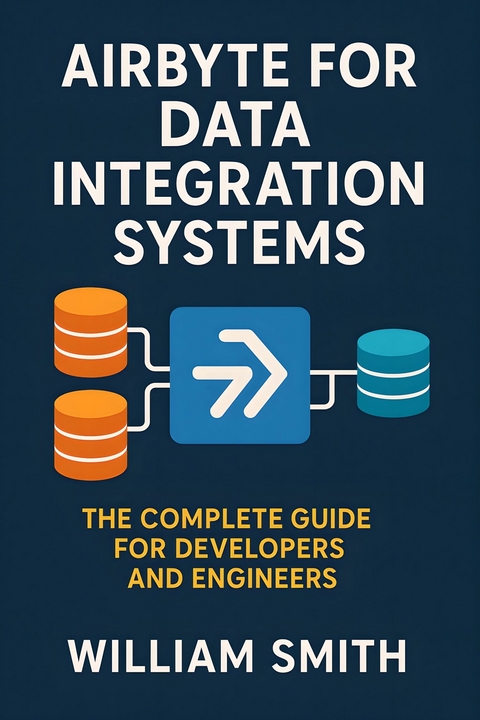
Airbyte for Data Integration Systems (eBook)
250 Seiten
HiTeX Press (Verlag)
978-0-00-097409-9 (ISBN)
'Airbyte for Data Integration Systems'
'Airbyte for Data Integration Systems' is a definitive guide to the architectural, operational, and developmental facets of modern data integration, with a special focus on the Airbyte platform. From the historical evolution of ETL/ELT to the transformative adoption of open-source frameworks, this book comprehensively surveys foundational patterns, current technical imperatives, and the dynamic landscape of integration solutions. Readers gain a thorough understanding of how Airbyte positions itself within the ecosystem, driving innovation, extensibility, and operational agility for complex, distributed environments.
Delving into the technical anatomy of Airbyte, the text presents an in-depth exploration of its modular stack, connector lifecycle, orchestration, scalability strategies, and security protocols. Through rich discussions of cloud, on-premises, and hybrid deployments, the book equips practitioners with actionable guidance for achieving high availability, performance optimization, and seamless integration with modern DevOps workflows. Dedicated chapters outline methodologies for custom connector development, from SDK tooling and API authentication to robust CI/CD, and community-driven practices for building a sustainable connector ecosystem.
Beyond technical best practices, 'Airbyte for Data Integration Systems' addresses advanced scalability, troubleshooting, and governance challenges central to enterprise data operations. With insights into orchestration frameworks, data quality, real-time synchronization, compliance mandates, and hands-on case studies from diverse sectors, the book empowers data engineers, architects, and platform owners to harness the full potential of Airbyte. Whether implementing resilient pipelines or shaping the future of open data standards, readers will find an essential reference for building secure, scalable, and future-ready data integration systems.
Chapter 1
Foundations of Data Integration
Data integration stands at the core of every intelligent, data-driven organization, evolving rapidly to match the complexity and real-time demands of modern architectures. This chapter unpacks the underlying principles, shifting paradigms, and operational realities that are redefining data integration. From the origins of ETL to the innovations fueling today’s open ecosystems, readers will discover why mastering these foundations is the gateway to unlocking scalable, future-proof data pipelines.
1.1 Historical Evolution of ETL and ELT
The landscape of data integration has undergone a profound transformation from the classical Extract-Transform-Load (ETL) paradigm to the increasingly prevalent Extract-Load-Transform (ELT) approach. Originally, ETL dominated enterprise data management, involving the extraction of data from disparate sources, the execution of complex transformations in dedicated middleware or batch processing environments, and subsequent loading into data warehouses optimized for analytics and reporting. This sequence reflects constraints prevalent during the rise of ETL in the late 20th century, where storage costs were substantial, compute resources centralized, and network bandwidth limited. Transformations were conducted prior to loading primarily to minimize storage requirements and reduce computational load on downstream systems.
With the advent of scalable, cost-effective data storage solutions, notably cloud-based object stores and columnar databases, the logic underpinning ETL began to shift. The economic landscape of storage no longer imposed the same limitations on raw data retention. Consequently, the ELT paradigm emerged, reversing the traditional order by first loading raw data into a centralized repository, often a cloud data platform, and deferring transformation until after ingestion. This progression leverages the elastic compute capabilities inherent in modern cloud architectures, allowing dynamic, on-demand processing closer to the data residence and supporting diverse transformation needs from a single source of truth.
Distributed architectures have been instrumental in this evolution. The maturation of massively parallel processing (MPP) databases and cloud-native data warehouses such as Amazon Redshift, Google BigQuery, and Snowflake introduced high concurrency and scalable compute power, enabling transformations to be executed efficiently within the storage layer. Traditional ETL systems, constrained by single-node or limited cluster compute models, struggled to cope with the increasing velocity and volume of data generated by contemporary enterprise applications, IoT devices, and social media streams. ELT frameworks exploit distributed processing to perform transformations as SQL queries or custom routines directly on raw ingested data, thus reducing data movement and latency.
Real-time synchronization requirements and the democratization of data have further challenged the ETL approach. Enterprises demand near-instantaneous data availability for operational analytics, machine learning pipelines, and real-time decision support systems. Batch-oriented ETL workflows, often scheduled during off-peak hours, cannot satisfy these latency constraints. Instead, ELT strategies combined with event-driven architectures and streaming technologies provide more granular and immediate data access. Additionally, the shift toward data democratization requires flexible transformation models that allow diverse users to access and manipulate data within governed self-service environments. ELT meets this need by storing comprehensive raw datasets and enabling multiple transformation perspectives without the need for repeated extraction procedures.
The growing API-centric ecosystem has also influenced this transformation. Modern microservices and SaaS platforms expose data through APIs, necessitating integration frameworks capable of handling semi-structured and nested data formats such as JSON or XML. Traditional ETL tools, optimized for relational and structured data sources, faced limitations in adapting to these nuanced data representations. Emerging open source frameworks and cloud-based integration tools now incorporate connectors and parsers designed explicitly for API ingestion, often integrating ELT patterns where raw data is loaded first and normalized or cleansed as needed.
Open source and cloud-driven frameworks responded to this new paradigm by emphasizing modularity, scalability, and extensibility. Frameworks such as Apache NiFi, Airbyte, and Meltano provide flexible pipelines that blend extraction and loading with configurable transformation steps, often exposing low-code interfaces to accelerate integration development and maintenance. Cloud platforms further abstract infrastructure management, enabling rapid deployment of ELT workflows while fostering collaboration across data engineering, data science, and business teams.
This historical progression from ETL to ELT reflects a broader technological and operational shift. It underscores how advances in storage economics, distributed computing, and cloud native capabilities have redefined data integration workflows. The rise of real-time analytics, user-centric data governance, and API-first application strategies fuels ongoing innovation in this domain. Understanding this evolution is crucial for designing contemporary data architectures that balance performance, scalability, and accessibility within complex, heterogeneous data ecosystems.
1.2 Core Architectural Patterns in Data Integration
Data integration architectures form the backbone for consolidating heterogeneous data sources into coherent, actionable information stores. At the core, three architectural patterns dominate the landscape: the hub-and-spoke model, microservices-oriented pipelines, and the emergent data mesh paradigm. Each pattern embodies distinct trade-offs in scalability, flexibility, data lineage, and governance, aligning with different organizational requirements and technological contexts.
The hub-and-spoke architecture centralizes integration logic within a dedicated hub, interfacing with various data source “spokes.” This design excels at enforcing uniform data definitions, transformations, and governance policies centrally. Data ingestion, cleansing, and consolidation occur in the hub, which then delivers curated datasets via well-defined services or data warehouses. The predictability and coherence of this approach simplify lineage tracking, as all transformations transit through a single locus. However, hub-and-spoke systems often face scalability constraints due to central processing bottlenecks. Scaling generally involves vertical enhancement of the hub infrastructure or complex partitioning strategies across the hub nodes. Flexibility is limited by the hub’s governance; adding new sources or altering transformation logic can incur latency and risk of systemic impact. This pattern is most effective in environments with moderately stable schema and strong requirements for data consistency and centralized control.
In contrast, microservices-oriented pipelines align more closely with distributed, loosely coupled system design principles. Here, discrete microservices own specific stages of the data integration workflow-extract, transform, load (ETL) tasks-and communicate asynchronously, often via event streams or message queues. Each microservice can be independently developed, deployed, and scaled, offering inherent flexibility to incorporate heterogeneous data sources and accommodate evolving business logic. This decomposition enables parallel processing pipelines that markedly enhance system throughput and resilience. Data lineage tracing, however, becomes more complex, requiring robust metadata management and tracing frameworks across services. Governance in microservices pipelines is typically decentralized, demanding governance-as-code practices and automated policy enforcement embedded within service contracts. Organizations attaining high agility and scalability often favor this approach, especially in cloud-native deployments where elastic resource allocation is essential.
The data mesh architecture represents an emergent paradigm that decentralizes data ownership, placing domain teams in charge of their own data products. It shifts integration responsibilities from centralized teams to cross-functional domains, embracing the “data as a product” philosophy. Each domain operates its own pipelines, exposes discoverable, self-describing, and interoperable data services, and maintains stewardship over data quality, compliance, and lineage. The data mesh pattern leverages federated governance, where a central platform team provisions tooling and standards but domains retain autonomy over implementation. This pattern inherently supports massive scalability by parallelizing integration efforts and minimizing centralized bottlenecks. Flexibility dramatically increases as domains innovate on their pipelines independently; however, it introduces governance complexity and requires sophisticated cataloging and mesh-wide observability frameworks to maintain data discoverability and trustworthiness. Data meshes are particularly suitable in large enterprises with diverse data ...
| Erscheint lt. Verlag | 24.7.2025 |
|---|---|
| Sprache | englisch |
| Themenwelt | Mathematik / Informatik ► Informatik ► Programmiersprachen / -werkzeuge |
| ISBN-10 | 0-00-097409-9 / 0000974099 |
| ISBN-13 | 978-0-00-097409-9 / 9780000974099 |
| Informationen gemäß Produktsicherheitsverordnung (GPSR) | |
| Haben Sie eine Frage zum Produkt? |
 EPUB (Adobe DRM)
Größe: 616 KB
Kopierschutz: Adobe-DRM
Adobe-DRM ist ein Kopierschutz, der das eBook vor Mißbrauch schützen soll. Dabei wird das eBook bereits beim Download auf Ihre persönliche Adobe-ID autorisiert. Lesen können Sie das eBook dann nur auf den Geräten, welche ebenfalls auf Ihre Adobe-ID registriert sind.
Details zum Adobe-DRM
Dateiformat: EPUB (Electronic Publication)
EPUB ist ein offener Standard für eBooks und eignet sich besonders zur Darstellung von Belletristik und Sachbüchern. Der Fließtext wird dynamisch an die Display- und Schriftgröße angepasst. Auch für mobile Lesegeräte ist EPUB daher gut geeignet.
Systemvoraussetzungen:
PC/Mac: Mit einem PC oder Mac können Sie dieses eBook lesen. Sie benötigen eine
eReader: Dieses eBook kann mit (fast) allen eBook-Readern gelesen werden. Mit dem amazon-Kindle ist es aber nicht kompatibel.
Smartphone/Tablet: Egal ob Apple oder Android, dieses eBook können Sie lesen. Sie benötigen eine
Geräteliste und zusätzliche Hinweise
Buying eBooks from abroad
For tax law reasons we can sell eBooks just within Germany and Switzerland. Regrettably we cannot fulfill eBook-orders from other countries.
aus dem Bereich


