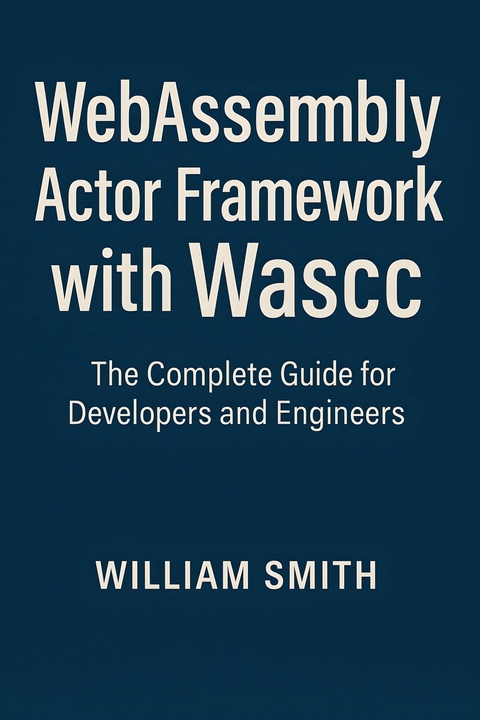
WebAssembly Actor Framework with Wascc (eBook)
250 Seiten
HiTeX Press (Verlag)
978-0-00-097408-2 (ISBN)
'WebAssembly Actor Framework with Wascc'
'WebAssembly Actor Framework with Wascc' is a comprehensive guide exploring the convergence of WebAssembly's lightweight, efficient execution model with the powerful actor paradigm for building modular, secure, and distributed systems. Starting with the fundamental architecture of WebAssembly and the principles behind the actor model, this book presents a clear context for why combining these two technologies unleashes new possibilities in concurrent, isolated, and fault-tolerant software design. Readers are led through the design goals, origins, and operational intricacies of both WebAssembly and actors, examining how this union addresses modern challenges around scalability, state management, and distributed computation.
Central to the book is an in-depth treatment of the wascc framework, covering its architecture, security model, and the capability-driven ecosystem that enables seamless integration with external resources. Readers learn by example how to author robust actor modules in Rust, manage their lifecycle, implement secure contracts, and leverage provider capabilities for secure, extensible functionality. Dedicated chapters demystify the process of building both actors and providers, detail practical patterns for reliable communication and supervision, and include advanced topics such as asynchronous execution, fault tolerance, and event sourcing for production-grade deployments.
Beyond core development, the book offers practical insights into deploying, scaling, and operating actor-based systems with wascc in the cloud, at the edge, and across heterogeneous environments. It addresses comprehensive security controls, compliance, identity, and audit requirements, while also exploring integrations with service meshes, FaaS, IoT, and legacy systems. The concluding section highlights future research, upcoming features, and community-driven innovation, making 'WebAssembly Actor Framework with Wascc' an indispensable reference for architects, developers, and engineers looking to build resilient, next-generation distributed applications using the latest in WebAssembly technology.
Chapter 2
Wascc Architecture and Core Concepts
Explore the architectural breakthroughs behind wascc—a WebAssembly-native actor framework engineered for cloud, edge, and distributed infrastructure. This chapter peels back the layers of wascc’s internal design, exposing the innovative abstractions, security mechanisms, and extensibility models that enable seamless modularity, capability-based permissions, and dynamic, federated deployments. Here, you will uncover what makes wascc not just a runtime, but a powerful foundation for building resilient, portable, and secure microservices ecosystems.
2.1 Wascc Overview and Principles
The WebAssembly Cloud Computing Consortium (wascc) framework is architected around a set of advanced design principles that enable effective decoupling of business logic from underlying platform dependencies, facilitate stringent security through sandboxing, and promote extensibility via modular, capability-oriented abstractions. These principles collectively enhance both operational security and developer agility, accommodating highly heterogeneous runtime environments with minimal friction.
At its core, wascc embraces a decoupled architecture that separates application business logic from the particularities of host platforms and infrastructure. Unlike traditional monolithic service deployments tightly coupled to their execution environments, wascc leverages WebAssembly (Wasm) modules to encapsulate logic in a platform-agnostic manner. This abstraction layer enables consistent execution of workloads across cloud, edge, and on-premises environments without modification. Wasm modules are designed to be immutable, sandboxed units of computation that define explicit interfaces via capability contracts, ensuring a clean separation between application concerns and system-specific implementations.
Sandboxing forms a foundational pillar in this architecture by significantly reducing the attack surface exposed to untrusted code. The Wasm runtime invoked by wascc implements strict memory isolation and controls host interaction through explicit capability interfaces. Each capability-a well-defined set of permissions granting access to system resources such as file I/O, networking, or cryptographic operations-is explicitly bound to a module, thereby minimizing privileges according to the principle of least privilege. By constraining module capabilities, wascc prevents unauthorized access, mitigates privilege escalation risks, and ensures that faults or breaches in one module do not propagate to the broader runtime system or other modules. This granular sandboxing model is a profound enhancement over inherent operating system sandboxing by providing application-level security boundaries tailored to the dynamic needs of modern cloud-native workflows.
The third defining principle of wascc is its modular and capability-oriented design, which facilitates extensibility and composability. The architecture envisions capabilities as pluggable modules that implement specific resource bindings, allowing developers and platform providers to extend the environment with new functionalities without affecting existing components. Wascc modules define their dependencies in terms of required capabilities, and the runtime dynamically resolves these at load time, enabling seamless integration of diverse functionalities, such as database connectors, messaging protocols, or domain-specific SDKs. This pattern decouples the implementation of business logic from resource access policies, promoting reusable, testable components and enabling straightforward upgrades or replacements of capabilities without modifying core application code.
Operationally, these principles translate into multiple concrete benefits. From a security perspective, minimizing the attack surface through explicit capability grants reduces the risk landscape, allowing rigorous auditing and policy enforcement mechanisms to be applied at module boundaries. The small trusted computing base of the WebAssembly runtime further strengthens security assurances by limiting the scope of necessary code review and vulnerability mitigation efforts. From a developer productivity standpoint, the portability and uniformity across deployments enable seamless migration and scaling, while the modular capability interface encourages clean, composable codebases. The deterministic nature of Wasm execution ensures reproducible behavior in diverse environments, facilitating debugging and continuous integration workflows.
Supporting heterogeneous environments-ranging from cloud data centers to constrained edge devices-requires adaptability in security and capability management. Wascc’s architecture naturally accommodates this by allowing platform operators to tailor capability sets for specific deployments, reflecting the operational context’s security policies and resource availability. For instance, an edge device may only provide networking and logging capabilities, while a cloud environment could offer a richer suite including storage, messaging, and cryptographic services. This adaptability, coupled with the inherent isolation and portability, makes wascc an ideal abstraction layer for distributed systems that must enforce strict security and policy controls while maintaining high developer velocity.
In summary, the wascc architectural philosophy advances the state of cloud-native application development by formalizing the segregation of concerns through decoupling, embedding robust security at the sandbox level via minimal privilege capabilities, and enabling extensibility through a modular, capability-oriented design. These principles collectively deliver a framework that harmonizes secure, high-performance execution with the agility demanded by modern heterogeneous and distributed computing infrastructures.
2.2 Actors, Capabilities, and Providers
The WebAssembly Cloud Computing (wascc) framework is founded on three pivotal abstractions: actors, capabilities, and providers. Together, these components establish a secure, modular, and extensible environment for deploying and managing cloud-native applications. Understanding their interplay is critical to comprehending the architecture’s intrinsic security and operational model.
An actor is fundamentally an isolated, signed WebAssembly (Wasm) module encapsulating a discrete unit of computation or service. Each actor adheres to a rigorously defined contract, specifying interfaces for invocation and interaction. This contract-based design enforces boundaries around the actor, whereby it executes within a sandboxed context devoid of implicit access to host system resources. The signature binding an actor serves as a guarantee of authenticity and integrity, ensuring the module remains untampered and verifiable prior to deployment.
Actors rely exclusively on explicit permissions to interact with external functionalities. This concept aligns with the capability-based security model, where access rights are expressed as unforgeable tokens called capabilities. Unlike traditional access control lists (ACLs) or role-based access control (RBAC), capability systems grant fine-grained, delegated authority directly to software components, minimizing privileges and attack surfaces. In wascc, actors express their required capabilities declaratively during deployment or initialization, specifying the minimum set of external interfaces necessary for their operation.
The capability providers are modular, pluggable components responsible for exposing host system features to actors through well-defined service interfaces. Providers abstract operating system functionalities such as file storage, networking, cryptography, and messaging into standardized WebAssembly interfaces. Each provider implements a suite of operations that actors may invoke, maintaining internal enforcement mechanisms to restrict execution to the privileges explicitly granted. For example, a key-value store provider exposes interfaces for data retrieval and storage, but an actor must hold the corresponding capability token to perform these operations.
The interaction between actors and capability providers is mediated by the runtime environment, which performs strict validation and enforcement of permissions at invocation time. When an actor issues a call to a provider interface, the runtime validates the actor’s capability tokens to confirm authorization. Requests lacking valid capabilities are rejected immediately, thereby preventing unauthorized access to sensitive resources. This dynamic checking mechanism upholds the principle of least privilege at runtime, ensuring that actors can only exercise the exact rights they request and are provisioned with.
This design naturally enables least-privilege architecture, a cornerstone of secure distributed systems. By isolating actors and modularizing capabilities, wascc eliminates the risk of lateral privilege escalation within the host environment. Each actor’s scope of influence is tightly controlled: it cannot exceed beyond the explicitly granted permissions, no matter the potential vulnerabilities within the module. In contrast to monolithic executables, this compartmentalization reduces the blast radius in...
| Erscheint lt. Verlag | 24.7.2025 |
|---|---|
| Sprache | englisch |
| Themenwelt | Mathematik / Informatik ► Informatik ► Programmiersprachen / -werkzeuge |
| ISBN-10 | 0-00-097408-0 / 0000974080 |
| ISBN-13 | 978-0-00-097408-2 / 9780000974082 |
| Informationen gemäß Produktsicherheitsverordnung (GPSR) | |
| Haben Sie eine Frage zum Produkt? |
 EPUB (Adobe DRM)
Größe: 746 KB
Kopierschutz: Adobe-DRM
Adobe-DRM ist ein Kopierschutz, der das eBook vor Mißbrauch schützen soll. Dabei wird das eBook bereits beim Download auf Ihre persönliche Adobe-ID autorisiert. Lesen können Sie das eBook dann nur auf den Geräten, welche ebenfalls auf Ihre Adobe-ID registriert sind.
Details zum Adobe-DRM
Dateiformat: EPUB (Electronic Publication)
EPUB ist ein offener Standard für eBooks und eignet sich besonders zur Darstellung von Belletristik und Sachbüchern. Der Fließtext wird dynamisch an die Display- und Schriftgröße angepasst. Auch für mobile Lesegeräte ist EPUB daher gut geeignet.
Systemvoraussetzungen:
PC/Mac: Mit einem PC oder Mac können Sie dieses eBook lesen. Sie benötigen eine
eReader: Dieses eBook kann mit (fast) allen eBook-Readern gelesen werden. Mit dem amazon-Kindle ist es aber nicht kompatibel.
Smartphone/Tablet: Egal ob Apple oder Android, dieses eBook können Sie lesen. Sie benötigen eine
Geräteliste und zusätzliche Hinweise
Buying eBooks from abroad
For tax law reasons we can sell eBooks just within Germany and Switzerland. Regrettably we cannot fulfill eBook-orders from other countries.
aus dem Bereich