


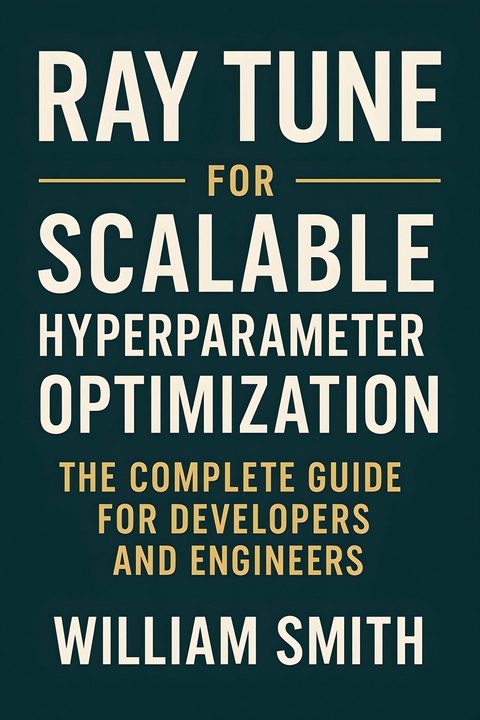
Ray Tune for Scalable Hyperparameter Optimization (eBook)
250 Seiten
HiTeX Press (Verlag)
978-0-00-097405-1 (ISBN)
'Ray Tune for Scalable Hyperparameter Optimization'
'Ray Tune for Scalable Hyperparameter Optimization' provides a comprehensive guide to mastering the complexities of hyperparameter tuning in modern machine learning workflows. The book begins by establishing a rigorous foundation in large-scale hyperparameter optimization, delving into both the mathematical essentials and the real-world demands for scalability and efficiency. Readers gain a nuanced understanding of search space explosion, resource management, and the advanced metrics crucial for evaluating and driving effective and efficient optimization at scale.
The book then gives an authoritative treatment of Ray Tune's architecture and API, offering both conceptual overviews and hands-on best practices. It details design abstractions, experiment lifecycles, robust checkpointing, fault tolerance, and plugin interfaces, empowering practitioners to extend and adapt Ray Tune to fit unique research or industry needs. Through in-depth discussions of parameter space definitions, customized scheduling algorithms, sampling strategies, and advanced resource scheduling, the text illustrates how professionals can unlock sophisticated, distributed hyperparameter search pipelines on local clusters, cloud platforms, and Kubernetes.
Culminating in practical applications, the book addresses large-scale deep learning, AutoML, and reproducibility, while also tackling operational concerns such as cluster security, monitoring, and cost optimization. Readers are guided through diagnostics, visualization, and experiment analysis, as well as advanced topics like federated tuning and neural architecture search. By combining real-world case studies, emergent best practices, and future research avenues, this book is an essential resource for data scientists, ML engineers, and researchers seeking to accelerate and industrialize their hyperparameter optimization efforts with Ray Tune.
Chapter 2
Ray Tune Fundamentals: Architecture and APIs
Behind every state-of-the-art hyperparameter search lies robust orchestration, elegant abstractions, and fault-tolerant design. This chapter demystifies the core architecture and APIs of Ray Tune, revealing how its distributed engine, flexible configuration model, and composable interfaces empower advanced practitioners to orchestrate sophisticated experiments seamlessly. Dive into the engine room of Ray Tune—you’ll discover how thoughtfully engineered software enables reproducibility, extensibility, and resilience at scale.
2.1 Ray Core: Concepts and Cluster Management
Ray’s distributed execution paradigm is founded upon three principal abstractions: remote functions, tasks, and actors. These constructs collectively enable the framework to express a wide spectrum of parallel and distributed computations with minimal developer overhead.
A remote function in Ray is a Python function annotated with the @ray.remote decorator. Invoking such a function does not execute it immediately but instead returns a future-like object called an ObjectRef, which represents the eventual result of the computation. The function invocation is scheduled asynchronously to execute on available worker nodes within the cluster. This model decouples function invocation from execution, providing a natural concurrency mechanism.
Tasks in Ray are the units of work represented by these remote function calls. Each task is scheduled to execute independently on cluster resources, facilitating massive scale-out. Ray’s task scheduler orchestrates the distribution of tasks by considering data locality, resource requirements, and current cluster load, thereby optimizing for throughput and latency.
Actors extend this model by enabling stateful computation. An actor is an instance of a user-defined class, where methods can be invoked remotely. The state within an actor persists across method calls, enabling the encapsulation of mutable state and complex coordination patterns among distributed components. Ray ensures serialized access to actor methods on a single replica, preserving consistency while allowing concurrency at the actor ensemble level.
Central to Ray’s power is its management of Ray clusters, which comprise a dynamically scalable set of nodes orchestrated by Ray’s control plane. A Ray cluster can be instantiated locally (e.g., on a single machine with multiple CPUs and GPUs) or across heterogeneous infrastructure environments, including clouds, on-premises hardware, and edge deployments. This flexibility facilitates seamless scaling of workloads from development to production.
The cluster management architecture includes several core components: the Raylet scheduler running on each worker node, the GCS (Global Control Store), and the Ray Dashboard for observability. The GCS acts as a consistent metadata store tracking cluster state, resource availability, object location, and task lineage. Each Raylet operates autonomously to schedule local tasks, coordinate with the GCS for cluster-wide decisions, and manage resource allocation such as CPU cores, GPUs, and custom resource labels.
Scaling within Ray clusters is achieved through automated node provisioning and resource-aware scheduling. When workload demand rises, Ray’s Cluster Autoscaler integrates with cloud APIs or infrastructure-specific interfaces to add or remove nodes dynamically. This elasticity permits efficient utilization while maintaining low-latency execution. The scheduler leverages fine-grained resource specifications on tasks and actors, enabling heterogeneous workloads-such as CPU-bound training interleaved with GPU-intensive tuning-to coexist and progress without interference.
Ray’s communication fabric relies on a lightweight RPC layer and an in-memory distributed object store called Plasma. Tasks exchange data through the object store, which supports zero-copy reads and asynchronous transfers. This design minimizes serialization overhead and maximizes throughput. Combined with lineage-based fault tolerance, where tasks can be replayed upon failure, Ray ensures resiliency and consistency without centralized bottlenecks.
These operational principles underpin the exceptional performance characteristics of Ray. The system sustains high-throughput execution by parallelizing thousands of tasks and actors concurrently across distributed nodes, while preserving low latency through asynchronous scheduling and object-sharing optimizations. Consequently, Ray forms a robust backbone for advanced workloads such as hyperparameter tuning via Ray Tune, reinforcement learning training, and real-time model serving.
The design choice to decouple execution semantics from physical resource management allows Ray to transparently adapt to various deployment topologies without rewriting application logic. Developers express computation imperatively in Python, leveraging familiar paradigms, while Ray performs sophisticated orchestration, resource scheduling, and failure recovery. This abstraction facilitates rapid experimentation and iterative development at unprecedented scale.
Ray’s core abstractions of remote functions, tasks, and actors, combined with its dynamic cluster management and efficient distributed runtime, create a versatile and scalable foundation that supports the high-throughput, low-latency requirements of modern machine learning workloads and extends gracefully across heterogeneous computing environments.
2.2 Ray Tune Design and Abstractions
Ray Tune structures hyperparameter tuning workflows through a set of core abstractions: trials, experiments, search algorithms, and schedulers. These building blocks provide modularity, extensibility, and scalable resource management in distributed environments, enabling users-from novices to experts-to efficiently explore complex optimization landscapes.
- Trials: A trial represents a single execution of an objective function evaluated at a specific configuration of hyperparameters. It encapsulates the lifecycle of training a model or evaluating a specified workload, tracking metadata such as hyperparameter values, intermediate metrics (e.g., loss or accuracy), and final results. Trials are the atomic units within Ray Tune: their isolation and statefulness allow concurrent execution, checkpointing, and early stopping. This isolation simplifies fault tolerance, as failed trials can be restarted without affecting others.
- Experiments: An experiment is a logical grouping of trials sharing a tuning goal and potentially differing only in hyperparameter assignments. It defines the search space, trial configuration, and the rules guiding trial execution. Experiments orchestrate the entire tuning lifecycle, scheduling trials dynamically based on feedback-driven decisions. By interpreting experiments as higher-level constructs encompassing many trials, Ray Tune enables users to systematically manage large-scale evaluations across distributed compute resources.
- Search Algorithms: Search algorithms form the adaptive backbone selecting hyperparameter configurations for trials. Ray Tune includes an extensible interface to implement various strategies such as random search, grid search, Bayesian optimization, evolutionary algorithms, and population-based training. Each search algorithm implements methods for suggesting new configurations based on observations from completed or partially completed trials. This modular separation distinctly decouples trial execution from hyperparameter exploration, allowing advanced users to plug in bespoke search strategies or combine multiple algorithms hierarchically.
- Schedulers: Schedulers govern intra-trial resource allocation and early stopping decisions. By monitoring intermediate metrics during trial execution, schedulers dynamically pause, resume, or terminate trials to allocate computational resources more efficiently. Algorithms such as Successive Halving, HyperBand, and Median Stopping Rule are readily integrated as schedulers that prioritize promising configurations while culling underperforming ones. This design supports multiple concurrent scheduling policies, making Ray Tune flexible for a broad range of optimization scenarios.
- Facilitating Modular Experiment Definition: The clear delineation between trials, experiments, search algorithms, and schedulers creates a modular API that fosters composability and extensibility. Users define an experiment via a declarative specification of the search space and resource requirements, and attach search algorithms and schedulers that implement specific tuning logics. Internally, Ray Tune manages the instantiation and coordination of trials according to these components, abstracting complexity while exposing comprehensive control points.
- Dynamic Resource Management: Ray Tune leverages Ray’s distributed execution and dynamic task...
| Erscheint lt. Verlag | 24.7.2025 |
|---|---|
| Sprache | englisch |
| Themenwelt | Mathematik / Informatik ► Informatik ► Programmiersprachen / -werkzeuge |
| ISBN-10 | 0-00-097405-6 / 0000974056 |
| ISBN-13 | 978-0-00-097405-1 / 9780000974051 |
| Informationen gemäß Produktsicherheitsverordnung (GPSR) | |
| Haben Sie eine Frage zum Produkt? |
 EPUB (Adobe DRM)
Größe: 922 KB
Kopierschutz: Adobe-DRM
Adobe-DRM ist ein Kopierschutz, der das eBook vor Mißbrauch schützen soll. Dabei wird das eBook bereits beim Download auf Ihre persönliche Adobe-ID autorisiert. Lesen können Sie das eBook dann nur auf den Geräten, welche ebenfalls auf Ihre Adobe-ID registriert sind.
Details zum Adobe-DRM
Dateiformat: EPUB (Electronic Publication)
EPUB ist ein offener Standard für eBooks und eignet sich besonders zur Darstellung von Belletristik und Sachbüchern. Der Fließtext wird dynamisch an die Display- und Schriftgröße angepasst. Auch für mobile Lesegeräte ist EPUB daher gut geeignet.
Systemvoraussetzungen:
PC/Mac: Mit einem PC oder Mac können Sie dieses eBook lesen. Sie benötigen eine
eReader: Dieses eBook kann mit (fast) allen eBook-Readern gelesen werden. Mit dem amazon-Kindle ist es aber nicht kompatibel.
Smartphone/Tablet: Egal ob Apple oder Android, dieses eBook können Sie lesen. Sie benötigen eine
Geräteliste und zusätzliche Hinweise
Buying eBooks from abroad
For tax law reasons we can sell eBooks just within Germany and Switzerland. Regrettably we cannot fulfill eBook-orders from other countries.
aus dem Bereich


