


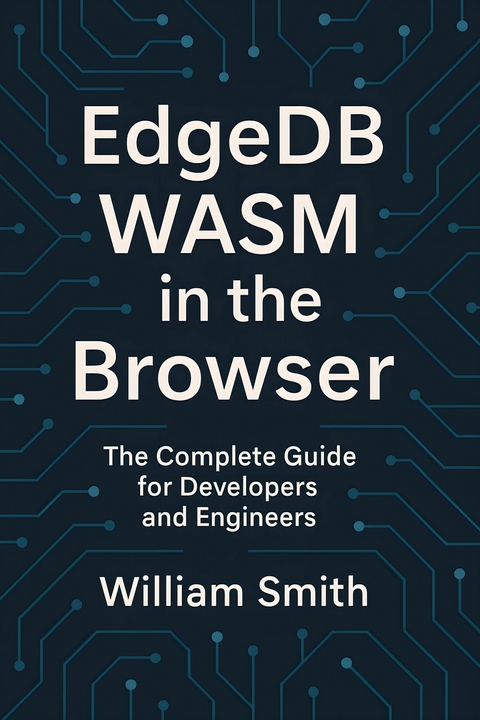
EdgeDB WASM in the Browser (eBook)
250 Seiten
HiTeX Press (Verlag)
978-0-00-097404-4 (ISBN)
'EdgeDB WASM in the Browser'
'EdgeDB WASM in the Browser' presents a comprehensive exploration of deploying EdgeDB-a cutting-edge, graph-relational database-as a WebAssembly (WASM) module for seamless execution within browser environments. The book systematically examines the architectural foundations of both EdgeDB and WebAssembly, providing readers with a robust understanding of browser-centric database dynamics, resource constraints, and security boundaries. Detailed comparisons with traditional client-side databases and in-depth threat modeling establish the context for why EdgeDB's new browser-based approach is both timely and transformative.
Diving into the practicalities, the book guides professionals through every step of compiling EdgeDB to WASM, from analyzing the database's internals and adapting dependencies to optimizing build processes and enforcing world-class security. It skillfully navigates the module's lifecycle in the browser, covering persistent storage integration, error recovery, versioning, and resource management. Readers also benefit from authoritative treatment of query processing, schema evolution, and transactional guarantees-all tailored for browser execution-alongside advanced instrumentation and optimization techniques.
Beyond core implementation, the text distinguishes itself with thorough coverage of frontend integration, synchronization protocols, data privacy, and regulatory compliance. From interfacing EdgeDB WASM with JavaScript frameworks to architecting robust offline-first applications, real-time updates, and end-to-end encryption, each chapter equips developers and architects with actionable patterns. Finally, the book explores testing, debugging, and performance engineering best practices, concluding with emerging trends, tooling, and open research-making it an indispensable guide for anyone pioneering data-rich web experiences at the intersection of databases and WebAssembly.
Chapter 2
Compiling EdgeDB to WebAssembly
Unlocking the full power of EdgeDB inside the browser means surmounting significant technical challenges in cross-compilation and runtime adaptation. This chapter leads the reader on a hands-on journey through the process of transforming a sophisticated database engine for seamless, secure execution in a web-native environment. Along the way, you’ll gain advanced insight into toolchains, dependency wrangling, build optimizations, and the intricate security measures essential for a robust EdgeDB WASM deployment.
2.1 Analysis of EdgeDB’s Source Architecture
EdgeDB’s source architecture presents a sophisticated, modular design aimed at balancing extensibility, performance, and maintainability within a networked database context. Understanding the internal structure through the lens of WebAssembly (WASM) compatibility involves dissecting the codebase organization, demarcating subsystem boundaries, and pinpointing components that would necessitate adaptation or refactoring for efficient browser execution.
The codebase is primarily written in Python and C, with critical computational kernels implemented in Rust. This multi-language ecosystem leverages Python’s expressiveness for orchestration, C’s interfacing capabilities, and Rust’s memory safety and concurrency advantages. From a WASM perspective, the Rust components are the most immediately portable due to mature toolchains such as wasm-bindgen and wasm-pack that facilitate compilation into WASM binaries. However, the Python and C layers pose significant challenges for direct browser deployment without substantial adaptation.
Structurally, EdgeDB is segmented into several cohesive subsystems: the query compiler, schema management, protocol handling, storage engine interface, and the runtime environment.
- The query compiler subsystem consumes EdgeQL, the custom declarative query language, translating it into an intermediate representation which is eventually transformed into low-level operations runnable by the storage engine. This compiler module is heavily reliant on abstract syntax tree (AST) analysis, recursive visitation patterns, and involves sophisticated type inference mechanisms. The compiler’s core data structures and algorithms are implemented predominantly in Rust, which is favorable for WASM compilation, albeit exposing a complex dependency graph.
- The schema management subsystem maintains metadata consistency and validation concerning database schema, types, constraints, and migrations. This subsystem is tightly intertwined with the query compiler, frequently sharing in-memory data models and persistent schema snapshots. While primarily implemented in Python, some performance-critical segments are parallelized or offloaded to Rust extensions. Achieving WASM compatibility necessitates disentangling the Python runtime dependencies and porting immutable state synchronization primitives to a compatible Rust/WASM layer or re-implementing them as pure Rust modules that can be compiled to WASM.
- Protocol handling involves client-server communication adhering to a custom-designed binary protocol over TCP. The protocol stack deals with message framing, authentication negotiation, and query/result streaming. This component’s design incorporates blocking I/O operations native to POSIX environments, which conflicts with the asynchronous, event-driven nature of browser environments where WASM operates. Transforming this subsystem demands re-engineering the protocol layer to utilize asynchronous APIs available in browser runtimes, typically via JavaScript event loops or WASI abstractions supported in WASM environments like asyncify.
- The storage engine interface abstracts interactions with the underlying persistent storage, currently leveraging PostgreSQL. This layer utilizes native PostgreSQL client libraries implemented in C, with Python wrappers to enable query execution and transaction management. Direct WASM compilation of C-based PostgreSQL clients is currently impractical due to system call dependencies and access to native sockets/filesystems unavailable in browsers. Replacing this subsystem would require refactoring toward a storage backend that exposes a secure API over HTTP or WebSockets, thereby decoupling the database engine from direct storage access and enabling stateless WASM modules to interact with remote services.
- The runtime environment within EdgeDB encompasses task scheduling, concurrency primitives, and resource management. Rust’s asynchronous programming model is exploited here using async/await constructs alongside runtime executors. WASM’s limitations in threading and system-level resource control demand refactoring the runtime to rely on single-threaded, event-driven execution patterns. Recent improvements in WASM threads support may alleviate some constraints, but careful redesign is essential for reliable browser compatibility.
Several architectural patterns in EdgeDB facilitate or complicate the compilation to WASM. A prominent facilitative design choice is the heavy use of Rust’s ownership and type systems, which align closely with WASM’s low-level memory model and sandboxing requirements. The clean separation of core computational logic into Rust crates, with clearly defined interfaces, enables incremental porting by isolating dependency boundaries. Conversely, the deep integration with Python for orchestration and dynamic features such as runtime reflection or dynamic code generation impedes direct porting. These Python elements introduce runtime overheads incompatible with WASM’s static binary model and necessitate reimplementation or runtime environment emulation, which is non-trivial in resource-constrained browsers.
Furthermore, dependencies on operating system abstractions like file system access, networking stacks, and native threads represent significant impediments. Though polyfills and WASI (WebAssembly System Interface) are emerging to address these gaps, EdgeDB’s current reliance on blocking I/O and filesystem semantics obligates a fundamental rethink of execution flow and state management to adhere to WASM’s sandboxed model.
The internal architecture of EdgeDB is characterized by a modular and layered design which both aids and challenges WASM adaptation. The Rust-based computational core offers a direct compilation pathway, conditional on disentangling from Python and C dependencies tied to native system services. Subsystems responsible for networking and persistent storage require redesign toward asynchronous, web-friendly paradigms and remote API abstractions. EdgeDB’s use of strong typing and memory-safe languages aligns well with WASM’s constraints, but the bridging of dynamic runtime features and system-level integration remains the pivotal complexity in achieving an effective in-browser runtime solution.
2.2 Selecting a Toolchain: Emscripten, WASI, and Alternatives
WebAssembly (WASM) toolchains and system interfaces have rapidly evolved to meet a broad spectrum of application demands, from client-side web applications to backend database engines like EdgeDB. Selecting an appropriate toolchain is critical to balancing performance, portability, and integration complexity. This section evaluates prominent WASM toolchains and system interfaces, including Emscripten, the WebAssembly System Interface (WASI), and emerging alternatives, with a focus on their suitability for EdgeDB’s architecture and operational requirements.
Emscripten stands as the most mature and widely adopted toolchain for compiling C/C++ to WASM. It provides a comprehensive runtime environment that emulates many POSIX-like system calls, including file I/O, threading (via Web Workers), and networking (using WebSockets and other browser-compatible protocols). Emscripten’s compatibility with existing C/C++ codebases is one of its strongest merits, facilitating rapid porting of complex native software. However, this extensive abstraction layer introduces overhead that can conflict with EdgeDB’s need for low-latency, high-throughput execution. Furthermore, the reliance on a relatively heavy runtime glue code and JavaScript shims can inflate the binary size and complicate deployment outside traditional browser or Node.js environments.
In contrast, WASI, standardized by the Bytecode Alliance, offers a minimalist, system-agnostic interface designed explicitly for WASM modules executing in sandboxed, non-browser environments. WASI exposes a modular set of system calls, such as file descriptors, clocks, random number generation, and environment variables, carefully designed to preserve platform neutrality and security. For EdgeDB, which targets server environments needing efficient syscalls and strong isolation, WASI’s clean, lightweight syscall interface is attractive. Its modularity supports incremental adoption and the potential for future extensions aligned with database-specific needs. Yet, WASI’s current ecosystem is comparatively nascent; its support for certain POSIX features is incomplete, and some advanced functionalities essential...
| Erscheint lt. Verlag | 24.7.2025 |
|---|---|
| Sprache | englisch |
| Themenwelt | Mathematik / Informatik ► Informatik ► Programmiersprachen / -werkzeuge |
| ISBN-10 | 0-00-097404-8 / 0000974048 |
| ISBN-13 | 978-0-00-097404-4 / 9780000974044 |
| Informationen gemäß Produktsicherheitsverordnung (GPSR) | |
| Haben Sie eine Frage zum Produkt? |
 EPUB (Adobe DRM)
Größe: 711 KB
Kopierschutz: Adobe-DRM
Adobe-DRM ist ein Kopierschutz, der das eBook vor Mißbrauch schützen soll. Dabei wird das eBook bereits beim Download auf Ihre persönliche Adobe-ID autorisiert. Lesen können Sie das eBook dann nur auf den Geräten, welche ebenfalls auf Ihre Adobe-ID registriert sind.
Details zum Adobe-DRM
Dateiformat: EPUB (Electronic Publication)
EPUB ist ein offener Standard für eBooks und eignet sich besonders zur Darstellung von Belletristik und Sachbüchern. Der Fließtext wird dynamisch an die Display- und Schriftgröße angepasst. Auch für mobile Lesegeräte ist EPUB daher gut geeignet.
Systemvoraussetzungen:
PC/Mac: Mit einem PC oder Mac können Sie dieses eBook lesen. Sie benötigen eine
eReader: Dieses eBook kann mit (fast) allen eBook-Readern gelesen werden. Mit dem amazon-Kindle ist es aber nicht kompatibel.
Smartphone/Tablet: Egal ob Apple oder Android, dieses eBook können Sie lesen. Sie benötigen eine
Geräteliste und zusätzliche Hinweise
Buying eBooks from abroad
For tax law reasons we can sell eBooks just within Germany and Switzerland. Regrettably we cannot fulfill eBook-orders from other countries.
aus dem Bereich


