


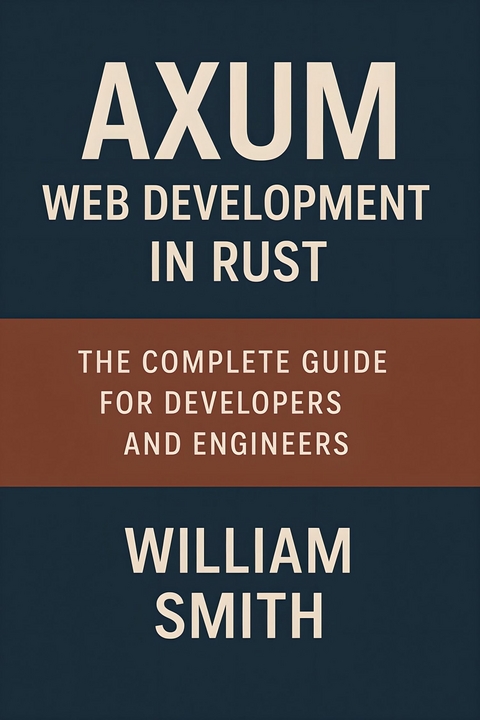
Axum Web Development in Rust (eBook)
250 Seiten
HiTeX Press (Verlag)
978-0-00-097399-3 (ISBN)
'Axum Web Development in Rust'
Axum Web Development in Rust is a definitive guide for experienced developers seeking to master backend web development with the Axum framework and Rust's robust, type-safe ecosystem. This comprehensive book reveals Axum's architectural philosophy and async foundations, contrasting it with other leading Rust web frameworks to illuminate its distinctive modularity, scalability, and performance. Through detailed chapters, readers learn best practices for structuring large-scale applications, establishing effective tooling, and exploiting the capabilities of the wider Tower middleware ecosystem.
The book delves deep into advanced routing, request handling, and state management, equipping readers with the expertise to design complex APIs with strong typing and ergonomic extraction. It covers essential patterns for dependency injection, concurrency, middleware composition, serialization, validation, and seamless integration with modern ORMs. Security is addressed holistically, encompassing TLS, authentication and authorization protocols, vulnerability mitigation, and runtime security tools for both development and deployment.
Going beyond application logic, Axum Web Development in Rust addresses critical concerns for production environments. Readers discover robust strategies for testing, observability, and performance tuning, as well as cloud-native deployment patterns such as Kubernetes, serverless, and CI/CD automation. The book culminates in advanced guidance for building real-world architectures, optimizing performance, supporting multi-protocol APIs, enabling seamless legacy integration, and future-proofing projects in the evolving Rust landscape, making it an indispensable reference for professional Rust web developers.
Chapter 2
Advanced Routing and Request Handling
Elevate your API design by mastering Axum’s powerful routing and request processing capabilities. In this chapter, we delve beyond the surface, uncovering how to craft expressive, maintainable, and highly performant endpoints. Explore the rich landscape of extractors, type-driven handlers, and advanced parsing—equipping you to build truly robust service interfaces and APIs that anticipate both developer and production needs.
2.1 Hierarchical and Nested Routing
Managing routes within complex Axum applications requires a strategy that supports modularity, clarity, and maintainability. Hierarchical and nested routing patterns facilitate these goals by allowing developers to decompose routing logic into reusable, composable units. This approach aligns with service-oriented design by encapsulating route groups, their corresponding handlers, and shared middleware in well-defined scopes.
At its core, Axum’s Router type supports route nesting through the nest and route combinators. Route nesting enables the attachment of sub-routers at specified path prefixes, which is essential for organizing related endpoints, such as those belonging to a particular resource or API version. Consider the following schematic example that illustrates hierarchical routing by nesting user-related and post-related routes under the /users and /posts base paths, respectively:
.nest("/users", users_router())
.nest("/posts", posts_router());
fn users_router() -> Router {
Router::new()
.route("/", get(list_users).post(create_user))
.route("/:id", get(get_user).put(update_user).delete(delete_user))
}
fn posts_router() -> Router {
Router::new()
.route("/", get(list_posts).post(create_post))
.route("/:id", get(get_post).put(update_post).delete(delete_post))
}
In this arrangement, each sub-router encapsulates the routes related to its domain, improving modularity and easing code navigation. This hierarchical design also supports attaching layer-specific middleware, such as authentication or rate limiting, to each subnet independently.
A common imperative in modern API design is versioning, which helps maintain backward compatibility and gradual evolution. Hierarchical routing naturally supports API versioning by nesting routers under versioned path prefixes such as /v1 or /v2. For example:
.nest("/users", v1_users_router())
.nest("/posts", v1_posts_router());
let api_v2 = Router::new()
...
| Erscheint lt. Verlag | 24.7.2025 |
|---|---|
| Sprache | englisch |
| Themenwelt | Mathematik / Informatik ► Informatik ► Programmiersprachen / -werkzeuge |
| ISBN-10 | 0-00-097399-8 / 0000973998 |
| ISBN-13 | 978-0-00-097399-3 / 9780000973993 |
| Informationen gemäß Produktsicherheitsverordnung (GPSR) | |
| Haben Sie eine Frage zum Produkt? |
 EPUB (Adobe DRM)
Größe: 683 KB
Kopierschutz: Adobe-DRM
Adobe-DRM ist ein Kopierschutz, der das eBook vor Mißbrauch schützen soll. Dabei wird das eBook bereits beim Download auf Ihre persönliche Adobe-ID autorisiert. Lesen können Sie das eBook dann nur auf den Geräten, welche ebenfalls auf Ihre Adobe-ID registriert sind.
Details zum Adobe-DRM
Dateiformat: EPUB (Electronic Publication)
EPUB ist ein offener Standard für eBooks und eignet sich besonders zur Darstellung von Belletristik und Sachbüchern. Der Fließtext wird dynamisch an die Display- und Schriftgröße angepasst. Auch für mobile Lesegeräte ist EPUB daher gut geeignet.
Systemvoraussetzungen:
PC/Mac: Mit einem PC oder Mac können Sie dieses eBook lesen. Sie benötigen eine
eReader: Dieses eBook kann mit (fast) allen eBook-Readern gelesen werden. Mit dem amazon-Kindle ist es aber nicht kompatibel.
Smartphone/Tablet: Egal ob Apple oder Android, dieses eBook können Sie lesen. Sie benötigen eine
Geräteliste und zusätzliche Hinweise
Buying eBooks from abroad
For tax law reasons we can sell eBooks just within Germany and Switzerland. Regrettably we cannot fulfill eBook-orders from other countries.
aus dem Bereich


