


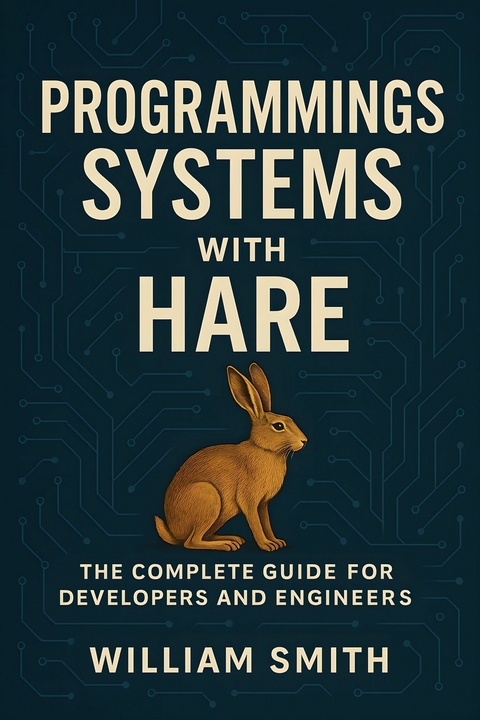
Programming Systems with Hare (eBook)
250 Seiten
HiTeX Press (Verlag)
978-0-00-097394-8 (ISBN)
'Programming Systems with Hare'
'Programming Systems with Hare' delivers a comprehensive exploration of the Hare programming language, tailored specifically for modern systems programming. This expertly curated guide begins with an incisive examination of Hare's core philosophies, type system, compilation pipeline, and its distinctive approach to low-level constructs. Readers develop a deep understanding of how Hare interfaces seamlessly with established systems infrastructure-such as C libraries and OS-level services-establishing a strong foundation for building robust, maintainable, and high-performance systems software.
The book systematically addresses critical aspects of systems development, from manual memory management and custom allocator integration to advanced concurrency, parallelism, and low-level optimization techniques. Each chapter is structured to balance theoretical insight with practical implementation strategies-including detailed discussions on synchronization primitives, channel-based communication, lock-free algorithms, and direct hardware interfacing. Security gets special emphasis, with chapters devoted to secure coding practices, memory safety, cryptographic integration, and both static and dynamic vulnerability analysis.
Practicality extends through rigorous discussion of testing, debugging, deployment, and operations. Readers learn to master Hare's test frameworks, leverage continuous integration pipelines, and build observability into their deployments for resilient operations. A rich collection of case studies demonstrates Hare's application in kernel development, embedded systems, cloud-native architectures, and legacy interoperability. Concluding with a forward-looking analysis, the book positions Hare as a pivotal tool for next-generation systems, offering both breadth and depth to practitioners and researchers intent on mastering systems programming in an evolving technological landscape.
Chapter 1
Foundations of Hare for Systems Programming
What makes Hare uniquely suited for systems programming? This chapter journeys deep into the language’s core, revealing design choices inspired by simplicity, predictability, and the demands of performance-critical development. We unravel Hare’s structural DNA, examining its strict type system, compilation process, and seamless interaction with existing system layers—setting the groundwork for building robust, efficient, and maintainable systems software.
1.1 Hare Language Principles and Philosophy
The Hare programming language emerges from a deliberate reconsideration of the design decisions that shape contemporary systems programming. At its core, Hare embodies a commitment to simplicity, explicitness, and resource transparency, rejecting the complexity and indirectness often associated with mainstream languages like C and Rust. These foundational principles are not mere academic ideals; rather, they are driven by pragmatic concerns inherent to low-level software development, where clarity and predictability directly influence correctness, maintainability, and performance.
Simplicity in Hare is not an absence of power but an intentional constraint on the language’s surface and semantic features. By minimizing syntactic sugar and eschewing implicit behaviors, Hare enables programmers to reason about code without needing encyclopedic knowledge of language subtleties. Every construct in Hare is designed to have one clear purpose, reducing cognitive overhead and fostering a mental model that aligns closely with underlying machine operations. This core choice mitigates common pitfalls such as subtle bugs induced by unexpected compiler transformations or ambiguous semantics, issues that frequently arise in richer but more complex languages.
Closely intertwined with simplicity is explicitness. Hare demands that programmers state their intentions clearly and directly in code. For example, resource allocation and ownership are expressed without hidden conventions or ambient lifetimes; pointer management and mutability are not implicit but explicitly denoted. This deliberate verbosity might initially appear cumbersome, but it is crucial in a domain where abstraction leaks can propagate catastrophic errors. Explicitness serves as a form of documentation enforced by compilation, ensuring that developers and reviewers alike can trace resource flows and side effects without speculation.
Resource transparency constitutes a third pillar of Hare’s philosophy. The language exposes the cost and mechanics of computation, memory usage, and concurrency primitives plainly to the developer. Unlike languages that encapsulate or abstract resource management behind layers of runtime systems or extensive compiler analyses, Hare leaves the mechanics perceptible in code. This transparency fosters confidence, as the execution profile and resource layout correspond closely to the written source, simplifying debugging and performance optimization in tightly constrained environments such as embedded systems or operating system kernels.
Readability and minimalism converge to enhance ease of reasoning, especially for low-level codebases where precise control over every instruction and memory address matters. Hare’s minimalist type system and straightforward control structures serve to prevent ambiguity in code flow, simplifying both manual inspection and formal verification. This quality addresses a notable challenge in systems programming: language complexity that detracts from verifying correctness or understanding subtle behaviors in concurrency and low-level interactions. By constraining expressiveness to a focused subset, Hare reduces the surface for errors while maintaining sufficient power for systems-level tasks.
Philosophically, Hare stands in contrast to C and Rust, both of which, despite their successes, embody different trade-offs and design philosophies. C’s design emphasizes proximity to hardware with a small set of features but tolerates undefined behavior and implicit conventions. Its unchecked pointers and memory safety pitfalls have perpetuated classes of vulnerabilities and hard-to-debug errors. Rust, meanwhile, offers a sophisticated ownership and borrowing model that guarantees memory safety and concurrency correctness at compile-time, but at the cost of significant complexity in syntax, semantics, and mental overhead. Rust’s advanced type system and lifetimes system introduce nontrivial learning curves and occasionally opaque compiler diagnostics, complicating adoption for seasoned low-level developers accustomed to the directness of C.
Hare’s design philosophy selectively incorporates lessons from these languages, opting for a pragmatic middle ground. It rejects the safety assurances embedded within Rust’s complex ownership mechanisms to provide instead a transparent, explicit model that relies on programmer discipline enforced by simpler, more predictable rules. Conversely, Hare improves on C by eliminating undefined behaviors and implicit conversions, imposing clear contracts on resource usage and correctness without layering additional complexity. This positions Hare as a language that values direct mental mapping between code, machine state, and developer intent above automated safety nets.
For experienced systems programmers, these choices matter profoundly. Debugging, auditing, and reasoning about low-level code demands clarity and predictability that Hare strives to provide without surrendering necessary control. The language’s transparency aids in profiling and static analysis workflows, while its simplicity reduces the likelihood of obscure compiler-induced transformations that can obscure root causes of defects. By elevating explicitness and resource visibility, Hare facilitates both manual verification and automated tooling that depend critically on straightforward code semantics.
In summary, Hare’s underlying principles prioritize a disciplined approach to systems programming: it embraces simplicity to enhance comprehension, enforces explicitness to prevent unintended behavior, and maintains resource transparency to align source code with runtime behavior. These decisions cultivate a language environment where seasoned developers can wield full control with confidence, fostering code that is robust, maintainable, and precisely tailored to the demanding needs of low-level systems software.
1.2 Type System and Data Representation
Hare’s statically-typed system is designed to offer rigorous guarantees of alignment, layout, and low-level data structure semantics, contributing substantially to both system integrity and runtime performance. At its core, Hare utilizes a type system that combines simplicity with expressive power to enforce strong invariants at compile time, minimizing the potential for undefined behavior and memory safety violations commonly encountered in low-level programming.
The static type checker in Hare enforces precise alignment constraints, which are derived directly from the platform’s Application Binary Interface (ABI) specifications. Each scalar type—such as integers, floating points, and pointers—has a known, fixed size and alignment requirement. Hare’s type rules ensure that aggregate types, including records (structs), tuples, and arrays, respect these base type constraints rigorously. For example, record fields are laid out sequentially with padding inserted explicitly by the compiler to maintain alignment boundaries. This design facilitates predictable and platform-consistent memory layouts irrespective of compiler optimizations, enabling seamless interfacing with hardware and external C APIs.
The layout guarantees extend to polymorphic and parametric types while preserving memory representation transparency. Hare disallows runtime type tags or hidden metadata that would otherwise introduce overhead or obscure memory layouts. Each parametric instantiation is monomorphized, ensuring that the resulting code and data representations are as efficient and straightforward as if handwritten. This approach contrasts strongly with many high-level languages, which often rely on boxed representations, fat pointers, or runtime type descriptors, increasing both memory consumption and indirection costs.
To assure type safety, Hare employs a non-null pointer system combined with explicit ownership and lifetime tracking at compile time. Unsafe operations such as unchecked casts, arbitrary pointer arithmetic, or direct memory mutation outside permitted bounds are strictly disallowed or require explicit opt-in through controlled and auditable unsafe blocks. This delineation facilitates both static verification and opportunities for formal reasoning about memory safety. The absence of a garbage collector reinforces the necessity for deterministic resource management, achievable due to the strong static guarantees.
Consider the following snippet illustrating a composite record type with embedded alignment:
...
| Erscheint lt. Verlag | 24.7.2025 |
|---|---|
| Sprache | englisch |
| Themenwelt | Mathematik / Informatik ► Informatik ► Programmiersprachen / -werkzeuge |
| ISBN-10 | 0-00-097394-7 / 0000973947 |
| ISBN-13 | 978-0-00-097394-8 / 9780000973948 |
| Informationen gemäß Produktsicherheitsverordnung (GPSR) | |
| Haben Sie eine Frage zum Produkt? |
 EPUB (Adobe DRM)
Größe: 691 KB
Kopierschutz: Adobe-DRM
Adobe-DRM ist ein Kopierschutz, der das eBook vor Mißbrauch schützen soll. Dabei wird das eBook bereits beim Download auf Ihre persönliche Adobe-ID autorisiert. Lesen können Sie das eBook dann nur auf den Geräten, welche ebenfalls auf Ihre Adobe-ID registriert sind.
Details zum Adobe-DRM
Dateiformat: EPUB (Electronic Publication)
EPUB ist ein offener Standard für eBooks und eignet sich besonders zur Darstellung von Belletristik und Sachbüchern. Der Fließtext wird dynamisch an die Display- und Schriftgröße angepasst. Auch für mobile Lesegeräte ist EPUB daher gut geeignet.
Systemvoraussetzungen:
PC/Mac: Mit einem PC oder Mac können Sie dieses eBook lesen. Sie benötigen eine
eReader: Dieses eBook kann mit (fast) allen eBook-Readern gelesen werden. Mit dem amazon-Kindle ist es aber nicht kompatibel.
Smartphone/Tablet: Egal ob Apple oder Android, dieses eBook können Sie lesen. Sie benötigen eine
Geräteliste und zusätzliche Hinweise
Buying eBooks from abroad
For tax law reasons we can sell eBooks just within Germany and Switzerland. Regrettably we cannot fulfill eBook-orders from other countries.
aus dem Bereich


