


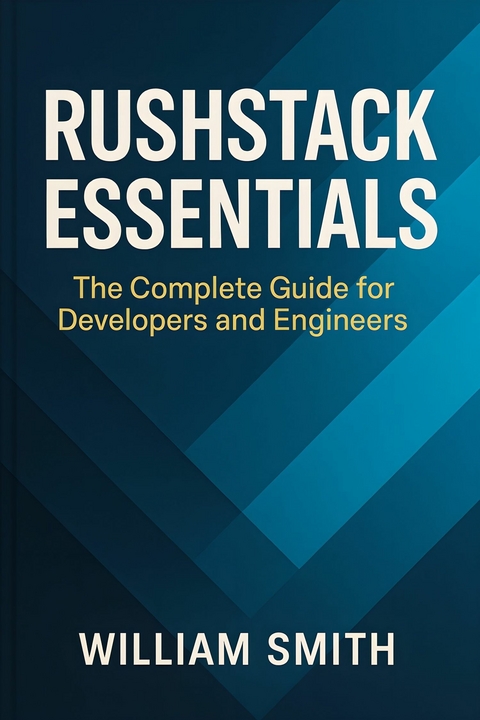
Rushstack Essentials (eBook)
250 Seiten
HiTeX Press (Verlag)
978-0-00-097393-1 (ISBN)
'Rushstack Essentials'
'Rushstack Essentials' is a comprehensive guide for engineers, architects, and technical leaders looking to master the modern art of monorepo management and scalable JavaScript/TypeScript development. The book opens with a deep dive into the history, evolution, and foundational philosophy of the Rushstack toolchain, then explores its key components-including Rush, Heft, and API Extractor-in meticulous detail. Through clear explanations and industry best practices, readers are introduced to the architectural paradigms underpinning large-scale monorepos, supported languages, extensibility mechanisms, and ecosystem synergies that make Rushstack a standout choice for enterprise development.
Moving beyond the basics, the book addresses advanced topics essential for real-world adoption: designing and configuring monorepos; managing complex dependencies; comparative insights on package managers such as PNPM and Yarn; and granular strategies for version control, change tracking, workspace organization, and policy enforcement. Dedicated chapters explore best-in-class approaches for automated testing, quality assurance at scale, and pipeline automation-demonstrating how to build robust CI/CD systems, automate changelogs, ensure secure software supply chains, and maintain regulatory compliance all while keeping developer productivity at the forefront.
Culminating with a forward-looking perspective, 'Rushstack Essentials' empowers teams to scale their development processes, foster healthy collaboration, and prepare for the future of the JavaScript ecosystem. Detailed guidance on governance, contribution models, training, advanced observability, and extensibility ensures this book is as valuable to organizational decision-makers as it is to hands-on practitioners. Whether modernizing an existing codebase or building a new platform from scratch, readers will find the knowledge and strategies needed to thrive with Rushstack in enterprises of any size.
Chapter 2
Monorepo Design and Configuration
Behind every high-performing monorepo lies intentional architecture and precise configuration. This chapter is your deep dive into the blueprints and best practices that transform sprawling codebases into maintainable powerhouses. Explore the mechanics, policies, and patterns that enable seamless onboarding, efficient collaboration, and adaptive evolution—all underpinned by the rigorous structure Rushstack prescribes.
2.1 rush.json and Project Registration
The rush.json file serves as the cornerstone for managing Microsoft’s Rush monorepo orchestrator, encapsulating critical configuration that governs the entire repository’s structure and operational policies. As the authoritative manifest, it delineates the workspace boundaries, defines project metadata, and prescribes the rules that coordinate project registration, package visibility, and build orchestration. Understanding the semantics and role of rush.json is essential for harnessing Rush effectively in complex, multi-package repositories.
At its core, the rush.json file is a JSON-formatted configuration residing at the root of the monorepo workspace. It specifies the set of projects, each identified by a unique name and linked to a relative folder path within the repository. This forms a project registry, through which Rush discovers and manages project scopes. The projects array within rush.json is structurally imperative, where each entry conforms to a schema specifying:
- "packageName": the NPM package name, serving as the definitive identifier for dependency resolution.
- "projectFolder": the relative directory location of the project within the monorepo.
- Optional metadata such as "reviewCategory", which is used for policy and governance enforcement.
The project discovery mechanism relies on the registration of these folders; by enumerating every project under projects, Rush restricts visibility and operational scope, preventing implicit project inclusion. This explicit registration serves as a boundary definition, ensuring that workspace tooling, such as dependency graph generation and change detection, only considers these sanctioned projects.
"projects": [
{
"packageName": "@acme/core",
"projectFolder": "libraries/core"
},
{
"packageName": "@acme/utils",
"projectFolder": "libraries/utils",
"reviewCategory": "utilities"
}
]
}
Package visibility is controlled stringently through rush.json. The manifest abstracts the set of all known projects and thus mediates the dependency ecosystem within the monorepo. Any package not listed within rush.json is effectively invisible to Rush commands such as rush add, rush build, or rush update. This ensures that only vetted projects participate in build orchestration, change detection, and incremental rebuilds, enhancing consistency and avoiding inadvertent side effects that might arise due to unmanaged directories or stray packages.
Policies encoded in rush.json also extend beyond project inclusion to govern repository-wide behaviors. For example, the reviewCategories attribute allows each project to be assigned a classification such as "applications" or "libraries", which can drive access control policies or automated code reviews. These classifications facilitate fine-grained restrictions and reporting during continuous integration, supporting scalable governance within large teams and multiple stakeholders.
Another critical functionality tied to rush.json is its role in package version management and policy enforcement. The file can be configured to cooperate with optional policy configuration files, such as common-versions.json or allowed-parameters.json, to exert centralized control over package versions and command argument usage. This interlinked configuration strategy synergizes with the project registration to ensure coherent, enforceable policies across the workspace.
The process of project registration begins during initial repository setup or when new packages are introduced. Manual edits to rush.json remain the canonical approach, although auxiliary tooling can assist by scanning for candidate projects and proposing entries. Each addition involves validating the package name against existing NPM registry conventions and verifying that the projectFolder path is relative and correctly mapped. Once registered, the project automatically becomes recognized by Rush’s dependency graph builder, enabling project lifecycle commands, incremental builds, and coordinated version bumps.
Boundary enforcement by rush.json has tangible implications on tooling. For example, when rush build executes, it interrogates rush.json to create a Directed Acyclic Graph (DAG) of dependencies, where nodes represent registered projects and edges represent declared package references. This graph underpins the incremental build process: Rush rebuilds only impacted projects rather than the entire monorepo. Missing or incorrectly specified projects break the graph’s integrity, risking build failures or incomplete artifacts.
Furthermore, rush.json enables Rush’s incremental change detection features via the change folder mechanism, tightly integrated with project registration. Changes in registered project folders trigger update commands and changelogs, simplifying versioning logistics. This alignment ensures that all modifications are accounted for strictly within the scope of explicitly listed projects, reinforcing workplace boundaries and minimizing noise in version control histories.
In addition to project registration, rush.json defines global parameters controlling the monorepo, such as the repository URL, eventHooks for custom scripts at lifecycle stages, and...
| Erscheint lt. Verlag | 24.7.2025 |
|---|---|
| Sprache | englisch |
| Themenwelt | Mathematik / Informatik ► Informatik ► Programmiersprachen / -werkzeuge |
| ISBN-10 | 0-00-097393-9 / 0000973939 |
| ISBN-13 | 978-0-00-097393-1 / 9780000973931 |
| Informationen gemäß Produktsicherheitsverordnung (GPSR) | |
| Haben Sie eine Frage zum Produkt? |
 EPUB (Adobe DRM)
Größe: 768 KB
Kopierschutz: Adobe-DRM
Adobe-DRM ist ein Kopierschutz, der das eBook vor Mißbrauch schützen soll. Dabei wird das eBook bereits beim Download auf Ihre persönliche Adobe-ID autorisiert. Lesen können Sie das eBook dann nur auf den Geräten, welche ebenfalls auf Ihre Adobe-ID registriert sind.
Details zum Adobe-DRM
Dateiformat: EPUB (Electronic Publication)
EPUB ist ein offener Standard für eBooks und eignet sich besonders zur Darstellung von Belletristik und Sachbüchern. Der Fließtext wird dynamisch an die Display- und Schriftgröße angepasst. Auch für mobile Lesegeräte ist EPUB daher gut geeignet.
Systemvoraussetzungen:
PC/Mac: Mit einem PC oder Mac können Sie dieses eBook lesen. Sie benötigen eine
eReader: Dieses eBook kann mit (fast) allen eBook-Readern gelesen werden. Mit dem amazon-Kindle ist es aber nicht kompatibel.
Smartphone/Tablet: Egal ob Apple oder Android, dieses eBook können Sie lesen. Sie benötigen eine
Geräteliste und zusätzliche Hinweise
Buying eBooks from abroad
For tax law reasons we can sell eBooks just within Germany and Switzerland. Regrettably we cannot fulfill eBook-orders from other countries.
aus dem Bereich


