


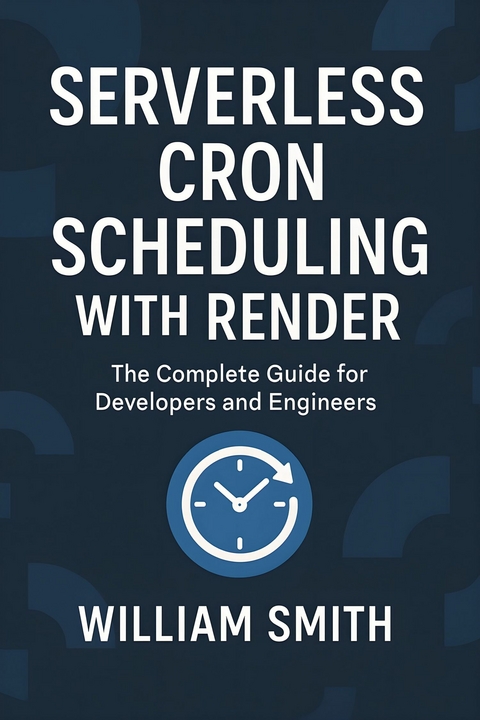
Serverless Cron Scheduling with Render (eBook)
250 Seiten
HiTeX Press (Verlag)
978-0-00-097391-7 (ISBN)
'Serverless Cron Scheduling with Render'
'Serverless Cron Scheduling with Render' is an authoritative guide to modern time-based automation in the cloud, offering a comprehensive exploration of cron job scheduling within contemporary serverless environments. Beginning with a rich account of cron's journey from Unix origins to the era of cloud-native serverless computing, the book establishes the foundational principles, design patterns, and trade-offs that shape how scheduled workloads are engineered and operated today. Readers gain deep insight into event-driven architecture, security paradigms, platform selection, and a comparative survey of leading managed cron services, all tailored to the unique demands of scalable, reliable automation.
A special emphasis is placed on Render, with an in-depth dissection of its scheduling architecture, lifecycle, and advanced integration capabilities. The book demystifies cron syntax-extending into Render-specific enhancements-and addresses key operational concerns such as concurrency control, secrets management, testing strategies, and deployment models. Throughout, practical chapters illustrate how to build robust jobs, manage resources, optimize performance, and seamlessly bridge serverless cron with Git workflows, containers, and infrastructure as code, empowering professionals to architect secure and maintainable solutions.
Beyond implementation, the guide delves into best practices for observability, resilience engineering, compliance, and DevOps automation. Readers benefit from real-world patterns for integrating external systems, orchestrating complex workflows, and achieving multi-cloud interoperability. With expert coverage of governance, incident response, cost optimization, and future trends, 'Serverless Cron Scheduling with Render' is an indispensable resource for engineers, architects, and DevOps practitioners navigating the fast-evolving landscape of serverless scheduling and automation.
Chapter 2
Render Platform: Architecture and Scheduling Model
Render reimagines scheduled task orchestration for the cloud era, providing a robust platform that blends operational simplicity with advanced composability. This chapter peers beneath the user interface to reveal the architectural innovations and scheduling mechanisms powering cron jobs on Render. From compute orchestration to secure configuration and hybrid deployment models, discover how Render transforms the challenges of scalable automation into opportunities for elegant, maintainable solutions.
2.1 Render’s Core Architecture
Render’s internal compute architecture is designed around the principle of horizontally scalable, isolated runtime environments, enabling highly efficient orchestration of workloads. This architecture elegantly decouples compute from persistent state, ensuring flexibility, resilience, and operational clarity within a distributed environment.
At the heart of Render’s compute orchestration lies a set of scheduling queues that manage workload placement and lifecycle events. These queues act as buffers for incoming tasks, enabling asynchronous scheduling decisions that optimize resource utilization. Each queue corresponds to a distinct class of workloads, varying by runtime characteristics, priority, and resource requirements. Tasks inserted into these queues are evaluated against a resource availability matrix derived from a dynamic inventory of compute nodes, each representing an isolated runtime environment.
The runtime environments themselves are constructed as lightweight, container-like sandboxes. These sandboxes encapsulate execution contexts with strict boundaries enforced by kernel-level namespaces and cgroups, ensuring minimal interference among workloads and guaranteeing workload isolation. This design promotes horizontal scaling by allowing workloads of disparate tenants or services to coexist on the same physical substrates without contamination or resource contention beyond defined quotas.
Render’s network topology plays a pivotal role in connecting and coordinating these environments. Internally, the platform adopts a meshed overlay network, which abstracts away physical placement and enables consistent low-latency communication between runtime instances irrespective of their physical node location. To maximize throughput and fault tolerance, the network links are orchestrated into fault domains-segments of computation and networking that are isolated to prevent cascading failures. These fault domains ensure that network partitions or hardware faults in one domain do not propagate errors to other parts of the cluster.
Orchestration primitives in Render are exposed through the control plane, a lightweight but highly responsive subsystem responsible for global state management and the enforcement of workload policies. The control plane operates separately from the data plane, allowing it to manage metadata, scheduling decisions, and configuration independently from the execution of the workloads themselves. This separation ensures that control operations do not impact compute performance and that persistent state metadata remains consistent and durable despite transient failures in runtime environments.
One critical aspect of Render’s control plane is its declarative approach to workload specification. Each workload is defined in terms of desired state, resource constraints, and lifecycle hooks. The control plane continuously reconciles the actual state with the desired state by issuing commands to the scheduling queues and runtime environments. Mechanisms such as leader election, distributed locks, and optimistic concurrency controls are employed to guarantee that decisions are made consistently and without race conditions across the distributed system.
The separation of compute and persistent state is achieved through stateless compute nodes complemented by dedicated, distributed state stores. While runtime environments process ephemeral workloads, persistent volumes and databases are managed independently through durable, replicated services. This architectural choice enforces immutability and enables rapid scaling or replacement of compute nodes without risking data loss or inconsistency. Persistent state stores are accessible via well-defined APIs, often proxied through Render’s network layer, ensuring secure and performant access patterns.
Render’s fault domain design introduces resilience by grouping compute nodes and associated network segments into isolated units with independent power, network paths, and hardware characteristics. The scheduler is topology-aware and preferentially balances workloads to minimize blast radius: when failures occur, only the affected fault domain needs remediation, while the rest of the system continues operating unimpaired. Alongside fault domains, health monitoring agents continuously probe node and network conditions, feeding telemetry data back to the control plane for proactive rescheduling or node evacuation.
Workload isolation is further reinforced by integrating runtime sandboxing technologies such as lightweight virtual machines or unikernels when necessary, augmenting container-level isolation to satisfy higher security or performance requirements. Network policies restrict intra-cluster traffic flows between isolated workloads to minimize lateral threat vectors and enforce multi-tenancy at the network layer.
In aggregate, Render’s core architecture embodies a robust interplay of scheduling abstractions, network topology design, persistence decoupling, and fault domain isolation. These elements coalesce to provide a scalable, resilient platform capable of dynamically handling heterogeneous workloads with stringent guarantees of isolation, consistency, and operational agility.
2.2 Cron Job Lifecycle in Render
The lifecycle of a cron job on Render encompasses a sequence of tightly orchestrated phases, from initial job creation to ultimate retirement. Each phase is designed to ensure reliable, secure, and scalable execution within the platform’s environment, leveraging a blend of declarative user inputs, backend scheduling orchestration, and containerized execution.
At the inception of the lifecycle, job definition occurs. Users specify the cron job’s characteristics via Render’s user interface or programmatically through the REST API. The job definition includes the command or script to execute, environment variables, runtime constraints, and a schedule using cron syntax. This initial specification is stored in Render’s configuration backend-a hierarchical, schema-validated data store-where job metadata such as the name, owner, concurrency policy, and retention rules are persisted. The job definition phase also involves validation against platform policies to prevent misuse of resources or scheduling conflicts.
Following job definition, the schedule resolution phase interprets the cron syntax to determine the execution timeline. Render employs a distributed scheduling service that calculates the next run times based on Coordinated Universal Time (UTC), maintaining consistency across global deployments. The scheduler resolves expressions such as “0 * * * *” (top of every hour) into a set of upcoming timestamps, embedding these into a queue for triggered execution. This service continuously reconciles running jobs with the desired state, using a reconciliation loop pattern driven by event streams from the job configuration store.
Once an execution time is reached, resource reservation is initiated. This phase involves allocating compute capacity within Render’s container orchestration cluster. The scheduler interacts with Kubernetes APIs-Render’s underlying compute fabric-requesting pod creation with resource requests and limits derived from the job definition. Resource quotas, node affinities, and taints are respected to align with multi-tenant resource governance policies. If resources are constrained, job execution may be delayed or retried based on configured backoff strategies.
Concurrently, container and image preparation is carried out. Render maintains a secure container image registry where user-provided or platform-generated images are stored. During this step, the orchestrator pulls the specified container image-based on a Dockerfile or prebuilt base image-and prepares the runtime environment by injecting secrets, environment variables, and any attached volumes. Image caching strategies reduce latency by avoiding redundant pulls for frequently executed jobs.
The secure execution environment establishes strict isolation using container runtime sandboxing, leveraging Linux namespaces, cgroups, and seccomp filters. Network policies restrict inbound and outbound traffic based on job requirements, mitigating potential attack surfaces. Secrets management integrates with Render’s encrypted vault system to decrypt and inject sensitive credentials only at runtime, obviating persistent storage of secrets within containers. The job process is launched as a containerized task, with logs forwarded in real-time to Render’s observability stack.
Throughout execution, the platform enforces monitoring. System-level metrics such as CPU usage, memory consumption, and...
| Erscheint lt. Verlag | 24.7.2025 |
|---|---|
| Sprache | englisch |
| Themenwelt | Mathematik / Informatik ► Informatik ► Programmiersprachen / -werkzeuge |
| ISBN-10 | 0-00-097391-2 / 0000973912 |
| ISBN-13 | 978-0-00-097391-7 / 9780000973917 |
| Informationen gemäß Produktsicherheitsverordnung (GPSR) | |
| Haben Sie eine Frage zum Produkt? |
 EPUB (Adobe DRM)
Größe: 724 KB
Kopierschutz: Adobe-DRM
Adobe-DRM ist ein Kopierschutz, der das eBook vor Mißbrauch schützen soll. Dabei wird das eBook bereits beim Download auf Ihre persönliche Adobe-ID autorisiert. Lesen können Sie das eBook dann nur auf den Geräten, welche ebenfalls auf Ihre Adobe-ID registriert sind.
Details zum Adobe-DRM
Dateiformat: EPUB (Electronic Publication)
EPUB ist ein offener Standard für eBooks und eignet sich besonders zur Darstellung von Belletristik und Sachbüchern. Der Fließtext wird dynamisch an die Display- und Schriftgröße angepasst. Auch für mobile Lesegeräte ist EPUB daher gut geeignet.
Systemvoraussetzungen:
PC/Mac: Mit einem PC oder Mac können Sie dieses eBook lesen. Sie benötigen eine
eReader: Dieses eBook kann mit (fast) allen eBook-Readern gelesen werden. Mit dem amazon-Kindle ist es aber nicht kompatibel.
Smartphone/Tablet: Egal ob Apple oder Android, dieses eBook können Sie lesen. Sie benötigen eine
Geräteliste und zusätzliche Hinweise
Buying eBooks from abroad
For tax law reasons we can sell eBooks just within Germany and Switzerland. Regrettably we cannot fulfill eBook-orders from other countries.
aus dem Bereich


