


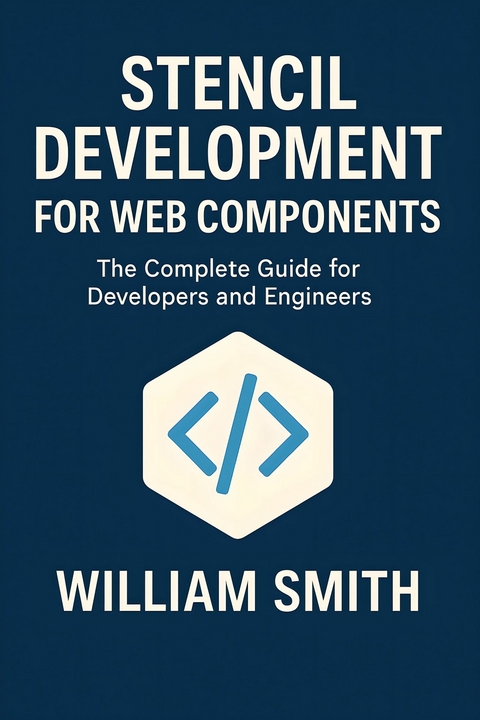
Stencil Development for Web Components (eBook)
250 Seiten
HiTeX Press (Verlag)
978-0-00-097388-7 (ISBN)
'Stencil Development for Web Components'
'Stencil Development for Web Components' is the definitive guide to mastering the design, implementation, and deployment of robust web components with Stencil. Beginning with a comprehensive exploration of the Web Components ecosystem, the book traces the evolution of web standards, the driving need for modern toolchains like Stencil, and the challenges of hand-crafting components in vanilla JavaScript. Readers gain clear insight into the comparative strengths of Stencil versus other popular frameworks, laying a strong foundation for advanced development.
Delving into Stencil's compiler architecture, the book unveils its internal mechanics-from virtual DOM optimization and lazy loading strategies to extensibility through plugins and diagnostics. Advanced chapters cover sophisticated techniques for authoring component APIs, managing state and lifecycle, orchestrating styling and theming, ensuring accessibility, and integrating seamlessly with major frameworks such as React, Angular, and Vue. The text further addresses interoperability, distribution, and best practices for using Stencil components in varied build systems and micro-frontend architectures, providing actionable guidance for enterprise scenarios.
Beyond the core development experience, this resource comprehensively covers performance optimization, security in production environments, rigorous testing methodologies, and building scalable, accessible design systems. Each chapter emphasizes operational excellence, including metrics, observability, continuous integration, and effective release management. Rounded out with forward-looking insights into the evolution of Web Components and Stencil's future, this book is an indispensable reference for developers and architects seeking to create maintainable, scalable, and secure component libraries in the modern web ecosystem.
Chapter 2
Stencil Compiler Architecture and Internals
Beneath Stencil’s concise component syntax lies a sophisticated compiler that transforms author intentions into highly efficient, standards-compliant Web Components. This chapter uncovers the inner workings of the Stencil build pipeline, revealing not only how source code is parsed and optimized, but how extensibility and diagnostics are woven deep into its architecture. Dive into the unseen mechanics that govern performance, modularity, and scalability for large-scale design systems.
2.1 Compiler Pipeline and Transformation
The Stencil compiler’s pipeline orchestrates a sophisticated sequence of phases that collectively transform source code written in TypeScript and TSX into optimized, target-specific JavaScript. Central to this process is a series of carefully coordinated transformations that enable both development agility and high runtime efficiency. The pipeline can be divided into four core stages: parsing, dependency graph analysis, static analysis for optimization, and code emission.
Parsing TypeScript and TSX: Parsing initiates the transformation journey by converting the raw source files into an Abstract Syntax Tree (AST). Leveraging the TypeScript compiler API, Stencil constructs a comprehensive AST that encapsulates both syntactic structure and semantic information essential for later phases. TSX files, which combine TypeScript with embedded JSX syntax, require additional handling; they are parsed in a single pass to form a unified AST that enables seamless traversal across component definitions and embedded template expressions.
function parseSourceFile(fileName: string, sourceText: string): ts.SourceFile {
return ts.createSourceFile(
fileName,
sourceText,
ts.ScriptTarget.Latest,
true, // setParentNodes
ts.ScriptKind.TSX // supports TSX if relevant
);
}
This phase not only builds the AST but also establishes symbol tables and type information by invoking the TypeScript type checker, thus embedding static typing metadata essential for precise transformations.
Dependency Graph Analysis: Next, the compiler constructs a directed acyclic graph (DAG) representing inter-module dependencies. Each node corresponds to a component or module, and edges signify import or use relationships. This graph serves multiple purposes: it enables ordering compilation steps to respect dependency constraints, facilitates incremental builds by identifying affected subgraphs, and detects circular dependencies which are critical for predictability in bundling.
Stencil extracts import declarations and component usage patterns by traversing the AST nodes using a visitor pattern, mapping out each dependency linkage. This static representation guides subsequent optimization and code generation phases.
Static Analysis for Optimization: The compiler performs an extensive static analysis phase focused on enabling aggressive optimizations while ensuring correctness. Key analyses include:
- Tree-shaking: Eliminates unused exports and code fragments by identifying code paths unreachable from any entry point in the dependency graph.
- Property and event pruning: Determines component properties and events that are never referenced or emitted, reducing runtime overhead.
- Inlining and constant folding: Detects statically determinable expressions and replaces them with constants or inline function bodies to minimize runtime computation.
- Change detection strategy inference: Analyzes component decorators and lifecycle methods to infer the most efficient change detection mechanism.
This analysis heavily uses metadata extracted from decorators, JSDoc comments, and type annotations preserved within the AST. The compiler exposes metadata in the form of structured JSON objects that describe component inputs, outputs, lifecycle hooks, and style encapsulation strategies, essential for code emitters to generate effective runtime scaffolding.
"tagName": "my-component",
"properties": [
{"name": "title", "type": "string", "reflect": true},
...
| Erscheint lt. Verlag | 24.7.2025 |
|---|---|
| Sprache | englisch |
| Themenwelt | Mathematik / Informatik ► Informatik ► Programmiersprachen / -werkzeuge |
| ISBN-10 | 0-00-097388-2 / 0000973882 |
| ISBN-13 | 978-0-00-097388-7 / 9780000973887 |
| Informationen gemäß Produktsicherheitsverordnung (GPSR) | |
| Haben Sie eine Frage zum Produkt? |
 EPUB (Adobe DRM)
Größe: 540 KB
Kopierschutz: Adobe-DRM
Adobe-DRM ist ein Kopierschutz, der das eBook vor Mißbrauch schützen soll. Dabei wird das eBook bereits beim Download auf Ihre persönliche Adobe-ID autorisiert. Lesen können Sie das eBook dann nur auf den Geräten, welche ebenfalls auf Ihre Adobe-ID registriert sind.
Details zum Adobe-DRM
Dateiformat: EPUB (Electronic Publication)
EPUB ist ein offener Standard für eBooks und eignet sich besonders zur Darstellung von Belletristik und Sachbüchern. Der Fließtext wird dynamisch an die Display- und Schriftgröße angepasst. Auch für mobile Lesegeräte ist EPUB daher gut geeignet.
Systemvoraussetzungen:
PC/Mac: Mit einem PC oder Mac können Sie dieses eBook lesen. Sie benötigen eine
eReader: Dieses eBook kann mit (fast) allen eBook-Readern gelesen werden. Mit dem amazon-Kindle ist es aber nicht kompatibel.
Smartphone/Tablet: Egal ob Apple oder Android, dieses eBook können Sie lesen. Sie benötigen eine
Geräteliste und zusätzliche Hinweise
Buying eBooks from abroad
For tax law reasons we can sell eBooks just within Germany and Switzerland. Regrettably we cannot fulfill eBook-orders from other countries.
aus dem Bereich


