


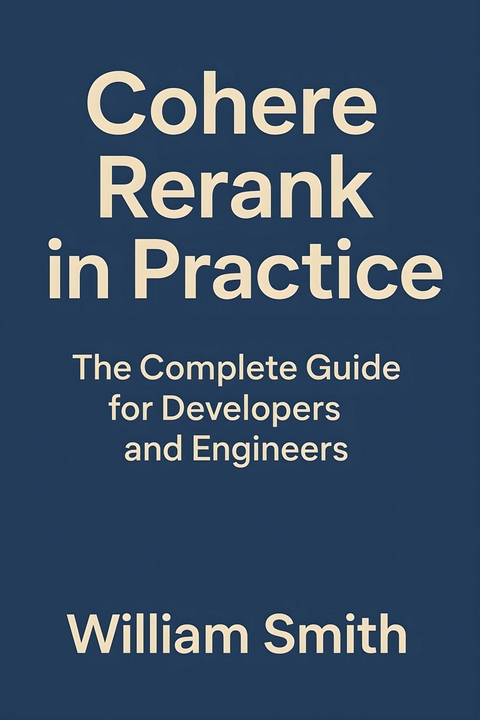
Cohere Rerank in Practice (eBook)
250 Seiten
HiTeX Press (Verlag)
978-0-00-097367-2 (ISBN)
'Cohere Rerank in Practice'
'Cohere Rerank in Practice' is a comprehensive guide to the modern landscape of information retrieval and neural reranking systems, with a particular focus on the Cohere Rerank platform. The book opens with clear explanations of retrieval system evolution, contrasting sparse and dense paradigms, and delving into the motivations and architectures that have shaped state-of-the-art reranking. Through detailed chapters, readers explore the foundational role of transformers, input engineering, model customization for multilingual and domain-specific tasks, and the rigorous benchmarks and metrics used to evaluate effectiveness.
The text provides hands-on insights into integrating Cohere Rerank into production pipelines, covering both real-time and batch processing deployments at scale. Readers are walked through robust design considerations for hybrid retrieval architectures-combining sparse, dense, and rerank models-alongside best practices for monitoring, observability, and troubleshooting. Data engineering receives particular emphasis, as the book addresses methods for handling complex queries, augmenting features across modalities, labeling data efficiently, and ensuring bias mitigation and auditable lineage throughout the system lifecycle.
Emphasizing security, privacy, regulatory compliance, and operational efficiency, this resource presents a holistic approach to deploying high-performing, responsible, and cost-effective reranking systems. It addresses advanced topics such as domain adaptation, zero- and few-shot applications, knowledge graph integration, and the unique needs of low-resource environments. The closing chapters investigate research frontiers-including LLMs as rerankers, multimodal techniques, explainability, and future directions-making 'Cohere Rerank in Practice' an essential reference for researchers, engineers, and practitioners building the next generation of intelligent retrieval systems.
Chapter 2
Cohere Rerank: Architecture and Model Design
Beyond first-pass retrieval lies the true challenge: refining raw relevance into actionable insights. This chapter provides an insider’s guide to the intricate machinery of Cohere Rerank, unveiling how advanced architectures and thoughtful model design turn ordinary candidate lists into highly relevant ranked outputs. We dissect every layer of the pipeline, from transformer foundations to domain adaptation, immersing you in the core engineering advances that power next-generation search applications.
2.1 Overview of the Transformer Foundation
Transformers have become the cornerstone of modern natural language processing, fundamentally reshaping how machines encode, understand, and generate human language. At the core of the Cohere Rerank architecture lies a sophisticated instantiation of the transformer paradigm, whose evolution from rudimentary attention mechanisms to large-scale pretrained language models underpins its remarkable semantic comprehension and reranking capabilities.
The inception of transformer architectures stemmed from the realization that traditional recurrent and convolutional models struggled with capturing long-range dependencies in text. Unlike these predecessors, the transformer entirely abandons recurrence in favor of attention mechanisms, which directly model relationships between all tokens in an input sequence. This shift enables parallelization during training and more expressive representations of contextual dependencies, critical for fine-grained semantic tasks like reranking.
Central to the transformer’s power is the self-attention mechanism, which computes dynamic, context-sensitive weights between every pair of tokens within a sequence. Given an input represented by matrices of queries Q, keys K, and values V , self-attention calculates:
where dk denotes the dimensionality of the key vectors, serving as a scaling factor that stabilizes gradient flow. This formulation allows each token to attend selectively to others, aggregating information based on learned relevance scores. Multi-head attention extends this concept by projecting inputs into multiple subspaces, capturing diverse aspects of semantic relationships concurrently.
Positional encoding complements self-attention by injecting information about the order of tokens, which self-attention alone cannot infer due to its permutation-invariant design. In the baseline transformer, sinusoidal positional encodings are added to the input embeddings:
where pos is the token position and i indexes embedding dimensions. These deterministic encodings enable the model to generalize to sequence lengths beyond those seen during training while preserving relative and absolute positional information critical for language understanding.
Architectural variants within transformer-based reranking models primarily diverge along two dimensions: cross-encoders and bi-encoders. Cross-encoders process the query and candidate documents jointly through a single transformer, allowing rich, token-level interactions between them via full self-attention. This design excels at fine-grained semantic matching due to its expressive capacity but suffers from quadratic computational complexity with respect to input length and is less scalable when evaluating large candidate sets.
In contrast, bi-encoders independently encode queries and documents into fixed-length embeddings using separate transformer encoders. Scoring relies on efficient similarity metrics such as dot product or cosine similarity, enabling rapid retrieval over large corpora. However, this independence restricts deep cross-interaction, potentially limiting semantic nuance in reranking precision. Cohere Rerank leverages innovations in both paradigms, balancing expressiveness and scalability by integrating cross-encoder attention mechanisms with pretrained language models optimized for reranking.
Pretraining large transformer-based language models involves unsupervised objectives like masked language modeling or autoregressive generation over expansive textual corpora. This process endows the models with broad contextual knowledge and syntactic awareness, which are then fine-tuned with domain-specific reranking datasets. Such large-scale, pretrained models serve as robust backbones that can differentiate subtle semantic variations critical for ranking relevance.
The scalability of transformer architectures is tightly linked to design choices in model size, attention mechanisms, and training regimes. Recent advancements include sparse and approximate attention techniques to mitigate quadratic complexity, and parameter-efficient fine-tuning to adapt large models with minimal resource expenditure. Furthermore, embedding dimensionality and network depth are carefully calibrated within Cohere Rerank to provide a rich representational space without prohibitive computational costs.
Ultimately, the expressiveness of reranking models grounded in transformers arises from their ability to learn hierarchical, context-aware representations that capture polysemy, idiomatic usage, and pragmatic nuances in language. Self-attention layers dynamically integrate diverse linguistic cues across sentence boundaries, while positional encodings preserve structural coherence. The selection between cross-encoder and bi-encoder frameworks modulates the trade-off between semantic depth and throughput, enabling flexible deployment strategies tailored to specific application scale and latency requirements.
The transformer foundation underlying Cohere Rerank embodies a confluence of architectural innovations-self-attention, positional encoding, and pretrained language understanding-arranged to maximize semantic fidelity and operational efficiency. By harnessing these elements, the system achieves a sophisticated balance of capacity, scalability, and expressiveness essential for high-performance reranking in contemporary NLP tasks.
2.2 End-to-End Rerank Pipeline in Cohere
The reranking pipeline within Cohere orchestrates a sequence of tightly integrated stages designed to transform raw candidate sets into a prioritized output ranked by relevance scores. This section dissects each critical component in the pipeline-from initial data ingestion and feature enrichment to final score generation-highlighting architectural decisions and performance optimizations necessary for production-quality deployments.
Candidate Set Ingestion and Feature Enrichment
The pipeline begins with ingestion of candidate documents or response options, often retrieved by a preliminary retrieval system such as lexical search or a lightweight embedding-based retriever. Each candidate is represented as a textual snippet supplemented with metadata fields including source identifiers, initial retrieval scores, and auxiliary contextual signals.
Feature enrichment is performed immediately after ingestion to augment raw candidate texts with engineered attributes. This may involve extracting domain-specific tags from external knowledge bases, computing token-level part-of-speech frequencies, or appending session-level behavioral statistics. Enrichment serves two purposes: aiding downstream encoders in contextualizing inputs, and enabling the model to leverage heterogeneous data beyond raw text.
From an architectural standpoint, enrichment typically leverages asynchronous pipelines with caching layers to avoid repeated costly computations. Key-value stores indexed by candidate identifiers optimize lookups, while parallel processing frameworks accelerate feature extraction across large candidate pools.
Encoding of Candidates and Context
Once enriched, candidates proceed to the encoding stage, where their textual and augmented feature representations are transformed into dense vector embeddings. Cohere’s encoders rely on transformer-based architectures fine-tuned specifically for ranking tasks. These encoders generate fixed-length embeddings that preserve semantic information and relational signals crucial for reranking.
Encoding is performed both at the candidate level and, separately, for the query or context. Context encoding captures user intent and conversation history, serving as a reference point. Candidate embeddings are aligned against the encoded context during later matching steps.
To optimize throughput, batch encoding is fundamental. Batching candidates enables efficient GPU utilization and reduces per-example latency. However, the trade-off emerges between batch size and real-time requirements: larger batches improve GPU efficiency but increase latency-a crucial consideration in interactive systems. Hybrid batching strategies can be employed, dynamically adjusting batch size as a function of request volume and latency service-level objectives (SLOs).
Pairwise Matching and Interaction Modeling
The core of the rerank pipeline is the pairwise comparison between the context embedding and each candidate embedding. Cohere implements a scalable pairwise matching module capable of modeling complex interactions beyond simple cosine similarity. This...
| Erscheint lt. Verlag | 24.7.2025 |
|---|---|
| Sprache | englisch |
| Themenwelt | Mathematik / Informatik ► Informatik ► Programmiersprachen / -werkzeuge |
| ISBN-10 | 0-00-097367-X / 000097367X |
| ISBN-13 | 978-0-00-097367-2 / 9780000973672 |
| Informationen gemäß Produktsicherheitsverordnung (GPSR) | |
| Haben Sie eine Frage zum Produkt? |
 EPUB (Adobe DRM)
Größe: 1,1 MB
Kopierschutz: Adobe-DRM
Adobe-DRM ist ein Kopierschutz, der das eBook vor Mißbrauch schützen soll. Dabei wird das eBook bereits beim Download auf Ihre persönliche Adobe-ID autorisiert. Lesen können Sie das eBook dann nur auf den Geräten, welche ebenfalls auf Ihre Adobe-ID registriert sind.
Details zum Adobe-DRM
Dateiformat: EPUB (Electronic Publication)
EPUB ist ein offener Standard für eBooks und eignet sich besonders zur Darstellung von Belletristik und Sachbüchern. Der Fließtext wird dynamisch an die Display- und Schriftgröße angepasst. Auch für mobile Lesegeräte ist EPUB daher gut geeignet.
Systemvoraussetzungen:
PC/Mac: Mit einem PC oder Mac können Sie dieses eBook lesen. Sie benötigen eine
eReader: Dieses eBook kann mit (fast) allen eBook-Readern gelesen werden. Mit dem amazon-Kindle ist es aber nicht kompatibel.
Smartphone/Tablet: Egal ob Apple oder Android, dieses eBook können Sie lesen. Sie benötigen eine
Geräteliste und zusätzliche Hinweise
Buying eBooks from abroad
For tax law reasons we can sell eBooks just within Germany and Switzerland. Regrettably we cannot fulfill eBook-orders from other countries.
aus dem Bereich


