


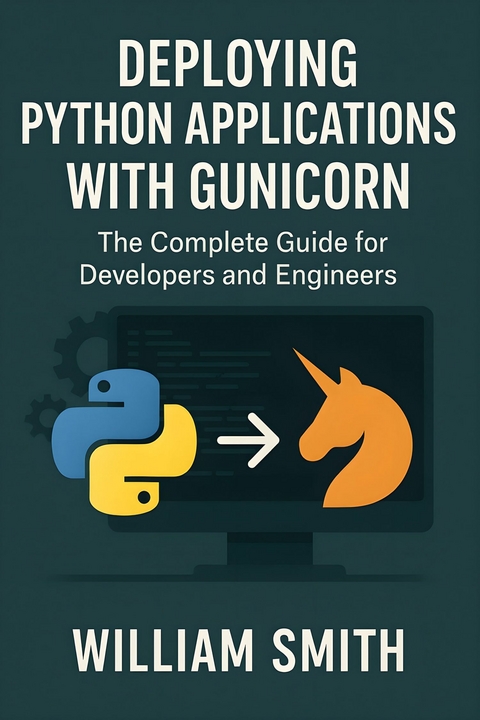
Deploying Python Applications with Gunicorn (eBook)
250 Seiten
HiTeX Press (Verlag)
978-0-00-097362-7 (ISBN)
'Deploying Python Applications with Gunicorn'
'Deploying Python Applications with Gunicorn' is an authoritative and comprehensive guide for developers, architects, and operations professionals seeking to master the deployment of robust Python web applications. The book begins by exploring the foundational concepts of the Python web ecosystem, including a deep dive into the WSGI standard, the role and integration of leading frameworks such as Django, Flask, and FastAPI, and a comparative analysis of WSGI, ASGI, and emerging protocols. Readers will gain clarity on where Gunicorn fits into the landscape, understanding its architectural philosophy and practical significance amidst evolving deployment patterns like monolithic and microservices approaches.
Building upon this solid foundation, the book offers an extensive examination of Gunicorn's architecture, configuration, and operationalization. Through nuanced discussions of worker models, concurrency, customization via hooks, and real-world optimization strategies, readers will acquire advanced skills for tuning Gunicorn for performance, reliability, and efficiency. Attention is given to security hardening, compliance, and integrating Gunicorn into modern DevOps pipelines, whether running on bare metal, in Docker containers, or orchestrated by Kubernetes. In addition, the book provides essential insights into best practices for observability-encompassing logging, metrics, tracing, and production debugging-ensuring high availability and rapid incident response in demanding environments.
The final sections of the book illustrate proven deployment patterns and industry case studies, address bottlenecks in large-scale systems, and look ahead to the future of Python web deployment with emerging trends such as ASGI, serverless, and edge computing. With its structured, detail-oriented approach, 'Deploying Python Applications with Gunicorn' empowers professionals to confidently design, secure, optimize, and scale Python services in any environment, laying the groundwork for resilient, maintainable, and next-generation web applications.
Chapter 2
Deep Dive into Gunicorn Architecture
Beneath its deceptively simple interface, Gunicorn hides a powerful architectural engine finely tuned for concurrent, reliable Python web application serving. This chapter unfolds the inner workings of Gunicorn, revealing what truly happens when your WSGI app meets production traffic. Uncover the mechanics of process orchestration, lifecycle hooks, inter-process communication, and advanced extensibility—each vital for building resilient, high-performance deployments.
2.1 Gunicorn’s Prefork Model and Process Management
Gunicorn employs a master-worker prefork model rooted in the traditional UNIX process management paradigm. This architecture delegates responsibilities between a single master process and multiple worker processes, providing robustness, fault tolerance, and efficient CPU utilization. The master process functions primarily as a supervisor overseeing worker lifecycle events, while the workers handle incoming HTTP requests independently. This separation exploits operating system-level mechanisms for process spawning and resource isolation, critical for scalable, concurrent web services in Python environments.
At the core of the prefork model is the use of the fork() system call, which clones the master process to create identical worker processes. Each worker inherits the master’s memory space at fork time, benefitting from copy-on-write semantics that minimize initial memory duplication overhead. This strategy allows Gunicorn to spawn multiple workers rapidly while preserving the master’s configuration and pre-loaded application state. The master process maintains a record of worker process identifiers (PIDs) and monitors their health through periodic signals and exit statuses.
Workers execute the application server code and independently accept and process client connections. This process isolation ensures that any fault, memory leak, or unexpected termination in a single worker does not impact the overall service availability. The master process implements a reaping mechanism to handle worker process termination using the waitpid() system call with the WNOHANG option. This non-blocking call allows the master to asynchronously collect the exit status of child processes, preventing zombie processes that would otherwise persist in the system process table.
Signal handling is fundamental to Gunicorn’s process management. The master process listens for external signals such as SIGTERM for graceful shutdown, SIGHUP for configuration reloads, and SIGUSR1 for log reopening. Upon receiving SIGTERM, the master initiates an orderly teardown by sending SIGTERM signals to all worker processes, allowing them to finish processing ongoing requests before exiting. For configuration reloads triggered by SIGHUP, the master forks a fresh set of worker processes with updated settings, subsequently instructing old workers to gracefully exit, ensuring zero downtime deployments. Worker processes are designed to handle SIGTERM and SIGQUIT signals by ceasing new request acceptance and performing resource cleanup, leveraging Python’s signal module interfaced with the underlying OS.
Process isolation within the prefork model extends beyond fault tolerance into security considerations. By restricting worker privileges and segregating them from the master process, Gunicorn mitigates risks such as privilege escalations or denial-of-service scenarios. Workers do not possess the ability to spawn child processes arbitrarily; instead, all process management operations are concentrated in the master. This design confines critical operations like binding to privileged ports and socket management within a single, tightly controlled process context.
Scaling across CPU cores is intrinsic to Gunicorn’s design via the prefork model. Since Python’s Global Interpreter Lock (GIL) limits concurrency within a single process, spawning multiple worker processes allows efficient distribution of CPU-bound operations across multiple cores. The master process typically spawns one worker per core, although this ratio can be adjusted according to workload characteristics and memory constraints. The underlying OS scheduler is then responsible for allocating CPU time slices among these processes, capitalizing on multicore architectures transparently. This parallelism facilitated by independent worker processes contrasts with asynchronous concurrency models and is well-adapted for Python’s synchronous WSGI applications.
Gunicorn’s master-worker communications rely on Unix domain sockets or TCP sockets created prior to forking. The master opens these socket descriptors and passes them to workers during the fork. This design harnesses the semantics of inherited file descriptors: each worker can independently accept connections on the shared socket without explicit inter-process synchronization. This also simplifies worker restarts or reloads, as the master can close, recreate, or update listening sockets without disrupting active workers, reinforcing the model’s robustness.
Gunicorn’s prefork model leverages fundamental OS primitives such as fork(), signals, and process reaping to orchestrate a resilient, scalable Python HTTP server. It establishes strict process boundaries via a single master overseeing multiple isolated workers. Signal-driven lifecycle management enables graceful reloads and shutdowns without service interruption. Process isolation enhances stability and security, while a multicore-aware worker spawning strategy circumvents Python’s concurrency limitations. Together, these mechanisms form a mature, efficient system architecture that continues to be the foundation for many production-grade Python web services.
2.2 Worker Types and Concurrency Models
Gunicorn’s versatility stems significantly from its support for diverse worker types, each implementing distinct concurrency models designed to optimize request handling under varying workload characteristics. Understanding these implementations-their concurrency primitives, operational trade-offs, and interplay with Python’s Global Interpreter Lock (GIL)-is essential to appropriately tailoring Gunicorn deployments for I/O-intensive, CPU-bound, or mixed workloads.
The default synchronous worker model in Gunicorn relies on a prefork multiprocessing architecture. Here, each worker process sequentially handles a single request at a time. The concurrency is achieved by running multiple worker processes concurrently, leveraging the operating system’s forked processes. This approach naturally circumvents Python’s GIL limitation, as each worker process maintains its own independent interpreter instance and memory space. However, synchronous workers are fundamentally limited during blocking I/O or CPU-intensive operations, since a worker cannot serve multiple requests concurrently within the same process. Under high latency I/O or slow request processing, this can lead to increased response times and underutilization of worker capacity. Still, synchronous workers excel in CPU-bound scenarios where process-level parallelism scales well, especially on multi-core hardware.
By contrast, Gunicorn supports asynchronous workers, commonly implemented via cooperative multitasking frameworks such as gevent or eventlet. These workers monkey-patch standard networking and I/O libraries to use non-blocking event loops and greenlets-lightweight microthreads managed in user space. Effectively, a single asynchronous worker process can handle many simultaneous connections, interleaving tasks as their I/O completes. The concurrency primitive here is a cooperative coroutine combined with an event-driven I/O multiplexer. This model achieves high scalability for I/O-bound workloads with many simultaneous slow requests. However, the asynchronous paradigm introduces complexity in application code: all blocking operations, including framework calls or third-party library functions, must cooperate by yielding control; any call blocking the event loop stalls the entire worker. Additionally, asynchronous workers maintain a single Python interpreter instance and thus remain subject to the GIL, preventing true CPU-bound parallelism within a single process. For mixed workloads, asynchronous workers may suffer performance degradation if CPU-heavy computations block the event loop.
An intermediate concurrency model is provided by Gunicorn’s threaded worker type, which employs multithreading within each worker process, typically using Python’s threading module. Threads share the same memory space and interpreter instance, allowing lightweight context switches compared to processes. This model can accelerate I/O-bound tasks by utilizing multiple threads blocked on network or disk I/O. However, the GIL severely restricts concurrent execution of Python bytecode across threads. Only one thread may execute Python instructions at a time, limiting CPU-bound throughput gains. Threaded workers enjoy compatibility benefits, as many synchronous frameworks and libraries operate naturally in multithreaded environments without modification, unlike the ...
| Erscheint lt. Verlag | 24.7.2025 |
|---|---|
| Sprache | englisch |
| Themenwelt | Mathematik / Informatik ► Informatik ► Programmiersprachen / -werkzeuge |
| ISBN-10 | 0-00-097362-9 / 0000973629 |
| ISBN-13 | 978-0-00-097362-7 / 9780000973627 |
| Informationen gemäß Produktsicherheitsverordnung (GPSR) | |
| Haben Sie eine Frage zum Produkt? |
 EPUB (Adobe DRM)
Größe: 1,0 MB
Kopierschutz: Adobe-DRM
Adobe-DRM ist ein Kopierschutz, der das eBook vor Mißbrauch schützen soll. Dabei wird das eBook bereits beim Download auf Ihre persönliche Adobe-ID autorisiert. Lesen können Sie das eBook dann nur auf den Geräten, welche ebenfalls auf Ihre Adobe-ID registriert sind.
Details zum Adobe-DRM
Dateiformat: EPUB (Electronic Publication)
EPUB ist ein offener Standard für eBooks und eignet sich besonders zur Darstellung von Belletristik und Sachbüchern. Der Fließtext wird dynamisch an die Display- und Schriftgröße angepasst. Auch für mobile Lesegeräte ist EPUB daher gut geeignet.
Systemvoraussetzungen:
PC/Mac: Mit einem PC oder Mac können Sie dieses eBook lesen. Sie benötigen eine
eReader: Dieses eBook kann mit (fast) allen eBook-Readern gelesen werden. Mit dem amazon-Kindle ist es aber nicht kompatibel.
Smartphone/Tablet: Egal ob Apple oder Android, dieses eBook können Sie lesen. Sie benötigen eine
Geräteliste und zusätzliche Hinweise
Buying eBooks from abroad
For tax law reasons we can sell eBooks just within Germany and Switzerland. Regrettably we cannot fulfill eBook-orders from other countries.
aus dem Bereich


