


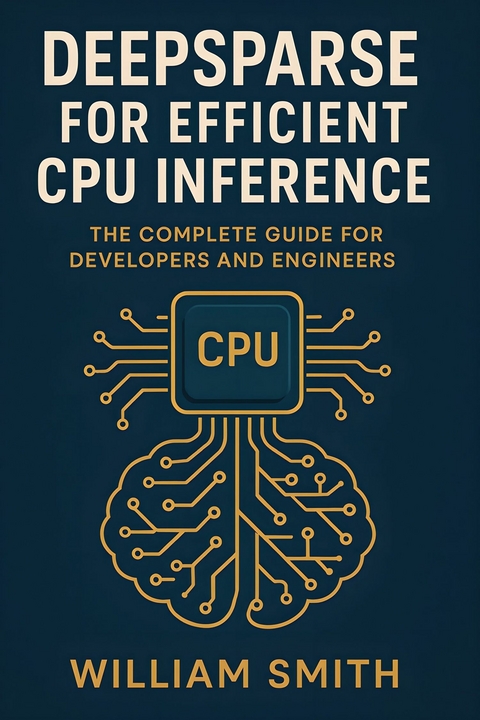
DeepSparse for Efficient CPU Inference (eBook)
250 Seiten
HiTeX Press (Verlag)
978-0-00-097359-7 (ISBN)
'DeepSparse for Efficient CPU Inference'
'DeepSparse for Efficient CPU Inference' is a comprehensive and authoritative guide for engineers, researchers, and practitioners seeking to harness the full potential of sparse neural network models on modern CPU architectures. The book delivers a solid foundation in the theory and practice of model sparsification, detailing essential techniques such as structured and unstructured pruning, quantization, and hardware-aware design. Readers are guided through the intricate balance between model accuracy, computational performance, and resource utilization, with a particular emphasis on achieving efficient, scalable, and reliable inference.
The core of the book explores the DeepSparse Engine, an advanced execution framework purpose-built for high-performance sparse model inference on CPUs. Through clear explanations of the engine's modular architecture, API layers, graph optimization techniques, and memory management innovations, readers gain actionable insight into deploying and optimizing sparse models. In-depth chapters cover integration with ONNX, custom operator development, low-latency real-time applications, NUMA optimizations, and the fine-tuning workflows necessary for robust, production-grade deployments. Best practices are complemented by rigorous methodologies for benchmarking, profiling, and automated performance assurance.
Enriched with real-world case studies in fields such as NLP, computer vision, healthcare, finance, and edge computing, the book offers practical strategies for deploying DeepSparse in both enterprise and distributed environments. Guidance on integrating with existing ML pipelines, ensuring security and compliance, and optimizing for cost and scalability makes this resource invaluable for organizations operating at scale. The concluding chapters illuminate future trends, ongoing research, and the expanding DeepSparse ecosystem, equipping readers with both the technical depth and the strategic perspective to stay ahead in the rapidly evolving field of efficient AI inference.
Chapter 1
Foundations of Sparse Inference and Model Compression
What if we could build intelligent systems that not only learn from data but do so with remarkable efficiency—delivering top-tier performance while consuming a fraction of the compute? This chapter delves into the foundations that make sparse neural network inference and model compression indispensable for modern AI on CPUs. By dissecting the theoretical breakthroughs, engineering trade-offs, and practical metrics behind these innovations, we reveal the blueprint for scaling AI smarter—not just larger.
1.1 Theoretical Underpinnings of Sparse Neural Networks
The utilization of sparsity in neural networks is grounded in profound mathematical and statistical principles that elucidate why sparse architectures can yield efficient and robust models. At the core of these principles lies the interplay between model capacity, generalization, and the intrinsic structure of data representations.
A fundamental motivation for introducing sparsity is rooted in the phenomenon of over-parameterization inherent in modern deep learning models. Contemporary neural networks often possess parameter counts vastly exceeding the sample sizes used for training. Classical statistical learning theory would suggest that such over-parameterization leads to overfitting, yet empirical observations reveal that these models not only fit training data but also generalize well. The reconciliation of this paradox involves a nuanced understanding of effective capacity as opposed to raw parameter count: sparse networks reduce the number of active parameters, thereby constraining the effective hypothesis space. Formally, let the parameter vector
| Erscheint lt. Verlag | 24.7.2025 |
|---|---|
| Sprache | englisch |
| Themenwelt | Mathematik / Informatik ► Informatik ► Programmiersprachen / -werkzeuge |
| ISBN-10 | 0-00-097359-9 / 0000973599 |
| ISBN-13 | 978-0-00-097359-7 / 9780000973597 |
| Informationen gemäß Produktsicherheitsverordnung (GPSR) | |
| Haben Sie eine Frage zum Produkt? |
 EPUB (Adobe DRM)
Größe: 835 KB
Kopierschutz: Adobe-DRM
Adobe-DRM ist ein Kopierschutz, der das eBook vor Mißbrauch schützen soll. Dabei wird das eBook bereits beim Download auf Ihre persönliche Adobe-ID autorisiert. Lesen können Sie das eBook dann nur auf den Geräten, welche ebenfalls auf Ihre Adobe-ID registriert sind.
Details zum Adobe-DRM
Dateiformat: EPUB (Electronic Publication)
EPUB ist ein offener Standard für eBooks und eignet sich besonders zur Darstellung von Belletristik und Sachbüchern. Der Fließtext wird dynamisch an die Display- und Schriftgröße angepasst. Auch für mobile Lesegeräte ist EPUB daher gut geeignet.
Systemvoraussetzungen:
PC/Mac: Mit einem PC oder Mac können Sie dieses eBook lesen. Sie benötigen eine
eReader: Dieses eBook kann mit (fast) allen eBook-Readern gelesen werden. Mit dem amazon-Kindle ist es aber nicht kompatibel.
Smartphone/Tablet: Egal ob Apple oder Android, dieses eBook können Sie lesen. Sie benötigen eine
Geräteliste und zusätzliche Hinweise
Buying eBooks from abroad
For tax law reasons we can sell eBooks just within Germany and Switzerland. Regrettably we cannot fulfill eBook-orders from other countries.
aus dem Bereich


