


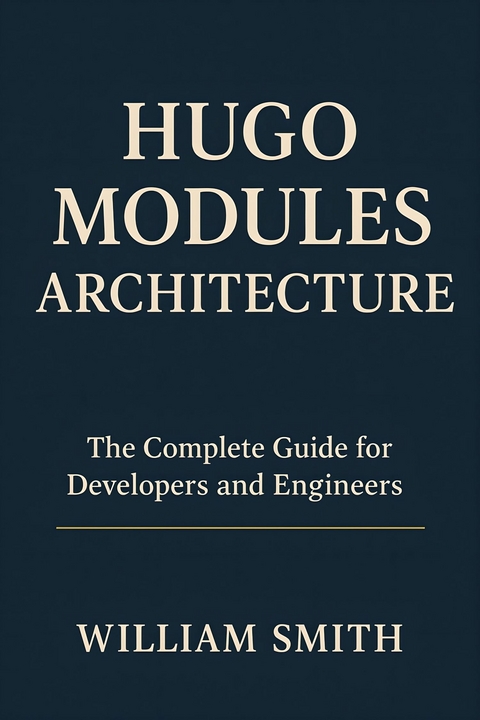
Hugo Modules Architecture (eBook)
250 Seiten
HiTeX Press (Verlag)
978-0-00-097354-2 (ISBN)
'Hugo Modules Architecture'
Unlock the full potential of modern static site development with 'Hugo Modules Architecture,' an essential guide for developers, architects, and organizations leveraging Hugo's powerful modular ecosystem. This comprehensive book offers a deep exploration of the principles, practices, and patterns that underpin the design and implementation of modular architectures in Hugo-from foundational concepts and terminology to advanced compositional techniques. Readers are guided through the historical evolution of Hugo's core, the strategic use of Go modules for seamless dependency management, and the critical steps involved in configuring, building, and deploying module-based sites at any scale.
Delving far beyond the basics, the book presents practical wisdom on organizing large-scale projects with best-practice directory structures, composing themes and content, and managing complex dependency trees. Detailed discussions cover techniques for merging configuration and data, implementing robust inheritance and override mechanisms, and crafting reusable component modules suitable for shared pattern libraries, design systems, and internationalized content. The book also shines a light on common pitfalls, anti-patterns, and performance considerations, equipping readers to troubleshoot and optimize their modular sites with confidence.
In its final chapters, 'Hugo Modules Architecture' addresses the wide-ranging operational, security, and governance challenges facing today's modular projects. Topics include CI/CD strategies, automated module testing, multi-environment deployment, security best practices, and scaling architectures for multi-site, distributed teams. The book concludes with a keen look toward the future: emerging community practices, standardization efforts, marketplace development, and the continuing evolution of the Hugo Modules ecosystem. Whether you are building personal blogs or enterprise-grade digital platforms, this authoritative resource will empower you to design, develop, and maintain modular Hugo sites with clarity, resilience, and innovation.
Chapter 2
In-depth Module Composition
Beyond the basics of modularity lies a world of precise control and inventive site assembly. This chapter draws back the curtain on how high-performing Hugo projects structure, compose, and override their component modules—empowering teams to build intricate, scalable sites by layering content, themes, and logic in sophisticated ways. Prepare to delve beneath simplistic module usage and master the blueprints for advanced modular design patterns.
2.1 Project Layouts and Directory Structures
The organization of Hugo projects significantly impacts maintainability, scalability and collaboration efficiency. Advanced strategies for structuring modular Hugo projects leverage both directory organization and repository layout to maximize isolation, reusability and clarity. This section explores refined approaches to project structuring, juxtaposing single-module versus multi-module architectures, and presents practical repository blueprints with critical analysis.
A core architectural decision in Hugo projects is whether to adopt a single-module or multi-module layout. A single-module project centers around one primary config.toml, with all content, layouts and assets co-located within the module. Conversely, a multi-module architecture decomposes the site into multiple Hugo modules, each potentially maintained as an independent Git repository and managed via the Hugo module system.
The single-module layout offers simplicity by containing all resources under one root directory, reducing configuration complexity and facilitating rapid prototyping. However, as the codebase grows or when multiple teams contribute, this layout suffers from namespace collisions, difficulty in isolating concerns and challenges in reusing components across different projects.
Multi-module layouts address these issues by enabling encapsulation of discrete functionalities-such as themes, component libraries or content bundles-into separate modules. Their namespaces, defined explicitly in module.yaml files, help maintain clear boundaries and prevent name conflicts. Furthermore, multiple teams can develop modules asynchronously, increasing parallelism and improving dependency management.
Namespaces in Hugo modules function as a mechanism to isolate resources such as templates, assets and data files. Following a consistent naming convention for module paths and directory structures is fundamental. A recommended practice is to use a reversed domain naming scheme, similar to Java packages, for module paths (e.g., com.example.blog.components), which minimizes clashes.
Within each module, folder names like layouts, content, assets and data must adhere to Hugo conventions, but the physical directory under version control reflects the module’s namespace hierarchy. For example:
com.example.blog.components/
layouts/
assets/
data/
com.example.common.styles/
assets/
layouts/
Such organization facilitates module publishing and reuse via semantic versioning and module proxies. Imported modules expose their contents under their own namespace, and internal references qualify resource paths accordingly to avoid ambiguity.
Two primary directory patterns emerge in modular Hugo projects: vertical and horizontal decomposition.
- Vertical decomposition partitions the project by concern within the same repository, such as separating content, theme and static assets into distinct modules. Benefits include clear responsibility divisions and ease of localized updates, though some coupling persists due to repository boundaries.
- Horizontal decomposition segments functionality across repositories or directories representing parallel concerns, for example, distinct module repositories for navigation components, image-processing pipelines and layout libraries. This promotes reusability across projects but requires rigorous dependency management.
Employing module.yaml to define explicit dependencies across modules enhances clarity:
path: com.example.blog.main
dependencies:
- path: com.example.common.styles
version: v1.2.3
- path: com.example.blog.components
version: v0.9.0
Multi-repository layouts extend horizontal decomposition to enable large-scale collaboration, where multiple teams maintain discrete modules. Each module repository can have independent release cycles and visibility controls, fostering specialized development and reducing conflicts.
A typical blueprint involves:
An integration repository coordinates module versions and site-level configuration, acting as the assembly point. Each child module (theme, content, UI components) is a Git submodule or fetched via Hugo’s module proxy. This separation reduces merge conflicts and aligns with Continuous Integration workflows.
| Blueprint | Advantages | Drawbacks |
| Monolithic Single Repository | Simplified setup; fewer indirections in local development; direct control over all assets | Scalability limitations; hard to... |
| Erscheint lt. Verlag | 24.7.2025 |
|---|---|
| Sprache | englisch |
| Themenwelt | Mathematik / Informatik ► Informatik ► Programmiersprachen / -werkzeuge |
| ISBN-10 | 0-00-097354-8 / 0000973548 |
| ISBN-13 | 978-0-00-097354-2 / 9780000973542 |
| Informationen gemäß Produktsicherheitsverordnung (GPSR) | |
| Haben Sie eine Frage zum Produkt? |
 EPUB (Adobe DRM)
Größe: 876 KB
Kopierschutz: Adobe-DRM
Adobe-DRM ist ein Kopierschutz, der das eBook vor Mißbrauch schützen soll. Dabei wird das eBook bereits beim Download auf Ihre persönliche Adobe-ID autorisiert. Lesen können Sie das eBook dann nur auf den Geräten, welche ebenfalls auf Ihre Adobe-ID registriert sind.
Details zum Adobe-DRM
Dateiformat: EPUB (Electronic Publication)
EPUB ist ein offener Standard für eBooks und eignet sich besonders zur Darstellung von Belletristik und Sachbüchern. Der Fließtext wird dynamisch an die Display- und Schriftgröße angepasst. Auch für mobile Lesegeräte ist EPUB daher gut geeignet.
Systemvoraussetzungen:
PC/Mac: Mit einem PC oder Mac können Sie dieses eBook lesen. Sie benötigen eine
eReader: Dieses eBook kann mit (fast) allen eBook-Readern gelesen werden. Mit dem amazon-Kindle ist es aber nicht kompatibel.
Smartphone/Tablet: Egal ob Apple oder Android, dieses eBook können Sie lesen. Sie benötigen eine
Geräteliste und zusätzliche Hinweise
Buying eBooks from abroad
For tax law reasons we can sell eBooks just within Germany and Switzerland. Regrettably we cannot fulfill eBook-orders from other countries.
aus dem Bereich


