


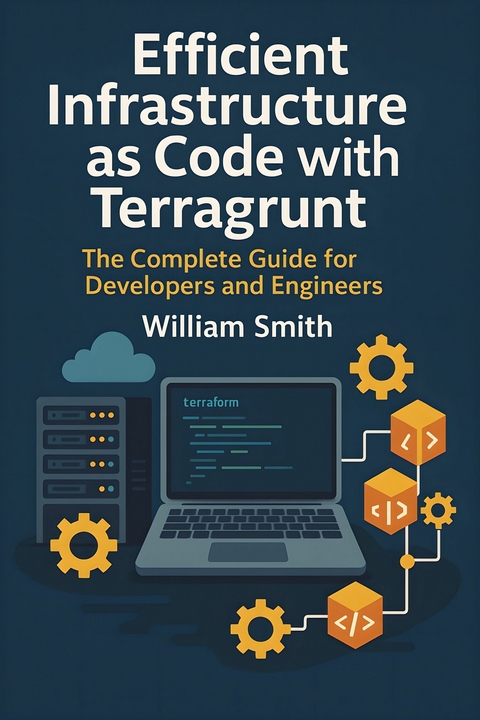
Efficient Infrastructure as Code with Terragrunt (eBook)
250 Seiten
HiTeX Press (Verlag)
978-0-00-097350-4 (ISBN)
'Efficient Infrastructure as Code with Terragrunt'
In the age of rapidly evolving cloud technologies, mastering infrastructure as code (IaC) has become essential for organizations striving for scalable, secure, and reliable systems. 'Efficient Infrastructure as Code with Terragrunt' delivers a comprehensive exploration of modern IaC practices, beginning with foundational principles, advanced Terraform usage, and the motivations behind Terragrunt's emergence. Readers are guided through architectural best practices, the intricacies of scaling IaC for complex teams, and an incisive comparison of tools within the wider ecosystem. The book establishes itself as an indispensable resource for both seasoned DevOps professionals and those embarking on their IaC journey.
The text delves deeply into Terragrunt's architecture, providing actionable guidance for architecting maintainable, modular environments and ensuring state integrity at scale. Through practical patterns and advanced techniques, readers learn to manage remote state, dependencies, policy enforcement, secrets, and compliance. Dedicated sections address multi-environment and multi-account deployments, CI/CD pipeline integration, drift detection, and robust strategies for safe automation. Real-world case studies and anti-patterns help readers avoid common pitfalls while offering blueprints for incremental adoption and refactoring of legacy codebases.
Looking toward the future, the book explores emerging practices such as GitOps-driven workflows, multi-cloud deployment, and service catalog self-service infrastructure. It highlights community-driven advancements and plugin ecosystems, preparing practitioners for what's next in the ever-expanding IaC landscape. Through a blend of deep technical insight and strategic foresight, 'Efficient Infrastructure as Code with Terragrunt' empowers readers to architect, manage, and protect infrastructure at enterprise scale with confidence and agility.
Chapter 2
Architecting Modular and Maintainable Terragrunt Environments
True infrastructure maturity isn’t just about codifying resources—it’s about building environments that elegantly adapt, scale, and persist through years of organizational change. This chapter provides an inside look at the compositional practices, engineering patterns, and configuration strategies that set apart world-class Terragrunt environments. Discover how modularity and maintainability aren’t just buzzwords, but the keys to unlocking robust, future-proof infrastructure operations.
2.1 Best Practices for Repository Structure
Large-scale Terragrunt projects demand thoughtful repository structures to ensure maintainability, scalability, and efficient collaboration across multiple teams and environments. The choice between mono-repository (mono-repo) and poly-repository (poly-repo) models critically influences not only code organization but also development workflows and integration patterns.
The mono-repository strategy consolidates all Terragrunt configurations, modules, and environment overlays into a single repository. This approach simplifies dependency visibility and guarantees consistency when making atomic changes that span multiple environments or modules. It facilitates cross-team collaboration by providing a centralized view of all infrastructure code, reducing the friction of cross-repository coordination. However, mono-repos can become unwieldy as project scale increases, requiring advanced tooling and automation to maintain repository performance and enforce access controls.
Conversely, poly-repositories partition infrastructure code by logical boundaries such as teams, business domains, or product lines, creating separate repositories for distinct infrastructure segments. This isolation facilitates focused access control, smaller codebases per team, and tailored CI/CD pipelines. Nevertheless, poly-repos introduce complexity in dependency management, version synchronization, and cross-cutting infrastructure changes, which must be managed through coherent policies or tooling.
A robust directory hierarchy tailored for large-scale Terragrunt projects must rigorously segregate environments (e.g., development, staging, production) and regions (e.g., us-east-1, eu-west-1) to support infrastructure-as-code best practices such as environment immutability and region-specific customizations.
A recommended pattern organizes Terragrunt configurations in a hierarchy resembling the following:
├── live │ ├── dev │ │ ├── us-east-1 │ │ │ ├── networking │ │ │ ├── database │ │ │ └── app │ │ └── eu-west-1 │ │ ├── networking │ │ ├── database │ │ └── app │ ├── staging │ └── prodEach environment directory holds region-specific folders that encapsulate modules and Terragrunt configuration files. This separation enforces clear boundaries and enables region-level customization through parameter passing or terragrunt.hcl inheritance.
In large projects, Terraform modules are often shared across environments and regions to encourage best practices, DRY principles, and governance. A centralized modules directory, ideally in a sibling repository or within the mono-repo, maintains reusable, versioned modules. For example:
modules ├── networking │ ├── vpc │ └── security-group ├── database │ └── rds └── app ├── backend └── frontendVersioning each module explicitly within Terragrunt configurations supports gradual rollout and rollback while reducing unintended drift across environments. Terragrunt’s dependency blocks facilitate explicit dependencies between modules and ensure reliable orchestration.
As teams multiply and the number of modules grows, cognitive load can become a bottleneck. Key strategies include:
- Consistent Naming Conventions: Establish predictable, semantic directory names and module naming schemes reflecting environment, region, and domain layers.
- Layered Abstraction with terragrunt.hcl: Utilize root-level terragrunt.hcl files to define common remote state backends, provider configurations, and shared variables via include blocks for DRYness.
- Hierarchical Inheritance: Terragrunt’s hierarchical configuration inheritance allows higher-level directories to declare common settings, reducing repetition and potential misconfigurations at lower levels.
- Component Isolation: Segment differing infrastructure concerns using logical folders (e.g., networking, database, application) to isolate context, facilitate focused reviews, and reduce mental overhead.
- Documentation and Diagrams: Accompany directory structures with clear READMEs and architectural diagrams outlining dependencies and interactions between modules and environments.
Consider a global enterprise managing infrastructure across multiple products and geographies using a mono-repo Terragrunt approach:
infrastructure ├── modules │ ├── core-network │ ├── monitoring │ └── storage ├── live │ ├── product-a │ │ ├── dev │ │ │ ├── us-east-1 │ │ │ └── eu-west-1 │ │ └── prod │ ├── product-b │ │ └── staging │ └── shared-services │ └── prodEach product corresponds to a top-level directory under live, separating concerns across business units. Teams owning a product retain autonomy over their environment lifecycle, while shared infrastructure (e.g., monitoring) lives in a dedicated folder. Terragrunt’s include and dependency features ensure modules remain loosely coupled, enabling high-velocity yet safe deployments.
Common repository anti-patterns include:
- Environment-specific Overrides Outside Isolated Paths: Overlapping configuration files scattered across the repository can cause unintended side effects. Strict path segregation and inheritance avoid this.
- Monolithic, Flat Module Repositories: Dense module directories lacking domain-based grouping hinder discoverability and increase onboarding time.
- Hard-Coded Values and Inconsistent Parameterization: Avoid embedding environment or region-specific values directly in modules; rely on Terragrunt dependency injection patterns.
- Neglecting Version Control Best Practices: Ensure atomic commits reflect single logical changes and use consistent branch naming aligned with deployment pipelines to facilitate traceability.
Adopting these practices produces a maintainable Terragrunt repository landscape that scales naturally with organizational growth. It fosters rapid, coordinated collaboration while systematically reducing errors introduced by configuration drift, complexity, and knowledge silos.
2.2 Module Reuse and Composition Strategies
Advanced infrastructure management with Terraform necessitates methodologies that extend beyond basic module invocation, particularly when aiming for scalable, maintainable, and consistent deployments. Deeply parameterized, reusable modules form the backbone of such infrastructures, with Terragrunt providing an orchestration layer to facilitate composition and lifecycle management. This section explores key strategies for module reuse and composition, emphasizing patterns of abstraction, encapsulation, and dependency management, thereby ensuring adherence to DRY (Don’t Repeat Yourself) principles while balancing complexity.
Central to module reuse is deep parameterization, wherein modules expose a rich interface of input variables to accommodate diverse environmental contexts without altering core module logic. This approach enables a single module to serve multiple use cases by adjusting configurations such as resource counts, naming conventions, or provider-specific options. However, excessive parameterization may lead to complex interfaces that challenge both usability and effectiveness. Therefore, modular design should favor sensible defaults and group related parameters into nested structures or objects to enhance clarity. For instance, rather than exposing disparate parameters for networking or security configurations, encapsulating them into reusable maps or complex types improves cohesion and eases parameter management.
Abstraction and encapsulation serve as foundational principles to structure modules hierarchically. Lower-level modules abstract raw infrastructure components, such as individual virtual machines or network subnets, while higher-level modules compose these into coherent application stacks or environments. This layered composition allows infrastructure teams to tailor abstractions at appropriate granularity levels, promoting reuse without exposing unnecessary complexity to end users. Encapsulation additionally entails hiding implementation...
| Erscheint lt. Verlag | 24.7.2025 |
|---|---|
| Sprache | englisch |
| Themenwelt | Mathematik / Informatik ► Informatik ► Programmiersprachen / -werkzeuge |
| ISBN-10 | 0-00-097350-5 / 0000973505 |
| ISBN-13 | 978-0-00-097350-4 / 9780000973504 |
| Informationen gemäß Produktsicherheitsverordnung (GPSR) | |
| Haben Sie eine Frage zum Produkt? |
 EPUB (Adobe DRM)
Größe: 644 KB
Kopierschutz: Adobe-DRM
Adobe-DRM ist ein Kopierschutz, der das eBook vor Mißbrauch schützen soll. Dabei wird das eBook bereits beim Download auf Ihre persönliche Adobe-ID autorisiert. Lesen können Sie das eBook dann nur auf den Geräten, welche ebenfalls auf Ihre Adobe-ID registriert sind.
Details zum Adobe-DRM
Dateiformat: EPUB (Electronic Publication)
EPUB ist ein offener Standard für eBooks und eignet sich besonders zur Darstellung von Belletristik und Sachbüchern. Der Fließtext wird dynamisch an die Display- und Schriftgröße angepasst. Auch für mobile Lesegeräte ist EPUB daher gut geeignet.
Systemvoraussetzungen:
PC/Mac: Mit einem PC oder Mac können Sie dieses eBook lesen. Sie benötigen eine
eReader: Dieses eBook kann mit (fast) allen eBook-Readern gelesen werden. Mit dem amazon-Kindle ist es aber nicht kompatibel.
Smartphone/Tablet: Egal ob Apple oder Android, dieses eBook können Sie lesen. Sie benötigen eine
Geräteliste und zusätzliche Hinweise
Buying eBooks from abroad
For tax law reasons we can sell eBooks just within Germany and Switzerland. Regrettably we cannot fulfill eBook-orders from other countries.
aus dem Bereich


