


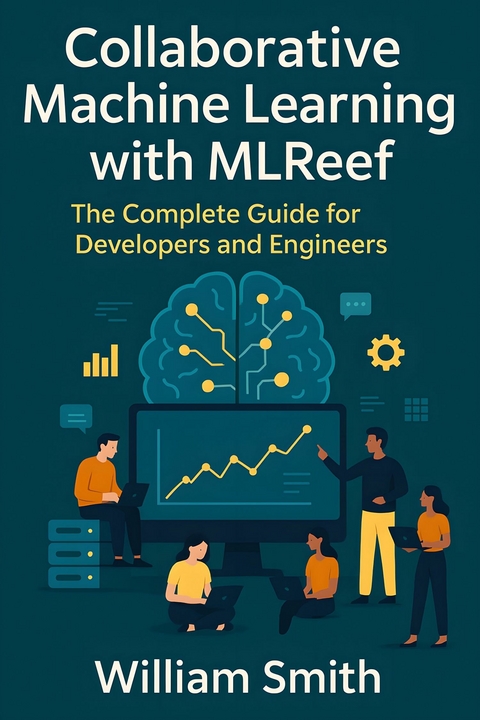
Collaborative Machine Learning with MLReef (eBook)
250 Seiten
HiTeX Press (Verlag)
978-0-00-097349-8 (ISBN)
'Collaborative Machine Learning with MLReef'
'Collaborative Machine Learning with MLReef' offers an in-depth, practical roadmap for teams and organizations navigating the complexities of collaborative machine learning in the modern era. The book opens with a comprehensive introduction to the motivations and evolution of collaborative ML, spotlighting the growing importance of productivity, reproducibility, and innovation in data-driven endeavors. Readers are introduced to the MLReef platform, gaining insight into its philosophy, architecture, and positioning within the dynamic landscape of machine learning collaboration. Through real-world use cases and an examination of key technical features, the book paints a clear picture of MLReef's unique contributions and the challenges that collaborative machine learning seeks to address.
Delving into the architecture and extensibility of MLReef, the book guides readers through system modules, scalable design, API integrations, and robust security mechanisms vital for large-scale adoption. Special emphasis is placed on reproducible research, modular workflow design, collaborative data management, and end-to-end MLOps practices-including deployment, monitoring, and continuous improvement. The text advances through advanced topics such as data lineage, privacy-preserving collaboration, federated learning, and responsible AI, ensuring a 360-degree perspective on what it means to operate at the forefront of collaborative machine learning.
Designed for practitioners, team leaders, and innovators, 'Collaborative Machine Learning with MLReef' serves both as a hands-on technical guide and a thoughtful exploration of community-driven development. It details advanced strategies for experiment tracking, model governance, security, and compliance-empowering readers to build reliable, scalable, and ethical ML solutions. The book concludes by addressing sustainability, open source growth, and the evolving future of distributed artificial intelligence, positioning MLReef as a catalyst for the next generation of collaborative intelligence in machine learning.
Chapter 1
Introduction to Collaborative Machine Learning and MLReef
In today’s landscape of rapid innovation, breakthroughs in machine learning are increasingly shaped by collaborative effort rather than isolated genius. This chapter explores how collective intelligence—amplified by powerful tools like MLReef—transforms the speed, scale, and reproducibility of ML research and application. Journey through the motivations, platforms, and pivotal challenges that define the new era of connected machine learning, and discover why the MLReef ecosystem stands at the forefront of this paradigm shift.
1.1 Motivation for Collaborative Machine Learning
The accelerating complexity of machine learning (ML) projects is fundamentally reshaping how teams organize, develop, and deploy ML solutions. Traditional, siloed approaches to ML development-characterized by isolated efforts with limited communication across roles-are increasingly inadequate in the face of contemporary ML workflows’ scale and scope. The intrinsic drivers toward collaborative machine learning emerge from several intertwined imperatives: scalable productivity, integrative expertise, shared innovation, and reproducibility. Each of these factors reflects both the evolving technological landscape and the organizational demands underpinning machine learning success.
At the heart of the drive for collaboration lies the necessity for scalable productivity. Modern ML projects are labor-intensive and resource-demanding, often requiring rapid iteration over models and hyperparameters, processing massive datasets, and employing advanced computational infrastructure. Individually, practitioners face bottlenecks in cycle times and resource efficiency. Collaborative frameworks enable the distribution and parallelization of workload, accelerating the end-to-end development pipeline. Beyond mere division of labor, collaboration facilitates concurrency in specialized tasks such as data preparation, feature engineering, algorithm tuning, and model validation by distinct roles functioning synergistically. This distributed responsibility model allows teams to leverage parallel expertise workflows, transcending the productivity ceilings that singular, sequential efforts encounter.
Integral to the effective execution of machine learning systems is the integration of diverse expertise. ML projects demand a confluence of competencies ranging from domain knowledge and data engineering to algorithmic development and deployment engineering. Teams composed of heterogeneous skill sets can address the multifaceted challenges complicating ML pipelines. Domain experts supply contextual understanding, ensuring that data is meaningfully curated and utilized; data engineers construct scalable pipelines for ingestion and processing; ML scientists focus on novel algorithm design and model optimization; while engineers ensure the resulting models integrate seamlessly into operational environments with robustness and security. Collaborative ML frameworks act as the connective tissue linking these specialized roles, marshaling their inputs into a cohesive development milieu. Without such integration, knowledge silos impede communication, delay feedback loops, and increase the risk of misalignment between model capabilities and application requirements.
The motivation for collaboration also extends to shared innovation. Machine learning research and applications evolve rapidly, driven by continuous theoretical advances and emergent best practices across industries. Collaborative settings create intellectual cross-pollination where team members exchange insights, establish common standards, and propagate effective methodologies. This collective creativity fosters accelerated problem-solving, encourages experimentation, and facilitates the reuse of codebases and model components. Open exchange of knowledge reduces duplicative effort and leverages existing solutions, streamlining workflows. Furthermore, collaborative environments support mentorship and skill development, promoting sustained organizational capacity building. In this way, collaborative ML transcends incremental task coordination and becomes a catalyst for innovation diffusion within and across teams.
Robust reproducibility constitutes a critical underpinning of machine learning’s scientific rigor and reliability. Reproducibility ensures that results can be independently verified, facilitating debugging, auditability, and continual model improvement. Siloed workflows, which may lack version control, unified documentation, and shared computational environments, challenge reproducibility efforts, often resulting in opaque or inconsistent outcomes. Collaborative tools and platforms enable standardized experiment tracking, precise environment specifications, and versioned data and code management crucial for reliable replication. This transparency empowers teams to build upon past work confidently, avoiding redundant investigations, providing accountability for model decisions, and supporting regulatory compliance when deploying ML solutions in sensitive or high-stakes contexts.
Compounding these motivational factors is the mounting complexity endemic to modern ML workflows. Contemporary pipelines often encompass large-scale data collection and cleaning, extensive feature extraction, model training with deep neural architectures, rigorous validation using multiple metrics, and deployment with continuous monitoring and retraining. Each stage introduces unique challenges such as data drift, ethical considerations, and system integration constraints. Traditional isolated approaches strain under this multifaceted burden, as sequential handoffs between specialists increase latency and introduce error. Collaborative ML environments counteract this by enabling concurrent task execution, enhanced communication protocols, and shared responsibility for end-to-end workflow quality and compliance.
The imperative for collaborative machine learning arises from the compounded demands of scale, expertise breadth, innovation velocity, and reproducibility rigor, which no single individual or siloed team can efficiently address. As ML workflows expand in depth and breadth, collaborative paradigms become essential facilitators for translating complex technical challenges into robust, maintainable, and high-impact solutions. This shift reflects a broader recognition that machine learning initiatives, to succeed at enterprise or research scales, must be orchestrated as integrated team endeavors rather than fragmented solo efforts.
1.2 Evolution of ML Collaboration Platforms
The evolution of machine learning (ML) collaboration platforms reflects the broader trajectory of software development methodologies adapted to the increasing complexity and interdisciplinarity of ML projects. Initially, ML collaboration was conducted through rudimentary, ad-hoc means that mimicked traditional software engineering processes. The early stages were dominated by isolated experimentation, manual sharing of code, and version control systems designed primarily for source code rather than for model artifacts, datasets, or experiment metadata.
In the nascent period of ML development, collaboration resembled conventional software version control workflows. Tools such as CVS and later Subversion (SVN) were commonly employed to maintain codebases, often combined with email or shared network drives to exchange models and data. These setups, while providing basic versioning capabilities, lacked native understanding of machine learning-specific needs such as tracking hyperparameters, dataset versions, and training outcomes. Consequently, collaboration was fragmented and error-prone, impeding reproducibility and scalability.
The introduction and adoption of Git represented a significant advancement. Git’s distributed architecture and robust branching mechanisms addressed many code versioning challenges, enabling more flexible workflows and decentralized contributions. Platforms like GitHub and GitLab popularized pull-request-driven development and integrated issue tracking, facilitating higher degrees of coordination and transparency within ML teams. However, Git’s file-centric model still did not encompass the full spectrum of ML artifacts, specifically the large datasets and model binaries, for which specialized versioning strategies were required.
The subsequent inflection point emerged from the recognition that ML projects revolve around not only source code but also extensive data and complex, non-linear experimentation processes. This understanding spurred the development of dedicated experiment tracking and dataset versioning tools. Systems such as MLflow and DVC (Data Version Control) appeared, enabling researchers and engineers to track experiments systematically, record metrics and parameters, and version large datasets using storage backends optimized for scale. These frameworks allowed for better reproducibility and lineage tracing of model development journeys, addressing a critical deficiency of earlier tools.
Parallel to these innovations, the open-source community began creating platforms tailored explicitly for collaborative ML workflows, integrating model versioning, model registry, and orchestration tools alongside experiment tracking. Notable projects like Kubeflow embodied this shift by...
| Erscheint lt. Verlag | 24.7.2025 |
|---|---|
| Sprache | englisch |
| Themenwelt | Mathematik / Informatik ► Informatik ► Programmiersprachen / -werkzeuge |
| ISBN-10 | 0-00-097349-1 / 0000973491 |
| ISBN-13 | 978-0-00-097349-8 / 9780000973498 |
| Informationen gemäß Produktsicherheitsverordnung (GPSR) | |
| Haben Sie eine Frage zum Produkt? |
 EPUB (Adobe DRM)
Größe: 575 KB
Kopierschutz: Adobe-DRM
Adobe-DRM ist ein Kopierschutz, der das eBook vor Mißbrauch schützen soll. Dabei wird das eBook bereits beim Download auf Ihre persönliche Adobe-ID autorisiert. Lesen können Sie das eBook dann nur auf den Geräten, welche ebenfalls auf Ihre Adobe-ID registriert sind.
Details zum Adobe-DRM
Dateiformat: EPUB (Electronic Publication)
EPUB ist ein offener Standard für eBooks und eignet sich besonders zur Darstellung von Belletristik und Sachbüchern. Der Fließtext wird dynamisch an die Display- und Schriftgröße angepasst. Auch für mobile Lesegeräte ist EPUB daher gut geeignet.
Systemvoraussetzungen:
PC/Mac: Mit einem PC oder Mac können Sie dieses eBook lesen. Sie benötigen eine
eReader: Dieses eBook kann mit (fast) allen eBook-Readern gelesen werden. Mit dem amazon-Kindle ist es aber nicht kompatibel.
Smartphone/Tablet: Egal ob Apple oder Android, dieses eBook können Sie lesen. Sie benötigen eine
Geräteliste und zusätzliche Hinweise
Buying eBooks from abroad
For tax law reasons we can sell eBooks just within Germany and Switzerland. Regrettably we cannot fulfill eBook-orders from other countries.
aus dem Bereich


