


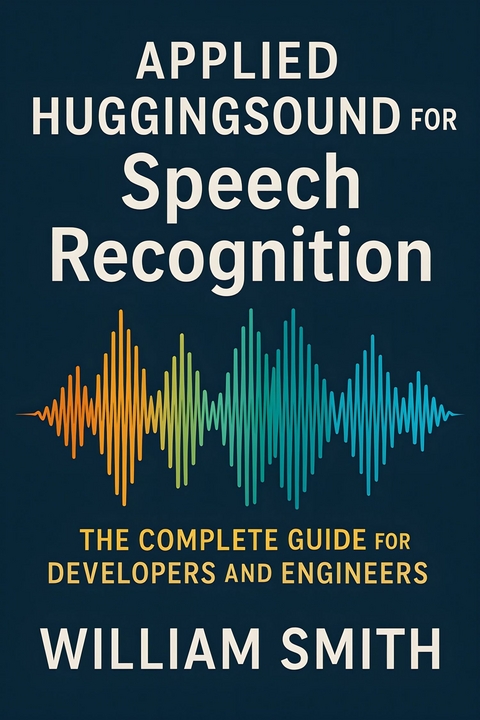
Applied HuggingSound for Speech Recognition (eBook)
250 Seiten
HiTeX Press (Verlag)
978-0-00-097346-7 (ISBN)
'Applied HuggingSound for Speech Recognition'
'Applied HuggingSound for Speech Recognition' is a comprehensive, state-of-the-art guide to building, deploying, and customizing advanced automatic speech recognition (ASR) systems using the HuggingSound framework. Beginning with a solid foundation in modern speech recognition powered by deep learning, the book traces the evolution of ASR from traditional methods to end-to-end neural architectures, introducing HuggingSound's ecosystem and its synergy with Hugging Face and Transformers. Readers will develop a nuanced understanding of sequence modeling, feature extraction, multilingual challenges, and the pivotal role of self-supervised pretraining, including leading models like Wav2Vec 2.0, HuBERT, and Whisper.
Spanning the entire ASR lifecycle, the book delves deeply into data engineering workflows, scalable audio preprocessing, effective dataset curation, and methods for robust annotation management. Comprehensive coverage is given to model selection and fine-tuning, including parameter-efficient adaptation, external language model integration, and innovations for handling both streaming and long-form audio. Readers will gain hands-on strategies for distributed training, hyperparameter optimization, resilient checkpointing, and effective error analysis using state-of-the-art evaluation metrics and pipelines-empowering practitioners to ensure quality, generalization, and reliability in real-world deployments.
Bridging research and production, 'Applied HuggingSound for Speech Recognition' offers an unparalleled exploration of deploying ASR solutions at scale. The text addresses best practices for model packaging, API development, real-time and batch inference, container orchestration, and privacy-compliant security. Through practical guidance on extensibility, debugging, open-source contribution, and integration for cutting-edge applications-including conversational AI, healthcare, multimedia search, translation, and accessibility-the book establishes itself as an essential reference for both academic researchers and industry professionals driving the future of speech technology.
Chapter 2
Data Engineering for Large-Scale Speech Recognition
Building state-of-the-art speech recognition systems at scale requires more than just powerful models—it demands rigorous, strategic handling of massive and diverse audio datasets. This chapter reveals the behind-the-scenes engineering that transforms raw speech into high-quality training assets, exploring the automation, scalability, and quality controls essential for robust ASR in the wild. Discover how experts architect data pipelines to wrangle chaos into clarity, fueling the next generation of multilingual, noise-resilient speech technologies.
2.1 Acquisition and Curation of Speech Datasets
Robust automatic speech recognition (ASR) systems necessitate access to voluminous and diverse speech datasets that encapsulate variability in speaker demographics, acoustic environments, and linguistic content. Advanced sourcing strategies for such datasets encompass public corpora utilization, crowdsourcing efforts, and large-scale data scraping, each accompanied by distinct challenges and considerations.
Publicly available speech corpora serve as foundational resources due to their standardized formats and documented metadata. Examples such as LibriSpeech, Common Voice, and TED-LIUM contain thousands of hours of transcribed speech spanning multiple accents, languages, and acoustic conditions. Leveraging these datasets allows researchers to benchmark models and validate generalization across domains. However, public corpora often exhibit limitations related to representativeness, with biases introduced by their original collection protocols, speaker demographics, and domain specificity. Consequently, careful analysis of dataset composition is required to identify gaps in accent, sociolects, or recording contexts, which may adversely affect model fairness if unaddressed.
Crowdsourcing introduces scalability and diversity by enabling the collection of speech data directly from heterogeneous populations. Platforms such as Amazon Mechanical Turk or dedicated mobile applications facilitate the elicitation of speech under controlled prompts or free-form dictation. Advanced protocols employ dynamic task design to balance speaker anonymity, data quality, and diversity. For example, task assignments can be stratified by geographic region, language proficiency, or age brackets to increase demographic coverage.
Quality control mechanisms are critical, leveraging automated speech analysis and manual review to filter low-quality or non-compliant submissions. These include confidence scoring using pre-trained recognition models, acoustic feature consistency checks, and linguistic plausibility assessments. Additionally, active learning frameworks can iteratively select underrepresented speaker categories or utterance types for labeling, optimizing dataset richness while controlling costs.
Large-scale scraping of speech data from web sources, including podcasts, video transcripts, and broadcast media, enables harvesting of vast audio repositories beyond curated datasets. Advanced pipelines employ automatic segmentation and diarization to isolate speaker turns and relevant acoustic segments, followed by forced alignment with associated transcripts or subtitles. Natural language processing (NLP) techniques extract metadata such as speaker identity, topics, and locale to inform dataset stratification.
However, data scraping introduces complex challenges regarding data provenance, consent, and quality. The heterogeneity of source materials may cause noisy labels and uneven transcript accuracy. Thus, robust preprocessing, including noise filtering, language detection, and transcript alignment correction, is mandatory to enhance usability for ASR training.
Data acquisition processes must navigate stringent legal and ethical frameworks to safeguard individual rights and comply with jurisdictional regulations. Intellectual property rights and licensing terms of sourced speech materials require thorough examination. Utilizing open licenses, such as Creative Commons Attribution-ShareAlike (CC BY-SA), where permissible, ensures compliance while allowing redistributability and reuse.
Informed consent is paramount when collecting speech from individuals, particularly via crowdsourcing. Privacy-preserving mechanisms include anonymization of personal identifiers and minimization of demographic data collection to only what is essential. Techniques such as differential privacy can be employed during data aggregation phases to obscure individual contributions while preserving statistical utility.
Data representativeness underpins fairness in ASR models. Thus, explicit strategies to include minority languages, dialects, and underrepresented speaker groups must be formalized. Failure to ensure such inclusivity risks perpetuating systemic biases and performance disparities across populations. Frameworks for ongoing evaluation and correction using bias metrics and error disparity analysis are recommended for maintaining equitable model behavior.
A practical compliance framework integrates legal, ethical, and technical controls throughout data lifecycle stages. The initial phase involves due diligence on dataset licenses, rights, and consent scope. Subsequent phases implement privacy-preserving data handling protocols, including secure storage, controlled access, and encryption as needed.
Monitoring adherence to ethical standards requires establishing governance bodies comprising legal experts, ethicists, and domain specialists. Documentation practices, such as datasheets for datasets, enhance transparency by cataloging acquisition methods, demographic coverage, and known limitations.
Finally, continuous auditing combined with adaptive curation enables datasets to evolve responsively to regulatory developments and emerging fairness concerns. Automated compliance tools leveraging natural language understanding and pattern recognition can assist in flagging potential issues preemptively.
-
Diversity and Representativeness: Intentionally sourcing data across multiple demographic, linguistic, and acoustic dimensions mitigates biases and enhances model robustness.
-
Quality Assurance: Implementing multi-layer filtering, review, and validation processes ensures data integrity necessary for effective ASR training.
-
Legal Rights and Licensing: Rigorous assessment of intellectual property and license constraints prevents infringement and promotes lawful dataset reuse.
-
Privacy and Ethics: Respecting speaker consent, anonymization, and ethical guidelines protects individual rights and fosters public trust.
-
Governance and Documentation: Systematic oversight, transparent reporting, and compliance audits embed accountability throughout dataset management.
Incorporating these advanced acquisition and curation methodologies establishes a rigorous foundation for constructing speech datasets that are not only vast and diverse but also ethically and legally sound, thereby strengthening the fairness and generalizability of ASR systems in real-world applications.
2.2 Audio Preprocessing Pipelines
Designing scalable audio preprocessing pipelines requires a balance between maximizing throughput, ensuring consistent and lossless transformations, and maintaining the integrity of the audio features critical for automatic speech recognition (ASR) systems. The preprocessing stage directly influences the quality of acoustic representations and consequently the performance of downstream ASR models. Core transformations-resampling, volume normalization, silence removal, and channel conversion-must be carefully orchestrated to accommodate heterogeneous audio datasets while preserving essential speech characteristics.
-
Resampling constitutes the foundational stage in many preprocessing workflows. Audio data often originate from diverse sources, recorded at different sampling rates, resulting in heterogeneity that complicates feature extraction and model training. Standardizing all audio streams to a target sampling rate, typically 16 kHz or 8 kHz for speech applications, is essential for consistency. Ideal resampling preserves the frequency content, avoiding aliasing or spectral distortion. High-quality polyphase filters or sinc interpolation resamplers optimize this step. The computational cost of resampling scales with input size, so efficient implementations leveraging streaming and block-wise processing are vital for throughput. Incorrect or naïve resampling can introduce artifacts that degrade phonetic cues and adversely affect acoustic modeling.
-
Volume normalization addresses the amplitude variability inherent in real-world audio, caused by differing microphone gains, speaker distances, or environmental factors. The goal is to produce uniform loudness levels without altering the dynamic range or causing...
| Erscheint lt. Verlag | 24.7.2025 |
|---|---|
| Sprache | englisch |
| Themenwelt | Mathematik / Informatik ► Informatik ► Programmiersprachen / -werkzeuge |
| ISBN-10 | 0-00-097346-7 / 0000973467 |
| ISBN-13 | 978-0-00-097346-7 / 9780000973467 |
| Informationen gemäß Produktsicherheitsverordnung (GPSR) | |
| Haben Sie eine Frage zum Produkt? |
 EPUB (Adobe DRM)
Größe: 844 KB
Kopierschutz: Adobe-DRM
Adobe-DRM ist ein Kopierschutz, der das eBook vor Mißbrauch schützen soll. Dabei wird das eBook bereits beim Download auf Ihre persönliche Adobe-ID autorisiert. Lesen können Sie das eBook dann nur auf den Geräten, welche ebenfalls auf Ihre Adobe-ID registriert sind.
Details zum Adobe-DRM
Dateiformat: EPUB (Electronic Publication)
EPUB ist ein offener Standard für eBooks und eignet sich besonders zur Darstellung von Belletristik und Sachbüchern. Der Fließtext wird dynamisch an die Display- und Schriftgröße angepasst. Auch für mobile Lesegeräte ist EPUB daher gut geeignet.
Systemvoraussetzungen:
PC/Mac: Mit einem PC oder Mac können Sie dieses eBook lesen. Sie benötigen eine
eReader: Dieses eBook kann mit (fast) allen eBook-Readern gelesen werden. Mit dem amazon-Kindle ist es aber nicht kompatibel.
Smartphone/Tablet: Egal ob Apple oder Android, dieses eBook können Sie lesen. Sie benötigen eine
Geräteliste und zusätzliche Hinweise
Buying eBooks from abroad
For tax law reasons we can sell eBooks just within Germany and Switzerland. Regrettably we cannot fulfill eBook-orders from other countries.
aus dem Bereich


