


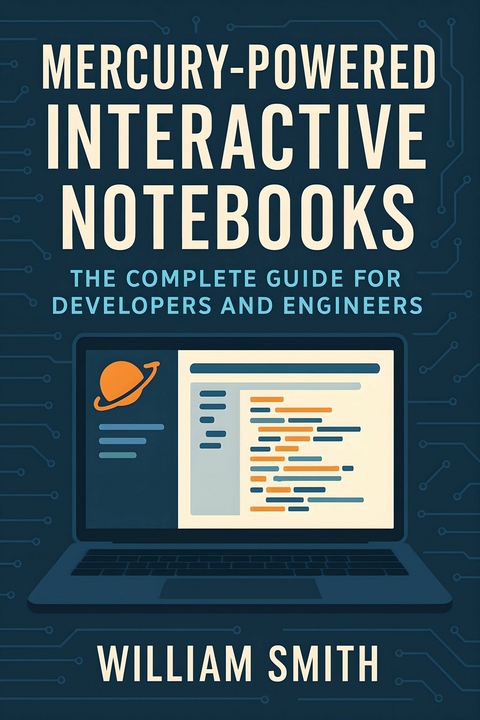
Mercury-Powered Interactive Notebooks (eBook)
250 Seiten
HiTeX Press (Verlag)
978-0-00-097344-3 (ISBN)
'Mercury-Powered Interactive Notebooks'
'Mercury-Powered Interactive Notebooks' is a comprehensive exploration of the next generation of computational notebooks, designed for technical leaders, developers, and data professionals striving to push the boundaries of interactivity and reproducibility. This authoritative guide begins by tracing the evolution of interactive notebooks, from their early inception to the cutting-edge innovations powering today's computational environments. Through incisive analyses of traditional limitations and architectural patterns, it illuminates the motivations behind Mercury's design principles and its unique approach to enhancing both user and developer experience.
At its core, the book offers an in-depth examination of Mercury's robust system architecture, featuring support for polyglot kernels, reactive execution, and advanced plugin capabilities. Readers will learn how Mercury fosters seamless interoperability across languages, delivers high-performance parallel and distributed computations, and empowers data visualization, real-time collaborative editing, and parameterized workflow authoring. Detailed chapters demystify topics such as secure sandboxed execution, diagnostics and kernel health, sophisticated data engineering and ML pipeline orchestration, and reproducible production deployment using modern DevOps practices.
As the narrative progresses, 'Mercury-Powered Interactive Notebooks' expands its focus to strategic enterprise concerns, including security, compliance, scalability, and cross-organization collaboration. The book concludes by envisioning the future of interactive computing, highlighting Mercury's innovative integration with AI, domain-specific extensions, quantum and edge computing, and responsible stewardship in digital science. Packed with actionable insights, best practices, and forward-looking perspectives, this is an essential resource for those building or scaling modern, secure, and extensible interactive notebook platforms.
Chapter 2
Mercury: System Architecture and Core Components
Behind every truly innovative interactive notebook lies a sophisticated system architecture—one built not just for computation, but for resilience, flexibility, and seamless collaboration. This chapter dissects the Mercury platform from the inside out, unraveling its modular core components and revealing the engineering breakthroughs and design trade-offs that unlock new levels of interactivity, extensibility, and performance.
2.1 High-Level System Overview
The Mercury system architecture is designed to orchestrate and execute complex computational workflows with efficiency and scalability. The architecture comprises four principal components: Frontend, Orchestration Backend, Execution Engines, and Persistence Layers-each fulfilling distinct yet tightly integrated roles within the ecosystem. Their interplay ensures seamless submission, scheduling, execution, and state management of diverse computational tasks. The following diagram illustrates the system-wide context and component interactions.
The Frontend Interface serves as the gateway through which users interact with Mercury. It supports workflow definition, monitoring, and results retrieval via programmatic APIs and graphical user interfaces. By abstracting the underlying complexity, the Frontend allows users to compose workflows with modular building blocks and visual tools while managing authentication, validation, and input preprocessing.
At the core, the Orchestration Backend is responsible for workflow management and task scheduling. It receives the structured workflow representations from the Frontend, interprets the dependencies and resource requirements, and coordinates task dispatch to various Execution Engines. The Orchestration Backend maintains a global view of the system state, tracking task progress, handling retries, and implementing policies for load balancing and fault tolerance. It leverages event-driven architectures and message queues for asynchronous command and state propagation, ensuring responsiveness and scalability.
The Execution Engines constitute a heterogeneous pool of computation units optimized for running specific classes of tasks. These engines may range from local thread pools and containerized environments to cloud-based serverless functions and GPU-accelerated clusters. Mercury’s modular design allows engines to register dynamically with the Orchestration Backend, advertising their capabilities and availability. During execution, the engines perform tasks in isolation, enforce sandboxing constraints, and report status and outputs back to the orchestration layer. This division facilitates parallelism and resource specialization, maximizing throughput and minimizing execution latency.
Critical to system resiliency and enablement of advanced features is the Persistence Layer, which comprises one or more storage systems dedicated to durable state and data retention. It stores workflow metadata, intermediate artifacts, logs, and final outputs. The Persistence Layer supports transactional consistency for state updates and offers efficient querying facilities for historical audit and incremental execution optimizations. Data replication and sharding strategies ensure fault tolerance and performance scaling. Furthermore, persistent checkpointing enables recovery from failures and facilitates long-running or multi-phase workflows.
The interactions among these components are orchestrated through well-defined protocols and data models, with JSON or protobuf schemas encoding workflow and task representations. Communication between components employs a mix of synchronous REST APIs and asynchronous messaging patterns, balancing responsiveness and throughput. Security is enforced at multiple layers via authentication, authorization, and encryption mechanisms to protect user data and computational assets.
This architecture situates Mercury as a flexible, extensible platform capable of integrating emerging computational paradigms and resource providers. By decoupling concerns into discrete layers that interact through standardized interfaces, Mercury achieves a balance between system complexity and operational transparency, facilitating both robust enterprise deployments and experimental research applications.
2.2 Kernel and Execution Model
Mercury’s dynamic support for polyglot computational kernels represents a pivotal advancement in heterogeneous computing frameworks, addressing the challenges of seamless execution and management across diverse programming environments. At its core, Mercury abstracts the complexities of deploying and coordinating multiple language runtimes, enabling the integration of kernels written in languages such as Python, R, Julia, and custom domain-specific languages within a unified execution context.
The execution life cycle of a Mercury kernel is defined through a sequence of well-orchestrated phases: initialization, execution, suspension, resumption, and termination. Upon instantiation, Mercury dynamically selects the appropriate kernel runtime based on metadata descriptors and runtime profiling information. This allows the invocation of kernels written in different languages without manual configuration or code conversion. Its dynamic loader utilizes language-specific JIT compilation or interpretation mechanisms, enabling runtime optimizations and adaptive resource allocation tailored to kernel characteristics and workload demands.
State management within Mercury is achieved through an innovative hybrid approach combining in-memory context preservation with persistent checkpointing. During execution, kernels maintain their computational state within isolated per-kernel memory spaces. These memory spaces are encapsulated using lightweight containers that employ copy-on-write semantics, ensuring minimal overhead when duplicating or migrating kernel states. Checkpointing occurs asynchronously, leveraging distributed object stores and versioned state snapshots to allow fault-tolerant recovery and cross-kernel state sharing. This mechanism supports preemptive kernel suspension and dynamic resource reallocation, critical for high-throughput workloads and elasticity in cloud environments.
Isolation techniques in Mercury are meticulously engineered to balance performance and security. Kernels operate within sandboxed environments instantiated via secure containers that enforce strict CPU, memory, and I/O quotas. These containers employ OS-level namespace isolation and seccomp filters to limit system call exposure, effectively preventing interference between kernels and reducing attack surfaces. Additionally, communication channels between kernels are mediated through capability-based message passing interfaces that enforce fine-grained access controls and prevent data leakage. This strict isolation combined with supervised inter-kernel communication enables scalable concurrent execution without compromising system integrity.
When comparing Mercury’s kernel execution model to those of other prominent platforms such as Apache Spark, Kubernetes-based function orchestrators, and serverless computing frameworks, several distinguishing factors emerge. Unlike Spark, which relies on JVM-centric execution and immutable RDD data models, Mercury supports fully mutable kernel state across arbitrary languages, promoting iterative and dynamic computational patterns. Its state persistence surpasses typical stateless function-as-a-service systems by integrating transparent checkpointing and state migration capabilities. Furthermore, Mercury adopts a concurrency model based on asynchronous event-driven scheduling enhanced with kernel-level cooperative multitasking. This contrasts with Kubernetes’ focus on container orchestration at coarse granularity and serverless platforms’ reliance on ephemeral stateless invocations.
Reliability in Mercury is fortified through fault isolation and deterministic recovery semantics. By continuously persisting kernel states and decoupling execution from physical resources, Mercury can seamlessly reschedule or replicate failing kernels without loss of computational progress. This approach contrasts with traditional batch processing systems, where failure recovery often entails job restarts and recomputation overhead. Mercury’s runtime also provides programmable failure handlers embedded within kernels, enabling adaptive retry policies and error-aware state transitions.
Concurrency management in Mercury harnesses a multi-tiered strategy that integrates fine-grained task parallelism within kernels and coarse-grained parallelism across kernels. The runtime schedules kernel executions using a work-stealing algorithm optimized for dynamic workload balancing. Kernels expose asynchronous APIs that allow non-blocking invocation and concurrent state updates with atomic consistency guarantees. Compared to platforms that rely predominantly on thread pools or container replication, Mercury’s model delivers enhanced throughput and latency predictability in heterogeneous, polyglot environments.
In sum, Mercury’s execution model harmonizes advanced state management, robust isolation, and scalable concurrency to support polyglot kernels with...
| Erscheint lt. Verlag | 24.7.2025 |
|---|---|
| Sprache | englisch |
| Themenwelt | Mathematik / Informatik ► Informatik ► Programmiersprachen / -werkzeuge |
| ISBN-10 | 0-00-097344-0 / 0000973440 |
| ISBN-13 | 978-0-00-097344-3 / 9780000973443 |
| Informationen gemäß Produktsicherheitsverordnung (GPSR) | |
| Haben Sie eine Frage zum Produkt? |
 EPUB (Adobe DRM)
Größe: 767 KB
Kopierschutz: Adobe-DRM
Adobe-DRM ist ein Kopierschutz, der das eBook vor Mißbrauch schützen soll. Dabei wird das eBook bereits beim Download auf Ihre persönliche Adobe-ID autorisiert. Lesen können Sie das eBook dann nur auf den Geräten, welche ebenfalls auf Ihre Adobe-ID registriert sind.
Details zum Adobe-DRM
Dateiformat: EPUB (Electronic Publication)
EPUB ist ein offener Standard für eBooks und eignet sich besonders zur Darstellung von Belletristik und Sachbüchern. Der Fließtext wird dynamisch an die Display- und Schriftgröße angepasst. Auch für mobile Lesegeräte ist EPUB daher gut geeignet.
Systemvoraussetzungen:
PC/Mac: Mit einem PC oder Mac können Sie dieses eBook lesen. Sie benötigen eine
eReader: Dieses eBook kann mit (fast) allen eBook-Readern gelesen werden. Mit dem amazon-Kindle ist es aber nicht kompatibel.
Smartphone/Tablet: Egal ob Apple oder Android, dieses eBook können Sie lesen. Sie benötigen eine
Geräteliste und zusätzliche Hinweise
Buying eBooks from abroad
For tax law reasons we can sell eBooks just within Germany and Switzerland. Regrettably we cannot fulfill eBook-orders from other countries.
aus dem Bereich


