


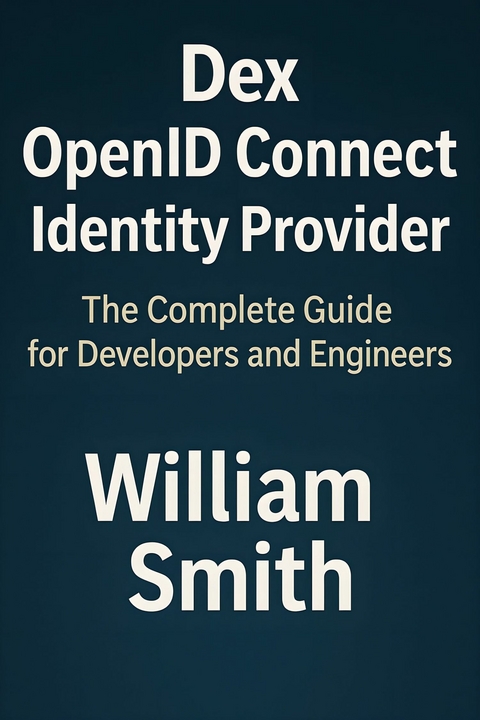
Dex OpenID Connect Identity Provider (eBook)
250 Seiten
HiTeX Press (Verlag)
978-0-00-097341-2 (ISBN)
'Dex OpenID Connect Identity Provider'
Dex OpenID Connect Identity Provider offers a comprehensive and authoritative guide to mastering Dex-an open-source identity provider designed for modern cloud-native environments. This book opens with a foundational exploration of digital identity and access management, clarifying key concepts like authentication, authorization, identity federation, and the evolution of open standards such as OAuth2 and OpenID Connect. It establishes essential security considerations while providing practical insight for readers seeking a holistic understanding of identity systems in distributed cloud architectures.
Through a detailed examination of Dex's technical architecture, the book walks readers from internal component design to advanced configuration, extensibility, and integration with external identity providers via robust connectors. Practical deployment models-including binaries, containers, and Kubernetes operators-are demystified alongside stateful storage strategies, network security, high availability, monitoring, and disaster recovery. Hands-on chapters guide administrators and engineers through real-world integrations with LDAP, Active Directory, SAML, cloud providers, and multi-connector authentication flows, pairing technical depth with actionable best practices.
Beyond implementation, the book addresses high-level security and compliance, incident response, scaling in Kubernetes, and emerging identity paradigms such as Zero Trust and decentralized identity. Developers benefit from practical patterns, CI/CD approaches, debugging techniques, and guidance on extending Dex's ecosystem. Culminating in case studies, migration strategies, operational advice, and a forward-looking view of Dex's roadmap, this work is an indispensable resource for professionals building reliable and secure identity platforms in dynamic IT landscapes.
Chapter 1
Foundations of Identity and Access Management
How do digital systems recognize and trust users, systems, or applications across increasingly complex and distributed environments? This chapter illuminates the robust theoretical and practical frameworks that underpin secure, federated identity and access management. Dive deep into the evolution of protocols, models, and standards that have shaped modern authentication—and discover the nuanced security considerations critical to building and maintaining trust in the cloud era.
1.1 Principles of Digital Identity
Digital identity constitutes an abstract representation of an entity within a computational or networked environment. Unlike physical identifiers, digital identity encapsulates a collection of attributes, credentials, and associated metadata that collectively establish a distinct presence in a distributed system. The abstraction fundamentally separates the notion of who an entity is from the methods used to identify or authenticate it, enabling flexible and contextual interpretation tailored to diverse applications.
At the core of digital identity lies the necessity for unique identification, which serves as the foundation for all subsequent interactions and trust derivations. Unique identifiers—often realized as globally or locally unique strings, numbers, or key pairs—are pivotal in distinguishing one entity from another without ambiguity. Common constructs include universally unique identifiers (UUIDs), decentralized identifiers (DIDs), and certificate-based public key identities. The choice of identifier format is highly influenced by system scale, governance models, and security requirements. For example, DIDs provide self-sovereignism and decentralized control, crucial in environments requiring minimal central authority, while traditional X.509 certificates anchor identities within a PKI framework governed by hierarchical trust.
Identity uniqueness must be established and managed across multiple dimensions: organizational boundaries, geographical regions, and technological platforms. This introduces inherent challenges in representation consistency and semantic alignment. Synchronization and reconciliation mechanisms are necessary to handle attribute heterogeneity and divergent identity schemas, especially in federated systems or cross-domain identity management. The adoption of standardized attribute taxonomies and ontologies, such as those found in SAML, OAuth scopes, or SCIM schemas, facilitates interoperable exchange and unified understanding of identity traits.
An entity’s digital identity comprises a diverse and extensible set of attributes reflecting characteristics, permissions, and context. Attributes may be intrinsic (e.g., biometric data, birthdate), assigned (e.g., employee ID, role), or derived (e.g., reputation score, transaction history). These attributes provide both descriptive and operational semantics, enabling fine-grained access control, behavioral profiling, and personalized interactions. Attribute assertions can be issued and vouched for by trusted authorities, enhancing the reliability and accountability of the identity representation.
The identity lifecycle encapsulates a sequence of phases from initial creation through active use, modification, and eventual deprovisioning or archival. Lifecycle management addresses not only the availability of identity data but also the enforcement of integrity, confidentiality, and compliance over time. Key processes include identity proofing, credential issuance, attribute update, delegation, and revocation. Identity proofing involves validating that a claimed identity corresponds to a real-world entity or a valid system agent, often through multi-factor authentication, biometric verification, or third-party attestations. This phase is critical to prevent impersonation and Sybil attacks—where malicious actors create multiple false identities.
Once established, digital identities must maintain representation consistency amid dynamic changes. This consistency is challenging in distributed architectures where replication, caching, and eventual consistency models may introduce transient conflicts or stale data. Policies for attribute synchronization, versioning, and conflict resolution are essential to preserve uniformity while accommodating latency and fault tolerance. Distributed ledger technologies and blockchain have been explored as mechanisms to provide tamper-evident, decentralized records to enhance consistency and trustworthiness in identity management.
Moreover, privacy and regulatory considerations permeate all aspects of digital identity principles. Attributes containing personally identifiable information (PII) demand strict handling according to frameworks such as GDPR or HIPAA. Techniques like attribute minimization, consent management, and selective disclosure protocols (e.g., zero-knowledge proofs, anonymous credentials) are employed to balance functionality with protection of individual privacy rights.
In multi-organizational and cross-jurisdictional contexts, interoperability challenges arise from heterogeneous infrastructure, schema disparity, and divergent legal frameworks. Federated identity models and protocols such as SAML, OpenID Connect, and WS-Federation facilitate identity federation by enabling an entity’s identity assertions to be trusted and consumed by multiple relying parties across domains. However, federation often requires complex trust anchors and governance agreements to resolve conflicts in attribute semantics, identity assurance levels, and auditability.
The encapsulation of identity as an abstraction, underpinned by robust uniqueness, rich attribute association, and dynamic lifecycle governance, thus forms the cornerstone of effective identity management in distributed systems. Appropriate architectural choices and adherence to principled frameworks are imperative to ensure that digital identities serve as reliable, secure, and privacy-respecting enablers within complex, heterogeneous technological landscapes.
1.2 Authentication and Authorization Models
Authentication and authorization constitute fundamental pillars of secure system design, yet their distinct purposes and mechanisms often invite confusion. Authentication is the process through which an entity proves its identity to a system, answering the question “Who are you?” In contrast, authorization determines the scope of permissible actions associated with that authenticated identity, effectively answering “What are you allowed to do?” This separation allows for flexible security architectures, enabling systems to validate identities independently of access rights management.
Classical authentication models rely on single-factor methods, typically a secret password or token. However, evolving threat landscapes motivated the adoption of multi-factor authentication (MFA), which requires evidence from two or more independent categories:
- knowledge (e.g., passwords),
- possession (e.g., hardware tokens or mobile devices), and
- inherence (e.g., biometric traits).
By combining factors, MFA significantly heightens assurance levels, mitigating risks from stolen credentials or clipboard sniffing attacks.
Contemporary authentication also leverages cryptographic assertions, forming the backbone of strong identity verification in distributed systems. Public key infrastructures (PKI) underpin these methods, where digital certificates and signatures cryptographically bind an entity’s identity to a key pair. This asymmetry enables proof of identity without exposing secrets. Protocols such as OAuth 2.0 and OpenID Connect (OIDC), widely adopted on the web, incorporate JSON Web Tokens (JWTs) as bearer tokens carrying assertions about authenticated users. These tokens include claim sets cryptographically signed by trusted authorities, allowing resource servers to verify authentication status and associated attributes efficiently.
Federated identity models extend authentication boundaries beyond the immediate system, enabling trust relationships between identity providers (IdPs) and relying parties. Federation allows users to authenticate via a centralized IdP and gain single sign-on (SSO) access across multiple domains, minimizing credential proliferation and enhancing user experience. Security Assertion Markup Language (SAML) and OIDC are prominent protocols supporting federation. SAML utilizes XML-based assertions exchanged via browser redirects, while OIDC builds atop OAuth 2.0 with JSON-centric messages suited for mobile and modern web applications. Federation introduces complex trust considerations, as relying parties must assess the risk and robustness profile of partner IdPs to define appropriate trust boundaries.
Authorization models range from coarse to fine-grained, governed by policies reflecting organizational rules and risk appetites. Role-Based Access Control (RBAC) simplifies authorization by associating permissions with roles assigned to users. Roles encapsulate job functions or privilege aggregates, facilitating scalable management. Despite widespread use, RBAC may lack the expressiveness needed for dynamic contexts or delegated permissions.
Policy-Based Access...
| Erscheint lt. Verlag | 24.7.2025 |
|---|---|
| Sprache | englisch |
| Themenwelt | Mathematik / Informatik ► Informatik ► Programmiersprachen / -werkzeuge |
| ISBN-10 | 0-00-097341-6 / 0000973416 |
| ISBN-13 | 978-0-00-097341-2 / 9780000973412 |
| Informationen gemäß Produktsicherheitsverordnung (GPSR) | |
| Haben Sie eine Frage zum Produkt? |
 EPUB (Adobe DRM)
Größe: 737 KB
Kopierschutz: Adobe-DRM
Adobe-DRM ist ein Kopierschutz, der das eBook vor Mißbrauch schützen soll. Dabei wird das eBook bereits beim Download auf Ihre persönliche Adobe-ID autorisiert. Lesen können Sie das eBook dann nur auf den Geräten, welche ebenfalls auf Ihre Adobe-ID registriert sind.
Details zum Adobe-DRM
Dateiformat: EPUB (Electronic Publication)
EPUB ist ein offener Standard für eBooks und eignet sich besonders zur Darstellung von Belletristik und Sachbüchern. Der Fließtext wird dynamisch an die Display- und Schriftgröße angepasst. Auch für mobile Lesegeräte ist EPUB daher gut geeignet.
Systemvoraussetzungen:
PC/Mac: Mit einem PC oder Mac können Sie dieses eBook lesen. Sie benötigen eine
eReader: Dieses eBook kann mit (fast) allen eBook-Readern gelesen werden. Mit dem amazon-Kindle ist es aber nicht kompatibel.
Smartphone/Tablet: Egal ob Apple oder Android, dieses eBook können Sie lesen. Sie benötigen eine
Geräteliste und zusätzliche Hinweise
Buying eBooks from abroad
For tax law reasons we can sell eBooks just within Germany and Switzerland. Regrettably we cannot fulfill eBook-orders from other countries.
aus dem Bereich


