


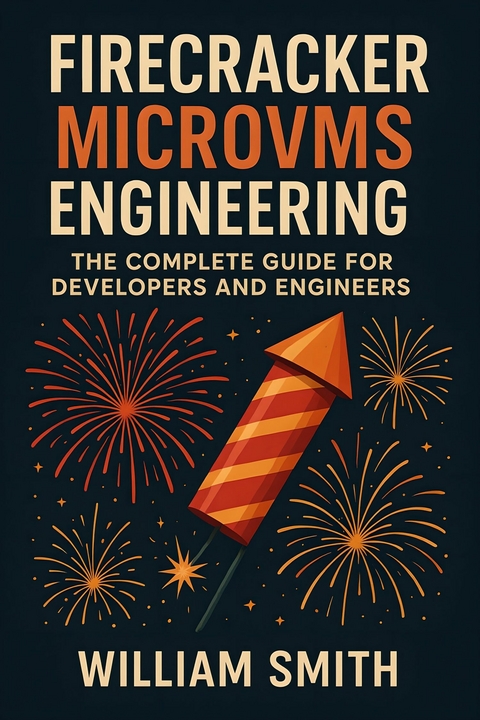
Firecracker MicroVMs Engineering (eBook)
250 Seiten
HiTeX Press (Verlag)
9780000973399 (ISBN)
'Firecracker MicroVMs Engineering'
'Firecracker MicroVMs Engineering' offers a comprehensive deep dive into the principles, architecture, and real-world applications of Firecracker-one of the most innovative micro-virtualization technologies reshaping cloud infrastructure. The book begins by mapping the evolution of virtualization, from traditional hypervisors and containers to the clear advantages of microVMs, spotlighting Firecracker's minimalistic yet robust design. Readers gain an immediate understanding of why secure, high-performance workload isolation is paramount for modern serverless computing, CI/CD, and multi-tenant environments.
Presented with clarity and depth, each chapter dissects Firecracker's internal architecture, security mechanisms, and performance optimizations. The text meticulously explores Firecracker's single-process model, device emulation, networking, and storage subsystems, guiding engineers through practical configuration, performance tuning, and resource management. Security receives critical attention, with coverage of risk modeling, syscall filtering, sandboxing, and advanced defense strategies-empowering organizations to confidently deploy microVMs at scale with auditable, hardened security postures.
The book extends beyond foundational knowledge, addressing orchestration with Kubernetes and Nomad, integration with serverless and CI/CD platforms, and emerging domains such as edge computing, AI/ML workloads, and confidential computing. With thorough guidance on customization, monitoring, Snapshot and image management, and fleet operations, 'Firecracker MicroVMs Engineering' is an indispensable resource for infrastructure engineers, security architects, and systems researchers pushing the boundaries of modern virtualization.
Chapter 2
Firecracker Architecture and Core Concepts
Under the hood, Firecracker is radically different from conventional virtualization engines—not by accident, but by meticulous design. This chapter pulls back the curtain on Firecracker’s internal machinery, revealing how focused simplicity, stringent privilege separation, and modern interface design produce a platform purpose-built for speed, scale, and security.
2.1 Process and Thread Model
Firecracker employs a uniquely streamlined approach to virtualization by leveraging a single-process architecture paired with a minimal thread design. This model diverges from traditional hypervisor implementations that typically rely on multiple processes or a more extensive threading infrastructure to manage VM lifecycle, I/O, and auxiliary tasks. The fundamental goal behind Firecracker’s architecture is to enforce strict privilege separation and reduce complexity, thereby enhancing security, determinism, and system observability.
At the core of Firecracker’s design is a single user-space process responsible for managing multiple microVMs. Each microVM is represented as a lightweight abstraction within this process, eliminating the overhead and context-switching penalty associated with interprocess communication. This consolidation enables tighter control over resource management and fault containment, as well as a simplified security model that inherently limits the attack surface. The single-process model ensures that all operations related to microVM lifecycle and device emulation are serialized through a consistent event-driven mechanism.
The minimal thread design complements the single-process architecture by limiting Firecracker’s runtime activity to a small, fixed set of threads. Primarily, Firecracker revolves around two principal threads: the vmm thread, which is responsible for orchestrating the event loop and device emulation, and the API server thread, which handles control plane interactions via a REST API. This division allows the system to cleanly separate the data plane and control plane components while minimizing synchronization overhead. Critically, the threading model avoids complex concurrency patterns and extensive locking schemes, which are common sources of unpredictability and bugs in multithreaded environments.
Central to Firecracker’s operation is its event loop mechanic based on the epoll system call. This event-driven model permits Firecracker to efficiently manage asynchronous I/O events, VM exit handling, and timer events within a unified control flow. The epoll interface monitors file descriptors associated with microVM devices, virtual CPUs, and control channels, dispatching events in a non-blocking manner. By funneling all interactions through this singular event loop, Firecracker maintains deterministic processing order and minimizes latency spikes that could jeopardize Quality of Service (QoS) guarantees.
The strict privilege separation is enforced both structurally and operationally. Firecracker adopts Linux namespaces and seccomp filters to impose mandatory access controls on the running process. Namespaces isolate the microVM’s resources, including network interfaces and process trees, effectively sandboxing each guest environment. Seccomp filters restrict the permissible kernel calls to a minimal, auditable subset required for hypervisor functionality. Together, these mechanisms confine the attack surface by constraining what the Firecracker process can do and protecting it from unauthorized system interactions. This layered defense model achieves a high degree of isolation without incurring the overhead of heavy virtualization or nested containers.
The minimalist execution environment enforced by Firecracker ensures a lean codebase optimized for security and performance. Unlike traditional hypervisors, which often include extensive emulation stacks or legacy device support, Firecracker limits its device models to essential components such as virtio-based network and block devices. This choice reduces the complexity of the execution environment and the likelihood of latent bugs. Additionally, all device emulation runs within the same process and thread context managed by the event loop, further consolidating control and simplifying the execution path.
From a security standpoint, the single-process model with minimal threads significantly lowers the risk profile. By avoiding multiple user-space processes and complex IPC mechanisms, Firecracker reduces opportunities for escalation or lateral movement in case of exploitation. The elimination of extraneous threads also curtails side-channel attack surfaces related to thread scheduling and resource contention. Moreover, the predictable and serialized handling of events enhances the audibility and verifiability of system behavior, facilitating vulnerability analysis and mitigation.
Determinism is another direct benefit of Firecracker’s process and thread model. Serializing all VM and device activity through the event loop eliminates nondeterministic race conditions prevalent in multithreaded environments. Events are handled in strict order, ensuring consistent observable outcomes for repeated microVM executions under identical conditions. This determinism is critical for debugging, forensic analysis, and compliance in cloud-native environments where reproducibility is vital.
System observability also improves due to the consolidated model. Metrics, logs, and traces can be gathered from a single control point without needing to correlate across multiple processes or threads. Firecracker incorporates lightweight telemetry hooks inside the event loop and API server, allowing fine-grained visibility into VM lifecycle events, resource utilization, and error conditions. This centralized observability aids rapid diagnosis of anomalies and supports automated monitoring solutions inherent to modern cloud infrastructures.
Firecracker’s single-process, minimal thread architecture with strict privilege separation and event-driven mechanics underpins its reputation as a secure, deterministic, and highly observable microVM monitor. This design paradigm reduces complexity and surface area while delivering predictable, efficient virtualization tailored for microservice-oriented cloud workloads.
2.2 Device Emulation in Firecracker
Firecracker’s approach to device emulation is driven by a minimalist philosophy aimed at delivering secure, fast, and lightweight microVMs tailored for serverless and container workloads. Unlike traditional hypervisors, which emulate a broad range of legacy hardware to support diverse guest operating systems, Firecracker targets a narrow set of essential devices. This strategic reduction fundamentally influences guest OS compatibility, performance characteristics, and the overall security posture.
At the core of Firecracker’s design is the selective emulation of only those devices strictly required for standard Linux guest operation. The primary devices exposed to the microVM include a virtio balloon device, a virtio block device, a virtio network device, and a single serial console device. These cover the fundamental needs for network connectivity, persistent storage, memory management, and debugging or interaction. By confining device support to virtio standards-an efficient paravirtualized I/O interface-Firecracker avoids the complexity and performance overhead commonly associated with full hardware emulation such as PCI bus enumerations or ISA device legacy modes.
The choice of virtio devices is deliberate given their paravirtualized nature, which enables near-native I/O throughput by minimizing emulation overhead and simplifying driver implementation within the guest. This reduces the complexity of the device models driven within Firecracker itself, which directly correlates to improved runtime efficiency and a substantial reduction in the attack surface. Indeed, Firecracker’s device models intentionally omit legacy features prevalent in traditional virtualization stacks: no support exists for emulating floppy drives, IDE controllers, legacy PCI bridges, or ACPI devices beyond the minimal required for booting Linux loosely. This minimalism inherently rejects decades of legacy baggage which often introduce vulnerabilities exploitable by malicious guest code.
An example illustrating this philosophy is Firecracker’s block device model. Rather than fully emulating a broad class of storage controllers, Firecracker presents a simplified virtio-block device interface, exposing a raw disk image or filesystem-backed block store. This driver model enables direct and efficient transfer of data through virtqueues, using minimal mediation by the hypervisor. Features such as device discovery and configuration have been streamlined to the bare essentials; there are no legacy fallback paths, and error handling focuses strictly on basic virtqueue protocol compliance. This tight focus helps prevent an entire class of device-level attacks that require handling complex or unexpected legacy behaviors.
Similarly, the network device is a virtio-net implementation that eschews legacy Ethernet emulation, restricting capabilities to those strictly necessary for controlled network I/O. Firecracker’s network model...
| Erscheint lt. Verlag | 24.7.2025 |
|---|---|
| Sprache | englisch |
| Themenwelt | Mathematik / Informatik ► Informatik ► Programmiersprachen / -werkzeuge |
| ISBN-13 | 9780000973399 / 9780000973399 |
| Informationen gemäß Produktsicherheitsverordnung (GPSR) | |
| Haben Sie eine Frage zum Produkt? |
 EPUB (Adobe DRM)
Größe: 690 KB
Kopierschutz: Adobe-DRM
Adobe-DRM ist ein Kopierschutz, der das eBook vor Mißbrauch schützen soll. Dabei wird das eBook bereits beim Download auf Ihre persönliche Adobe-ID autorisiert. Lesen können Sie das eBook dann nur auf den Geräten, welche ebenfalls auf Ihre Adobe-ID registriert sind.
Details zum Adobe-DRM
Dateiformat: EPUB (Electronic Publication)
EPUB ist ein offener Standard für eBooks und eignet sich besonders zur Darstellung von Belletristik und Sachbüchern. Der Fließtext wird dynamisch an die Display- und Schriftgröße angepasst. Auch für mobile Lesegeräte ist EPUB daher gut geeignet.
Systemvoraussetzungen:
PC/Mac: Mit einem PC oder Mac können Sie dieses eBook lesen. Sie benötigen eine
eReader: Dieses eBook kann mit (fast) allen eBook-Readern gelesen werden. Mit dem amazon-Kindle ist es aber nicht kompatibel.
Smartphone/Tablet: Egal ob Apple oder Android, dieses eBook können Sie lesen. Sie benötigen eine
Geräteliste und zusätzliche Hinweise
Buying eBooks from abroad
For tax law reasons we can sell eBooks just within Germany and Switzerland. Regrettably we cannot fulfill eBook-orders from other countries.
aus dem Bereich


