


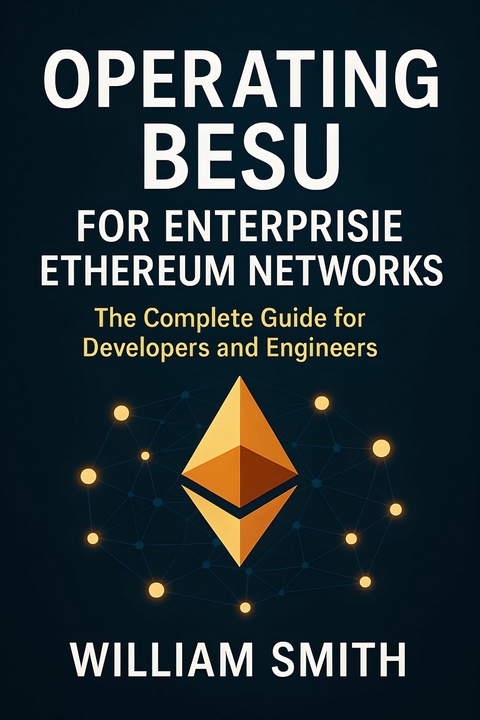
Operating Besu for Enterprise Ethereum Networks (eBook)
250 Seiten
HiTeX Press (Verlag)
978-0-00-097329-0 (ISBN)
'Operating Besu for Enterprise Ethereum Networks'
'Operating Besu for Enterprise Ethereum Networks' is an authoritative and comprehensive guide designed for architects, operators, and DevOps professionals responsible for deploying and managing Hyperledger Besu nodes within enterprise-grade Ethereum environments. This book opens with a rigorous exploration of Besu's advanced architecture, delving into core components, consensus algorithms, blockchain storage mechanisms, and extensibility patterns to ensure readers develop a deep technical foundation. Key focus is given to Besu's robust networking stack and diverse API offerings, equipping practitioners to build scalable, reliable, and secure blockchain networks tailored to complex organizational requirements.
Moving beyond architecture, the guide thoroughly addresses deployment strategies, including cloud-native Kubernetes orchestration, hybrid and bare-metal infrastructure, high-availability configurations, and disaster recovery planning. Extensive operational know-how is provided through chapters on monitoring, metrics collection, distributed tracing, performance tuning, and zero-downtime maintenance, fostering an automation-first approach. The work further details advanced topics such as consensus customization, validator management, finality guarantees, secure chain governance, and seamless chain upgrades-empowering operators to maintain resilient, future-ready networks.
Security and integration stand at the forefront of enterprise blockchain operations, and this book rises to the challenge with dedicated sections on node hardening, advanced privacy using Orion, key management, and compliance logging. Readers will also gain practical guidance on integrating Besu with enterprise systems, event streaming, and real-time observability platforms. Coverage of emerging privacy models, interoperable standards, and Layer 2 solutions ensures that readers can confidently address the evolving landscape of enterprise Ethereum, positioning their organizations for long-term success amid rapid technological change.
Chapter 2
Deployment Strategies and Infrastructure Design
What does it take to deploy Hyperledger Besu at enterprise scale—securely, flexibly, and for maximum uptime? In this chapter, we unveil the intricate choices and architectural patterns that underpin cloud-native, hybrid, and bare-metal Besu networks, empowering you to engineer resilient, scalable, and compliant Ethereum infrastructures from the ground up.
2.1 Cloud-Native Deployments
Designing and operating Hyperledger Besu as a first-class citizen within cloud-native environments necessitates a comprehensive approach that integrates containerization, orchestration, managed services, and cloud-specific features. The objective is to leverage elasticity, automation, and resilience capabilities intrinsic to modern public and private clouds while maintaining the high performance and security characteristics expected of enterprise blockchain infrastructure.
The foundation of cloud-native deployment is containerization. Encapsulating Besu nodes within lightweight containers-most commonly using Docker-facilitates modularity, consistency, and portability across heterogeneous cloud infrastructures. A typical Besu container image bundles the Java runtime environment, the Besu binary, and any optimizations, environmental configurations, or security parameters. Container images must be designed with an emphasis on minimal attack surface and efficient startup times to optimize orchestration responsiveness. For example, multi-stage Docker builds can be employed to reduce image size by compiling components in intermediate containers before copying binaries into a lean runtime container.
To orchestrate multiple Besu containers, Kubernetes has emerged as the de facto standard, offering resource definitions tailored to distribution and lifecycle control. Kubernetes Deployments define the desired state for Besu pods, enabling rolling updates to minimize downtime during upgrades. StatefulSets become critical when persistent identity and storage are required, as Besu nodes often need stable network identifiers and access to persistent volumes for ledger data and key stores. Kubernetes ConfigMaps and Secrets manage runtime configuration and sensitive credentials, such as node keys, RPC credentials, or TLS certificates. Autoscaling can be defined through Horizontal Pod Autoscalers (HPA), which adjust the number of Besu nodes based on metrics like CPU utilization or custom blockchain-specific health indicators, enabling elastic performance tuning aligned with network demands.
Cloud-provider managed services can complement and simplify Besu deployments significantly. Managed Kubernetes offerings, such as Amazon EKS, Google GKE, and Azure AKS, reduce operational overhead by abstracting control-plane management, upgrades, and high-availability configurations. Managed container registries provide secure, versioned storage and distribution of Besu container images. Cloud-native load balancers integrate seamlessly with Kubernetes Ingress resources, enabling automatic routing of JSON-RPC, WebSocket, or REST API requests across Besu node ensembles with health-aware failover. For enhanced operational observability, cloud-native logging and monitoring services (CloudWatch, Stackdriver, Azure Monitor) can capture metrics from Besu’s Prometheus exporters, application logs, and system telemetry, allowing proactive scaling and fault management.
Storage and networking overlays represent fundamental challenges in cloud-native blockchain deployments. Besu’s ledger data persistence typically requires high-throughput, low-latency block storage that ensures data integrity and durability. Depending on the cloud provider, dynamically provisioned PersistentVolumes backed by SSD or NVMe storage classes offer optimized performance for transaction logs and state databases. When designing storage for Besu, separation of concerns enhances resilience: ephemeral storage is suitable for caches and temporary files, whereas persistent volumes address the blockchain state and key material. Backup strategies should leverage cloud-native snapshotting and cross-region replication to guard against data loss and support disaster recovery.
Networking in cloud-native deployments must accommodate the peer-to-peer nature of Ethereum networks and the external APIs exposed by Besu nodes. Kubernetes networking overlays such as Calico or Cilium provide capabilities for fine-grained network policies, IP address management, and encrypted pod communication. Besu’s discovery protocol requires stable and routable addresses; thus, Kubernetes Services of type LoadBalancer or NodePort expose node endpoints externally. For private cloud deployments, integrating overlay networks or service meshes (e.g., Istio, Linkerd) can enhance observability and secure inter-node communication with mTLS, traffic routing, and retries. Aligning network policies with cloud-provider security groups and firewall settings is imperative to minimize attack surfaces while maintaining necessary connectivity.
Best practices in cloud-native Besu deployments emphasize automation and declarative management. Infrastructure as Code (IaC) tools like Terraform or Pulumi consistently provision cloud resources, from Kubernetes clusters to storage volumes and networking components, enabling reproducible environments. Continuous Integration/Continuous Deployment (CI/CD) pipelines automate building, testing, and promoting Besu container images, coupled with Infrastructure as Code, ensuring rapid, reliable rollouts of patches and feature updates. Health checks and readiness probes defined in Kubernetes YAML manifests bolster node lifecycle management, preventing traffic routing to unhealthy pods. Leveraging cloud-native secrets management services (AWS Secrets Manager, Azure Key Vault, Google Secret Manager) safeguards sensitive data through lifecycle policies and auditing.
Elasticity manifests not only through autoscaling but also in cluster topology adaptation. Network load fluctuations or membership changes benefit from dynamic scaling of validator and non-validator nodes, exploiting ephemeral cloud capacity during peak demands and scaling down to minimize cost during lulls. Stateful workloads like Besu require careful orchestration to avoid ledger divergence and data loss-mechanisms such as Kubernetes Pod Disruption Budgets (PDB) and persistent storage reclaim policies ensure controlled node replacement and data retention.
Executing Hyperledger Besu as an integral element of cloud-native architecture demands intentional container design, Kubernetes resource orchestration, integration with cloud-provider managed components, and meticulous configuration of storage and networking. Exploiting cloud elasticity and automation transforms Besu deployments into scalable, highly available, and secure blockchain infrastructures that fulfill enterprise-grade workloads in diverse cloud environments.
2.2 Bare-Metal and Hybrid Environments
Deploying Besu nodes on bare-metal servers involves a comprehensive understanding of both hardware capabilities and network design to optimize node performance and reliability. Unlike virtualized or containerized deployments, physical servers provide dedicated resources that can be finely tuned for the workload characteristics of Ethereum transaction processing, consensus participation, and ledger maintenance. The primary hardware considerations begin with CPU, memory, storage, and network subsystem selection.
CPU cores and clock speed strongly influence the node’s capacity to process smart contract executions, cryptographic operations, and transaction validation. High core count CPUs with scalable clock frequencies are recommended to parallelize workload threads effectively while avoiding contention. For consensus participation in permissioned networks or high-throughput environments, multiple cores help sustain sustained transaction processing without bottlenecks.
Memory sizing must accommodate JVM heap allocations alongside off-heap buffers employed by Besu for caching blockchain states and network buffers. A minimum of 16 gigabytes of RAM is usually advisable, scaling upwards for high-throughput scenarios or extensive private state databases. Insufficient memory can increase garbage collection pause times and degrade overall responsiveness.
Storage performance is paramount due to the frequent random reads and writes associated with the blockchain state and transaction logs. Enterprise-grade NVMe SSDs substantially outperform SATA SSDs and HDDs when measured by IOPS and latency, enabling faster state sync and reducing node catch-up times after restarts. Besu’s LevelDB or RocksDB backend benefits significantly from low-latency drives, particularly under load with frequent reorgs or pruning operations. RAID configurations focused on redundancy (e.g., RAID 10) can secure data integrity without sacrificing too much throughput.
Network isolation and bandwidth represent another critical dimension. Dedicated network interfaces for Besu nodes prevent contention with unrelated traffic and minimize jitter, which can cause consensus delays in both IBFT and Clique consensus mechanisms. Using physically separate network interfaces connected to private VLANs or layer-2 segments mitigates latency variability and increases security by isolating Ethereum...
| Erscheint lt. Verlag | 24.7.2025 |
|---|---|
| Sprache | englisch |
| Themenwelt | Mathematik / Informatik ► Informatik ► Programmiersprachen / -werkzeuge |
| ISBN-10 | 0-00-097329-7 / 0000973297 |
| ISBN-13 | 978-0-00-097329-0 / 9780000973290 |
| Informationen gemäß Produktsicherheitsverordnung (GPSR) | |
| Haben Sie eine Frage zum Produkt? |
 EPUB (Adobe DRM)
Größe: 661 KB
Kopierschutz: Adobe-DRM
Adobe-DRM ist ein Kopierschutz, der das eBook vor Mißbrauch schützen soll. Dabei wird das eBook bereits beim Download auf Ihre persönliche Adobe-ID autorisiert. Lesen können Sie das eBook dann nur auf den Geräten, welche ebenfalls auf Ihre Adobe-ID registriert sind.
Details zum Adobe-DRM
Dateiformat: EPUB (Electronic Publication)
EPUB ist ein offener Standard für eBooks und eignet sich besonders zur Darstellung von Belletristik und Sachbüchern. Der Fließtext wird dynamisch an die Display- und Schriftgröße angepasst. Auch für mobile Lesegeräte ist EPUB daher gut geeignet.
Systemvoraussetzungen:
PC/Mac: Mit einem PC oder Mac können Sie dieses eBook lesen. Sie benötigen eine
eReader: Dieses eBook kann mit (fast) allen eBook-Readern gelesen werden. Mit dem amazon-Kindle ist es aber nicht kompatibel.
Smartphone/Tablet: Egal ob Apple oder Android, dieses eBook können Sie lesen. Sie benötigen eine
Geräteliste und zusätzliche Hinweise
Buying eBooks from abroad
For tax law reasons we can sell eBooks just within Germany and Switzerland. Regrettably we cannot fulfill eBook-orders from other countries.
aus dem Bereich


