


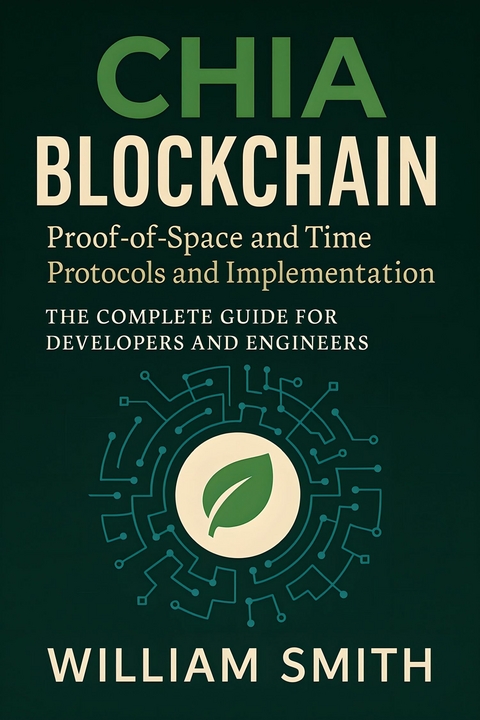
Chia Blockchain (eBook)
250 Seiten
HiTeX Press (Verlag)
978-0-00-097327-6 (ISBN)
'Chia Blockchain: Proof-of-Space and Time Protocols and Implementation'
'Chia Blockchain: Proof-of-Space and Time Protocols and Implementation' is a comprehensive and authoritative guide dedicated to the groundbreaking innovations underlying the Chia blockchain. Beginning with foundational principles, the book meticulously addresses the ecological motivations, accessibility goals, and architectural advancements that distinguish Chia from traditional blockchains. Readers are introduced to the ecosystem's core philosophy, governance mechanisms, and participant roles, gaining a holistic perspective on the network's decentralized and sustainable ethos.
Delving deeper, the text rigorously explores the technical heart of Chia's consensus: the proof-of-space and verifiable delay functions (VDFs) that anchor its security and efficiency. Through formal definitions, cryptographic analyses, challenge protocols, and adversarial models, the reader is equipped with an expert understanding of how Chia leverages hard drive storage and cryptographic puzzles to achieve consensus while dramatically reducing energy consumption. Advanced topics include the mathematical underpinnings of VDFs, scalability through hardware acceleration, and resilience protocols for robust chain operation under real-world adversarial conditions.
The closing sections illuminate Chia's practical implementation, from plotting and large-scale farming techniques to the bespoke Chialisp smart contract language. Best practices for resource optimization, operational security, developer tooling, and interoperability are thoroughly dissected, presenting developers, engineers, and researchers with actionable insights for building on and extending the Chia platform. This work is an indispensable reference for anyone seeking a deep technical understanding of one of the most innovative and eco-conscious blockchains to date.
Chapter 1
Chia Blockchain Fundamentals
Chia Blockchain represents a radical rethink of distributed ledger technology, setting itself apart through its eco-centric consensus and community-guided evolution. This chapter investigates Chia’s departure from energy-hungry mining, examining the motivations, mechanisms, and participants that form the foundation of its network. Unlocking how Chia’s vision for sustainability, accessibility, and decentralization shapes both its protocol design and its global ecosystem, this chapter invites you to question the status quo of today’s blockchain paradigms.
1.1 Design Philosophy and Objectives
The foundational principles underlying Chia’s protocol reflect a deliberate response to the prevailing critiques and limitations observed in earlier blockchain systems, particularly those employing Proof of Work (PoW). Central to Chia’s design is an overarching environmental imperative: to facilitate a sustainable blockchain infrastructure that drastically reduces the ecological footprint associated with consensus mechanisms. This objective informed the selection of Proof of Space and Time as Chia’s core consensus primitives, diverging fundamentally from energy-intensive hashing computations that dominate many legacy cryptocurrencies.
Proof of Space leverages unused disk storage capacity, a largely idle and decentralized resource, rather than specialized computational power. By harnessing storage, which is comparatively abundant and distributed across global participants, Chia minimizes the electricity consumption intrinsic to mining activities. Complementing this, Proof of Time—implemented via a verifiable delay function (VDF)—introduces a sequential, non-parallelizable time delay to further secure the blockchain without entailing high energy demands. The synergy of these mechanisms results in a consensus approach that achieves robust security while reducing adverse environmental impact by multiple orders of magnitude compared to traditional PoW blockchains.
Equally critical to Chia’s ethos is the pursuit of broad accessibility. The architecture precludes reliance on expensive, purpose-built hardware, enabling individuals with common consumer drives to participate in network consensus activities. This approach significantly lowers entry barriers, fostering a more inclusive ecosystem of farmers—participants who allocate storage to secure the network and earn rewards. The economic accessibility afforded by utilizing everyday hardware ensures a more diverse participant base, effectively democratizing participation across geographical, economic, and technical spectra. This openness is essential not only for network security but also for creating a vibrant community with varied interests and perspectives.
The commitment to economic and structural decentralization is another cornerstone shaping Chia’s design philosophy. Decentralization aims to prevent concentrations of power that could undermine the system’s integrity, censorship-resistance, or fairness. By decentralizing the consensus mechanism and enabling widespread, low-cost participation, Chia reduces incentives for vertical integration or monopolization by entities with superior technological or financial resources. Protocol parameters—such as plot sizes, reward schedules, and difficulty adjustments—are calibrated to promote equitable competition. The intrinsic randomness in block selection, combined with the distributed nature of storage resources, further disperses influence over ledger updates.
Alongside protocol choices, incentive alignment plays a pivotal role in sustaining decentralization and network health. Farmers earn rewards proportionally to their allocated plots, directly incentivizing the maintenance of honest participation without requiring prohibitive investments. The reward distribution methodology balances reward predictability with security considerations, encouraging consistent network support. At the same time, stakeholders and developers are motivated through transparent economic models and governance mechanisms that view network growth and health as collective objectives rather than zero-sum games.
Community culture around Chia reflects these technical and economic design principles. Emphasizing inclusivity, transparency, and mutual support, the community actively fosters knowledge-sharing and collaborative problem-solving. This human-centric aspect reinforces decentralization not only in the protocol’s architecture but also in governance and evolution. Open-source development, community voting on protocol upgrades, and ongoing dialog among diverse actors underpin Chia’s adaptive governance framework, ensuring that changes align with the shared vision of sustainability and fairness.
Specific technical choices within the protocol elucidate how these design objectives manifest in practice. For instance, the plotting process is intentionally resource-intensive in terms of storage and randomized computations, yet computationally lightweight, which prevents rapid centralization of farming capacity by specialized hardware manufacturers. The Proof of Time function’s sequential nature limits acceleration by parallel processing, maintaining equitable block propagation intervals that preserve network stability. Moreover, mechanisms such as challenges and proofs are designed to be efficient and verifiable at scale, permitting a growing network without imposing prohibitive computational overhead on participants.
The balance between security, efficiency, and decentralization inevitably involves trade-offs. By reframing consensus around storage utilization rather than raw computational power, Chia introduces new attack vectors and operational considerations, such as plot copying risks or potential centralization in regions with comparatively cheaper storage. The protocol incorporates mitigation strategies, including cryptographic proofs that bind space allocation to specific participants and constant diffusion of network participation to prevent emergence of dominant clusters. These solutions reflect a conscious design priority to maintain resilience without compromising the fundamental sustainability principle.
In summary, Chia’s design philosophy integrates a multifaceted set of objectives that interlock to provide an eco-friendly, accessible, and decentralized blockchain architecture. The environmental drive led to a radical departure from energy-hungry consensus protocols, establishing a sustainable foundation. Broad accessibility fosters a heterogeneous participant base, critical for structural decentralization and censorship resistance. Economic incentives and community culture reinforce these goals, ensuring the protocol’s evolution aligns with both technical rigor and collective interest. This cohesive framework situates Chia as a pioneering example of how blockchain technology can be responsibly engineered to meet the challenges of scalability, security, and sustainability in tandem.
1.2 Overview of Blockchain Architectures
Blockchain architectures exhibit a diverse array of design principles and consensus mechanisms, each engineered to address critical trade-offs among security, scalability, decentralization, and energy efficiency. This section presents a technical comparative survey of prominent blockchain architectures, focusing on Proof of Work (PoW), Proof of Stake (PoS), Directed Acyclic Graphs (DAGs), and hybrid models. The discussion culminates in situating Chia’s architecture within this landscape, elucidating its novel approach and strategic implications.
Proof of Work (PoW) remains the foundational consensus protocol in cryptocurrencies, originally introduced by Bitcoin [?]. The protocol hinges on computational puzzles, wherein miners expend energy to solve cryptographic hash functions, competing to produce a valid block. The probabilistic nature of PoW ensures that block creation corresponds roughly to proportional computational effort, underpinning security by making attacks economically prohibitive.
Architecturally, PoW blockchains maintain a sequential chain of blocks linked via hashes, constituting an immutable ledger. While PoW offers robust security anchored in the costliness of hardware and electricity, its major drawbacks include limited transaction throughput-typically 7 to 30 transactions per second-and significant environmental impact due to high energy consumption. The exponential difficulty adjustment mechanism further complicates latency and scalability.
Proof of Stake (PoS) emerged to address PoW’s inefficiencies by replacing resource-intensive computation with economic stake as the weighted parameter for consensus. Validators are selected to propose and attest new blocks proportionally to their token holdings, significantly reducing energy costs. Variants of PoS include chain-based PoS as seen in Ethereum 2.0 [?] and Byzantine Fault Tolerant (BFT) style consensus protocols like Tendermint [?].
PoS architectures introduce critical trade-offs. While energy efficiency and throughput improve, security depends on economic game theory and the cost of acquiring majority stake. Additionally, challenges such as the “nothing-at-stake” problem and long-range attacks necessitate ...
| Erscheint lt. Verlag | 24.7.2025 |
|---|---|
| Sprache | englisch |
| Themenwelt | Mathematik / Informatik ► Informatik ► Programmiersprachen / -werkzeuge |
| ISBN-10 | 0-00-097327-0 / 0000973270 |
| ISBN-13 | 978-0-00-097327-6 / 9780000973276 |
| Informationen gemäß Produktsicherheitsverordnung (GPSR) | |
| Haben Sie eine Frage zum Produkt? |
 EPUB (Adobe DRM)
Größe: 820 KB
Kopierschutz: Adobe-DRM
Adobe-DRM ist ein Kopierschutz, der das eBook vor Mißbrauch schützen soll. Dabei wird das eBook bereits beim Download auf Ihre persönliche Adobe-ID autorisiert. Lesen können Sie das eBook dann nur auf den Geräten, welche ebenfalls auf Ihre Adobe-ID registriert sind.
Details zum Adobe-DRM
Dateiformat: EPUB (Electronic Publication)
EPUB ist ein offener Standard für eBooks und eignet sich besonders zur Darstellung von Belletristik und Sachbüchern. Der Fließtext wird dynamisch an die Display- und Schriftgröße angepasst. Auch für mobile Lesegeräte ist EPUB daher gut geeignet.
Systemvoraussetzungen:
PC/Mac: Mit einem PC oder Mac können Sie dieses eBook lesen. Sie benötigen eine
eReader: Dieses eBook kann mit (fast) allen eBook-Readern gelesen werden. Mit dem amazon-Kindle ist es aber nicht kompatibel.
Smartphone/Tablet: Egal ob Apple oder Android, dieses eBook können Sie lesen. Sie benötigen eine
Geräteliste und zusätzliche Hinweise
Buying eBooks from abroad
For tax law reasons we can sell eBooks just within Germany and Switzerland. Regrettably we cannot fulfill eBook-orders from other countries.
aus dem Bereich


