


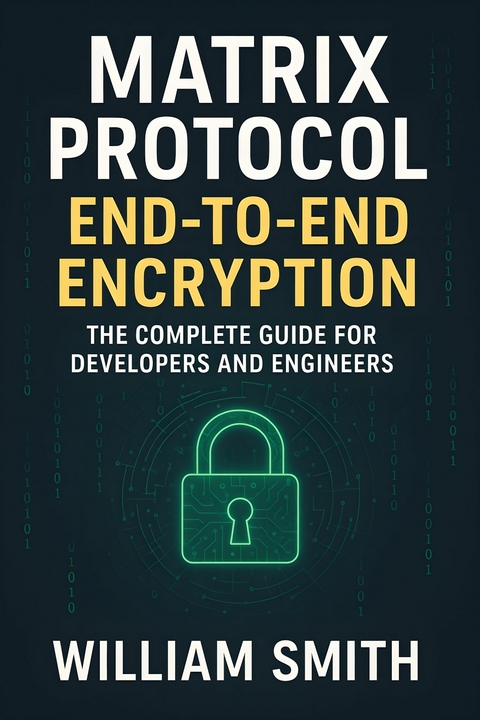
Matrix Protocol End-to-End Encryption (eBook)
250 Seiten
HiTeX Press (Verlag)
978-0-00-097323-8 (ISBN)
'Matrix Protocol End-to-End Encryption'
Matrix Protocol End-to-End Encryption offers a comprehensive and authoritative exploration of the security foundations underpinning one of the most versatile and decentralized communication protocols in the modern digital landscape. The book opens with an in-depth analysis of Matrix's federated architecture, examining how its protocol design embraces openness while meeting the formidable challenges of distributed trust, device proliferation, and sophisticated threat models. Drawing on insights from the evolution of secure messaging-including OTR, Signal, and pioneering advances unique to Matrix-the text deftly contextualizes why end-to-end encryption (E2EE) is indispensable for genuine user privacy across federated networks.
Delving into the mechanics and theory of Matrix's E2EE, the book methodically dissects cryptographic primitives, key management strategies, and verification mechanisms essential to robust security. Leading readers through the technical intricacies of the Olm and Megolm protocols, it details how Matrix balances forward secrecy, usability, and scalability in both one-to-one and group communications. From complex session lifecycles and trust chains to nuanced workflows for device verification, compromise detection, and secure key recovery, the narrative addresses both the cryptographic rigor and operational realities that define Matrix's approach.
Beyond protocol specifications, the book investigates the lived experience of deploying and evolving E2EE at scale: implementation best practices, compliance and legal considerations, community governance, and the perennial challenge of usability. It further contemplates advanced topics such as metadata minimization, encrypted media, bridging to external networks, and post-quantum cryptography. Matrix Protocol End-to-End Encryption is an essential resource for architects, engineers, and security professionals dedicated to understanding and shaping the future of secure, interoperable communication platforms.
Chapter 2
Key Management, Identity, and Verification
Behind the robust front of Matrix’s end-to-end encryption lies a finely engineered choreography of key management and identity assurance that determines the actual boundaries of trust. This chapter exposes the cryptographic machinery and verification workflows that empower users—not just servers—to control security decisions. It is a technical deep-dive into identity, key lifecycle, and the art of establishing verifiable authenticity across a tangled web of devices and federated infrastructure.
2.1 Device and User Identity Keys
In the Matrix protocol, persistent identity keys serve as fundamental cryptographic anchors that establish long-term trust for both devices and users within a highly decentralized, federated environment. These keys enable robust authentication, trust propagation, and message integrity across distributed domains. Their architecture and lifecycle are critical for understanding the secure operation of Matrix’s end-to-end encrypted communication.
Each Matrix user creates one or multiple user identity keys, which uniquely represent their cryptographic identity at the account level. These keys form the root of the trust chain for all of the user’s associated devices. Conversely, device identity keys are generated independently for each authorized client or endpoint, enabling granular trust management and device-specific authentication. Together, user and device keys facilitate a hierarchical trust model where device keys are cryptographically signed by user keys, enabling seamless verification of device legitimacy without requiring continuous out-of-band validation.
Key Generation and Storage
User identity keys are generated during account registration or key initialization phases, commonly implemented as long-term Ed25519 key pairs due to their strong security properties, efficient signature generation, and compact key sizes. Device identity keys are also Ed25519 key pairs, created locally on the device upon first login or device registration. Both key types reside securely in device-local secure storage, such as hardware-backed keystores when available, to prevent extraction by attackers.
The persistence of these keys over the user and device lifetime is paramount. Loss or compromise of user identity keys threatens the authenticity guarantees for all associated devices, while device key compromise impacts only the specific device’s trust. The Matrix protocol supports recovery and rotation mechanisms to address key loss or compromise while maintaining continuity of identity and minimizing disruption.
Cross-Signing and Trust Establishment
Matrix’s cross-signing framework is pivotal in leveraging user and device identity keys to establish trust both within a single user’s device roster and across federated domains. Cross-signing allows a user’s primary identity key (acting as a master key) to digitally sign subordinate keys for other devices or even other users. This hierarchical structure supports scalable trust propagation and reduces the burden of manual verification.
Users initially verify each device explicitly, either through out-of-band mechanisms or by scanning QR codes, binding device keys to their identity. Once a device is trusted, the user’s master key cryptographically signs the device’s identity key, producing a cross-signing signature. This signature is published to the homeserver and distributed among federated servers, enabling remote clients and other users to verify device authenticity without direct interaction.
Furthermore, the cross-signing approach extends beyond personal devices to incorporate user cross-signing, wherein users sign each other’s master keys after verification, effectively creating a web of trust. This federated trust model facilitates cryptographic authentication of users even across different homeservers, mitigating risks inherent in decentralized architectures.
Digital Signature Schemes and Security Guarantees
The Matrix protocol employs concise but robust digital signature schemes centered on the Ed25519 elliptic curve signature algorithm, which offers high-speed signing and verification combined with strong security assurances against forgery. Ed25519’s deterministic signatures prevent nonce reuse attacks and simplify implementation, reducing vulnerabilities.
Each signature encodes not only the cryptographic proof but also metadata specifying the signer key, timestamp, and the signed data object, encapsulating device and session information. This metadata binding guarantees the authenticity and integrity of cross-signing signatures as well as messages signed directly by device keys.
When verifying a signed message or key binding, the verifier performs the following steps:
- 1.
- Retrieves the claimed signer’s public key from the local store or federation source.
- 2.
- Uses the Ed25519 verification algorithm to confirm the signature is valid.
- 3.
- Checks that the signature metadata aligns with the expected signer identity and timestamp.
- 4.
- Confirms the signer key itself is trusted, either via a chain of cross-signing signatures or previously established trust.
Only after all these checks pass will devices accept the signed key or message, thus ensuring that malicious impersonation or tampering is infeasible under the assumed cryptographic strength.
Lifecycle and Revocation Considerations
The lifecycle of device and user identity keys encompasses several phases: creation, usage, rotation, compromise handling, and eventual decommissioning. Secure and transparent management of these stages is essential to maintain trust in the federated system.
Rotation entails generating new keys and cross-signing them from existing trusted keys, enabling a smooth transition without disrupting ongoing encrypted sessions or federated verification. Key revocation is propagated through the homeserver and federation layers by publishing unsigned or negatively signed key states, signaling to all peers that previously trusted keys are no longer valid. The extent to which revocation immediately prevents malicious activity depends on the speed of propagation and the local verifier’s policy.
To facilitate recovery and compromise mitigation, Matrix supports automated backups of keys encrypted under user-chosen secrets, allowing users to restore identity keys on new devices securely. Combining cross-signing with secure key backup mechanisms ensures that the overall system remains resilient in the face of device loss or compromise.
Implications for Federation and User Experience
The deployment of persistent identity keys strongly influences both technical federation and user experience aspects. On the federation level, having cryptographically anchored user and device identities allows homeservers to exchange signed states and verify each other’s users efficiently without centralized authorities. This capability underpins Matrix’s decentralization promise while maintaining the security guarantees typically associated with centralized systems.
From a user perspective, keys abstract complex cryptographic operations into manageable trust relationships. Cross-signing reduces the need for repetitive manual verifications when adding new devices, improving usability without sacrificing security. Visual indicators in client software rely on underlying identity key trust hierarchies to provide users with clear signals of device legitimacy and message validity.
Device and user identity keys provide the foundational trust and authentication mechanisms critical for the secure, scalable, and user-friendly operation of Matrix. Their cryptographic strength, hierarchical cross-signing relations, and lifecycle management collectively enable long-term authenticity and integrity guarantees in a federated communication ecosystem.
2.2 One-Time Keys, Session Keys, and Key Lifecycle
In the Matrix protocol, the management of cryptographic keys revolves around maintaining robust security guarantees such as forward secrecy and deniability, particularly in end-to-end encrypted communication. This is achieved through the interplay of ephemeral keys—specifically one-time keys and session keys—and their systematic lifecycle of generation, distribution, utilization, and retirement. The cryptographic foundations orchestrate seamless secure messaging while accommodating asynchronous communication patterns intrinsic to distributed systems.
One-time keys, as the nomenclature suggests, are ephemeral asymmetric key pairs generated by a client to be used exactly once during session establishment. Their principal role within Olm, the double ratchet-based cryptographic ratchet system in Matrix, is to facilitate secure key agreement and bootstrapping of new sessions. Upon client initialization, a device will generate a batch of one-time keys comprising Curve25519 public/private keypairs. The public elements are published to the server, while private portions remain secret to the device....
| Erscheint lt. Verlag | 24.7.2025 |
|---|---|
| Sprache | englisch |
| Themenwelt | Mathematik / Informatik ► Informatik ► Programmiersprachen / -werkzeuge |
| ISBN-10 | 0-00-097323-8 / 0000973238 |
| ISBN-13 | 978-0-00-097323-8 / 9780000973238 |
| Informationen gemäß Produktsicherheitsverordnung (GPSR) | |
| Haben Sie eine Frage zum Produkt? |
 EPUB (Adobe DRM)
Größe: 850 KB
Kopierschutz: Adobe-DRM
Adobe-DRM ist ein Kopierschutz, der das eBook vor Mißbrauch schützen soll. Dabei wird das eBook bereits beim Download auf Ihre persönliche Adobe-ID autorisiert. Lesen können Sie das eBook dann nur auf den Geräten, welche ebenfalls auf Ihre Adobe-ID registriert sind.
Details zum Adobe-DRM
Dateiformat: EPUB (Electronic Publication)
EPUB ist ein offener Standard für eBooks und eignet sich besonders zur Darstellung von Belletristik und Sachbüchern. Der Fließtext wird dynamisch an die Display- und Schriftgröße angepasst. Auch für mobile Lesegeräte ist EPUB daher gut geeignet.
Systemvoraussetzungen:
PC/Mac: Mit einem PC oder Mac können Sie dieses eBook lesen. Sie benötigen eine
eReader: Dieses eBook kann mit (fast) allen eBook-Readern gelesen werden. Mit dem amazon-Kindle ist es aber nicht kompatibel.
Smartphone/Tablet: Egal ob Apple oder Android, dieses eBook können Sie lesen. Sie benötigen eine
Geräteliste und zusätzliche Hinweise
Buying eBooks from abroad
For tax law reasons we can sell eBooks just within Germany and Switzerland. Regrettably we cannot fulfill eBook-orders from other countries.
aus dem Bereich


