


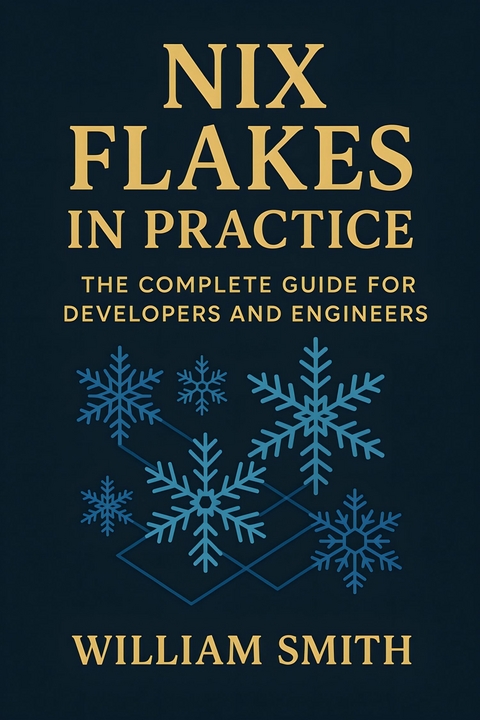
Nix Flakes in Practice (eBook)
250 Seiten
HiTeX Press (Verlag)
978-0-00-097317-7 (ISBN)
'Nix Flakes in Practice'
'Nix Flakes in Practice' is a comprehensive and authoritative guide to mastering the next evolution of reproducible infrastructure, development environments, and software delivery with Nix. This book begins by grounding readers in the foundational principles of Nix-immutability, reproducibility, and declarative configuration-before systematically exploring the motivations driving the adoption of Flakes across the Nix ecosystem. From the historical context and community-driven evolution to the technical distinctions between traditional workflows and flakes-based approaches, readers gain a clear understanding of why and how Flakes are reshaping best practices for package management and system configuration.
Through a series of meticulously structured chapters, the book delves into the anatomy and mechanics of Flakes, guiding practitioners of all experience levels through core concepts such as defining inputs and outputs, managing dependency composition, automating builds and CI/CD, and extending Flakes for advanced use cases. Detailed coverage is given to key areas including cross-platform development, secure supply chain management, scalable NixOS infrastructure as code, and the interplay between Flakes and legacy systems. Rich with practical patterns and real-world case studies, each topic is paired with actionable advice for building robust, maintainable, and future-proof solutions.
Designed for developers, DevOps engineers, and infrastructure architects, 'Nix Flakes in Practice' also explores the broader ecosystem and future of Flakes, highlighting governance, emerging tooling, and community innovation. Readers will walk away not only with the technical skills necessary to deploy and maintain advanced flake-based projects but also with the insight needed to contribute to and thrive in the rapidly evolving Nix landscape. Whether you are migrating legacy infrastructure, starting new greenfield projects, or cultivating open-source flakes for the community, this book is your indispensable companion for mastering the Flakes paradigm in practice.
Chapter 2
Anatomy of a Flake
Flakes encapsulate the promise of Nix into concise, declarative, and portable units—but their true power is revealed only when you master their nuanced structure. This chapter peels back the layers of a flake, demystifying its syntax, schema, and advanced features. Through deep technical exploration, you’ll learn how to design, validate, and organize production-ready flakes that catalyze reproducibility and scale.
2.1 Structure and Syntax of flake.nix
The flake.nix file serves as the formal entry point for Nix flakes, encapsulating a consistently structured JSON-like schema that defines package sets, development environments, overlays, and other Nix constructs. Its syntax unifies declarative configuration with Nix’s functional programming paradigm, enabling reproducibility, composability, and ease of sharing. The file itself is a single Nix expression, typically a function or attribute set, with reserved attributes that flake-aware tools recognize to provide standardized functionality.
A canonical flake.nix structure is an attribute set characterized primarily by the reserved top-level attributes description, inputs, outputs, and occasionally packages, devShells, or checks. The formal schema is approximately:
{ description = "A brief textual summary of the flake"; inputs = { # Flake dependencies }; outputs = { self, inputs, ... }: { # Attrsets defining packages, devShells, etc. }; }The description is an optional string documenting the flake’s purpose. The inputs attribute is itself an attribute set of named flakes representing dependencies. Each input can be referenced by name within the outputs function.
The essence of flake.nix lies in the outputs attribute, a function that accepts a parameter set. At minimum, this parameter set contains self (the flake itself) and inputs (the resolved dependencies). It may also include other context values, especially if the flake accepts inputs via args or overlays. The function returns an attribute set that defines packages, development shells, apps, and other outputs. This attribute set is interpreted by package managers or development tools to locate artifacts and environments.
Consider a minimalistic flake.nix example illustrating these components:
description = "Example flake illustrating syntax";
inputs = {
nixpkgs.url = "github:NixOS/nixpkgs/nixos-unstable";
};
outputs = { self, nixpkgs, ... }:
let
system = "x86_64-linux";
pkgs = import nixpkgs { inherit system; };
in {
packages.${system}.hello = pkgs.hello;
devShells.${system}.default = pkgs.mkShell {
buildInputs = [ pkgs.hello ];
};
};
}
Breaking down this example:
- description succinctly identifies the flake.
- inputs declares one dependency named nixpkgs, specifying a GitHub repository and branch to fetch the package collection.
- outputs is a function destructuring the inputs and self. Inside, it defines the target system and imports nixpkgs with the system argument.
- The returned attribute set contains two nested attribute sets keyed on the system string: one for packages, exposing the hello package, and another for devShells, defining a default development shell using mkShell.
This canonical pattern generalizes to more complex flakes by expanding inputs to include multiple dependencies and outputs to enumerate numerous packages, derivations, applications, or modules for varying systems and target environments.
A key convention is...
| Erscheint lt. Verlag | 24.7.2025 |
|---|---|
| Sprache | englisch |
| Themenwelt | Mathematik / Informatik ► Informatik ► Programmiersprachen / -werkzeuge |
| ISBN-10 | 0-00-097317-3 / 0000973173 |
| ISBN-13 | 978-0-00-097317-7 / 9780000973177 |
| Informationen gemäß Produktsicherheitsverordnung (GPSR) | |
| Haben Sie eine Frage zum Produkt? |
 EPUB (Adobe DRM)
Größe: 690 KB
Kopierschutz: Adobe-DRM
Adobe-DRM ist ein Kopierschutz, der das eBook vor Mißbrauch schützen soll. Dabei wird das eBook bereits beim Download auf Ihre persönliche Adobe-ID autorisiert. Lesen können Sie das eBook dann nur auf den Geräten, welche ebenfalls auf Ihre Adobe-ID registriert sind.
Details zum Adobe-DRM
Dateiformat: EPUB (Electronic Publication)
EPUB ist ein offener Standard für eBooks und eignet sich besonders zur Darstellung von Belletristik und Sachbüchern. Der Fließtext wird dynamisch an die Display- und Schriftgröße angepasst. Auch für mobile Lesegeräte ist EPUB daher gut geeignet.
Systemvoraussetzungen:
PC/Mac: Mit einem PC oder Mac können Sie dieses eBook lesen. Sie benötigen eine
eReader: Dieses eBook kann mit (fast) allen eBook-Readern gelesen werden. Mit dem amazon-Kindle ist es aber nicht kompatibel.
Smartphone/Tablet: Egal ob Apple oder Android, dieses eBook können Sie lesen. Sie benötigen eine
Geräteliste und zusätzliche Hinweise
Buying eBooks from abroad
For tax law reasons we can sell eBooks just within Germany and Switzerland. Regrettably we cannot fulfill eBook-orders from other countries.
aus dem Bereich


