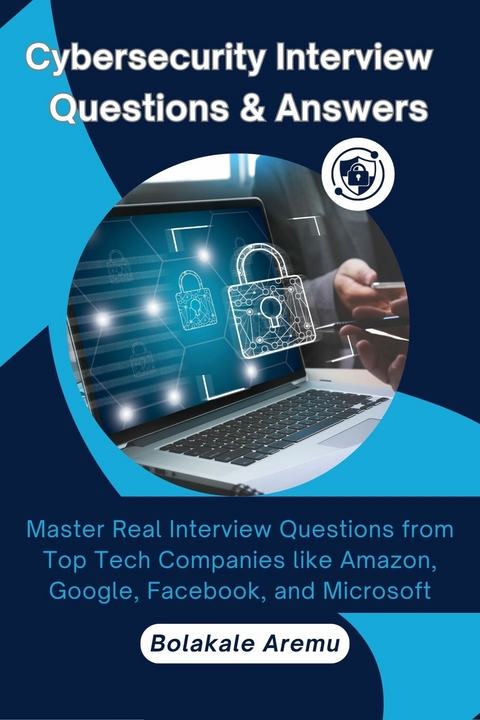
Cybersecurity Interview Questions & Answers (eBook)
212 Seiten
Publishdrive (Verlag)
978-0-00-097057-2 (ISBN)
Short on time before your cybersecurity interview? Don't panic-this practical guide is built to help you prepare fast, think smart, and answer like a pro.
Whether you're aiming for a role at a top tech company or breaking into your first cybersecurity job, this book will equip you with the skills, strategy, and confidence to stand out in today's competitive job market.
Module 1: Mastering Cybersecurity Fundamentals - Common Interview Questions That Set You Apart
Welcome to Module 1, where your cybersecurity interview prep begins with the fundamentals—because acing the technical stuff isn't enough if you can't navigate the questions behind the questions.
This module isn’t just a list of common interview prompts. It’s a roadmap to understanding what interviewers really want to know—about how you think, how you act under pressure, and whether you’re wired for the ever-evolving world of cybersecurity.
Here’s what you’ll dive into:
1. Personal Questions
Are you a good fit for the team? Do your values align with a security-first culture? Learn how to frame your background in a way that resonates.
2. Situational Questions
Can you communicate clearly and collaborate under pressure? These questions test more than your knowledge—they reveal your real-world decision-making.
3. Behavioral Questions
Interviewers want evidence. How have you handled incidents, failures, or high-stakes decisions in the past? And what do those say about your future performance?
4. Advanced & Big Tech Questions
Get a peek into the kind of deep-dive technical and strategic questions asked at companies like Amazon, Google, Facebook, and Microsoft.
But before we tackle questions, we’ll also make sure your foundation is strong.
You’ll get a clear understanding of:
1. Core Cybersecurity Concepts
Grasp the principles every professional must know to secure systems and data effectively.
2. Common Threats & Attacks
From phishing to zero-day exploits, understand what you’re up against.
3. The CIA Triad
Master the essential model of Confidentiality, Integrity, and Availability—your starting point for any security strategy.
By the end of this module, you won’t just be ready for questions—you’ll be able to read between the lines, respond with clarity, and show why you’re the right hire.
Question 1.1 – Select the correct answer
What is the most effective and comprehensive way to stay updated on the latest developments and trends in the cybersecurity field?
A. I primarily depend on weekly updates from my company’s IT department, as they summarize the most critical cybersecurity trends and threats.
B. I focus on academic journals and research papers for updates, as they are the most reliable sources for all cybersecurity trends.
C. I actively monitor security advisories, follow industry blogs and news platforms, and engage with leading cybersecurity experts on social media. Additionally, I attend conferences and network with other professionals to exchange insights and best practices.
D. I rely on popular tech influencers who occasionally cover cybersecurity topics to keep me informed about major developments.
Correct Answer: C
Overall Explanation
Keeping up with industry trends is critical in cybersecurity, as it plays a key role in safeguarding my organization against evolving threats. I stay connected to the field by regularly monitoring vulnerability alerts, advisory platforms, and trusted cybersecurity news sources and blogs.
Additionally, I follow leading experts and organizations on social media to stay informed about emerging developments. I also actively participate in conferences, live events, and professional meetups, where I exchange insights and strategies with other cybersecurity professionals.
Question 1.2 – Select the correct answer
Which emerging cybersecurity trend excites you the most and is likely to have the greatest impact in the next five years?
A. The rise of AI-driven threat detection systems that can identify and mitigate attacks in real-time.
B. The increased reliance on legacy systems and their adaptation to modern cybersecurity standards.
C. The shift towards fully automated patch management systems that remove the need for human intervention entirely.
D. The growing use of basic encryption protocols as the primary defense mechanism for sensitive data.
Correct Answer: A
Overall Explanation
A. The rise of AI-driven threat detection systems that can identify and mitigate attacks in real-time.
Correct. AI-driven threat detection represents a groundbreaking advancement in cybersecurity. These systems use machine learning to analyze patterns, detect anomalies, and respond to threats faster than humans ever could. As cyberattacks become more sophisticated, AI's ability to adapt and mitigate risks in real-time will play a crucial role in protecting organizations over the next five years.
B. The increased reliance on legacy systems and their adaptation to modern cybersecurity standards.
Incorrect. While legacy systems are often adapted to meet modern standards, they remain a significant vulnerability. Relying on outdated systems poses challenges such as limited scalability and susceptibility to new attack vectors, which makes them a poor candidate for driving impactful future trends in cybersecurity.
C. The shift towards fully automated patch management systems that remove the need for human intervention entirely.
Incorrect. This is tempting because while automation in patch management is improving, completely removing human oversight is neither realistic nor advisable. Human expertise is still essential for handling complex security scenarios and verifying that automated systems are functioning correctly.
D. The growing use of basic encryption protocols as the primary defense mechanism for sensitive data.
Incorrect. Basic encryption protocols are already a standard practice in cybersecurity and are not sufficient to address evolving threats. Advanced encryption methods and layered security measures are needed to protect against sophisticated cyberattacks, making this option outdated and ineffective as a future trend.
Question 1.3 – Select the correct answer
What is an emerging threat in cybersecurity that deserves more attention?
A. The widespread use of antivirus software as the sole means of endpoint protection.
B. The proliferation of deepfake technology being used for social engineering and identity fraud.
C. The increasing adoption of password reuse by users across multiple platforms.
D. The growing popularity of VPN services among individuals for securing personal data.
Correct Answer: B
Overall Explanation
B. The proliferation of deepfake technology being used for social engineering and identity fraud.
Correct. Deepfake technology is advancing rapidly and poses a serious threat in cybersecurity. Attackers can use manipulated videos and audio to impersonate individuals, manipulate information, or deceive organizations into granting access to sensitive systems. The rise of deepfakes demands greater attention as they can undermine trust and security measures.
A. The widespread use of antivirus software as the sole means of endpoint protection.
Incorrect. While antivirus software is important, it is a basic measure and not an emerging threat. Relying solely on antivirus software is an outdated practice that fails to address modern, sophisticated threats like zero-day attacks and advanced persistent threats (APTs).
C. The increasing adoption of password reuse by users across multiple platforms.
Incorrect. Password reuse, though a longstanding concern, is not an emerging threat. It reflects poor security practices by users rather than a new or evolving risk, and the industry has already developed tools like password managers to address this issue.
D. The growing popularity of VPN services among individuals for securing personal data.
Incorrect. This is tempting because while VPN usage is increasing, it is not a cybersecurity threat. VPNs are tools designed to enhance privacy and security, not vulnerabilities themselves. The risks associated with VPNs typically arise from improper configuration or the use of untrustworthy providers, which are not emerging issues.
Question 1.4 – Select the correct answer
If asked to "Tell us about yourself" in a cybersecurity interview, which of the following is the most appropriate response?
A. Provide a brief summary of your professional background, highlighting your cybersecurity skills, experience, and achievements relevant to the role.
B. Share your personal hobbies, interests, and family background to give the interviewer a sense of who you are outside of work.
C. Start with your earliest career experiences and provide a detailed chronological history, covering every job you’ve held.
D. Keep it concise by focusing solely on your educational qualifications without mentioning your practical experience.
Correct Answer: A
Overall Explanation
A. Provide a brief summary of your professional background, highlighting your cybersecurity skills, experience, and achievements relevant to the role.
Correct. Interviewers want to understand your professional qualifications and how your expertise aligns with the job requirements. A focused, relevant summary helps you make a strong first impression and positions you as a capable candidate.
B. Share your personal hobbies, interests, and family background to give the interviewer a sense of who you are outside of work.
Incorrect. Personal hobbies and family...
| Erscheint lt. Verlag | 19.7.2025 |
|---|---|
| Sprache | englisch |
| Themenwelt | Informatik ► Netzwerke ► Sicherheit / Firewall |
| ISBN-10 | 0-00-097057-3 / 0000970573 |
| ISBN-13 | 978-0-00-097057-2 / 9780000970572 |
| Informationen gemäß Produktsicherheitsverordnung (GPSR) | |
| Haben Sie eine Frage zum Produkt? |
 EPUB (Adobe DRM)
Größe: 1,6 MB
Kopierschutz: Adobe-DRM
Adobe-DRM ist ein Kopierschutz, der das eBook vor Mißbrauch schützen soll. Dabei wird das eBook bereits beim Download auf Ihre persönliche Adobe-ID autorisiert. Lesen können Sie das eBook dann nur auf den Geräten, welche ebenfalls auf Ihre Adobe-ID registriert sind.
Details zum Adobe-DRM
Dateiformat: EPUB (Electronic Publication)
EPUB ist ein offener Standard für eBooks und eignet sich besonders zur Darstellung von Belletristik und Sachbüchern. Der Fließtext wird dynamisch an die Display- und Schriftgröße angepasst. Auch für mobile Lesegeräte ist EPUB daher gut geeignet.
Systemvoraussetzungen:
PC/Mac: Mit einem PC oder Mac können Sie dieses eBook lesen. Sie benötigen eine
eReader: Dieses eBook kann mit (fast) allen eBook-Readern gelesen werden. Mit dem amazon-Kindle ist es aber nicht kompatibel.
Smartphone/Tablet: Egal ob Apple oder Android, dieses eBook können Sie lesen. Sie benötigen eine
Geräteliste und zusätzliche Hinweise
Buying eBooks from abroad
For tax law reasons we can sell eBooks just within Germany and Switzerland. Regrettably we cannot fulfill eBook-orders from other countries.
aus dem Bereich