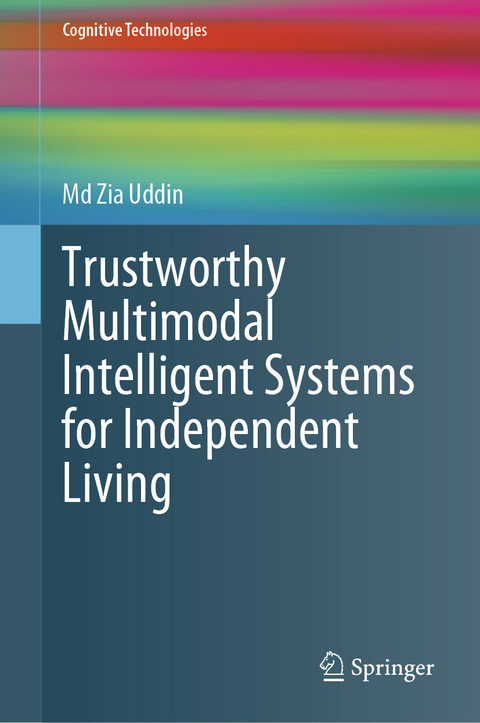
Trustworthy Multimodal Intelligent Systems for Independent Living (eBook)
326 Seiten
Springer-Verlag
978-3-031-97359-8 (ISBN)
This book is an essential guide for anyone interested in how artificial intelligence can enhance the quality of life for individuals who wish to maintain autonomy in their own homes. The author begins by introducing the reader to AI applications in independent living environments, such as smart assisted homes and AI-driven personalization, and thoughtfully explores the ethical challenges involved. With a strong focus on the intersection of technology and human needs, the book provides a detailed roadmap for building intelligent systems that promote safety, independence, and dignity, especially for elderly or vulnerable populations. The author offers both foundational knowledge and critical discussions around the opportunities and limitations of AI when applied to daily life scenarios.
A major strength of the book lies in its thorough examination of multimodal systems. Readers are introduced to a rich array of sensor technologies including wearable devices, environmental sensors, vision-based systems, and sound-based inputs. These components are described not only in terms of their individual functionalities but also in how they interact and fuse data to support complex inference tasks. The text walks the reader through system architectures—centralized and distributed—while emphasizing data fusion, synchronization, and real-time versus batch processing. Through practical examples such as fall detection alerts and activity recognition, the book highlights the engineering challenges and solutions involved in building robust, responsive, and user-accepted assistive systems. Ethical deployment, user engagement, long-term maintenance, and family involvement are all addressed in ways that reflect real-world concerns and user diversity.
The book also tackles some of the most pressing topics in AI today: data privacy, explainability, and trust. With an entire section dedicated to synthetic data, it explains how artificial data can be used to train effective models while safeguarding user privacy.
| Erscheint lt. Verlag | 21.7.2025 |
|---|---|
| Sprache | englisch |
| Themenwelt | Mathematik / Informatik ► Informatik ► Datenbanken |
| Informatik ► Theorie / Studium ► Künstliche Intelligenz / Robotik | |
| Mathematik / Informatik ► Mathematik ► Statistik | |
| ISBN-10 | 3-031-97359-3 / 3031973593 |
| ISBN-13 | 978-3-031-97359-8 / 9783031973598 |
| Informationen gemäß Produktsicherheitsverordnung (GPSR) | |
| Haben Sie eine Frage zum Produkt? |
 PDF (Wasserzeichen)
Größe: 12,7 MB
DRM: Digitales Wasserzeichen
Dieses eBook enthält ein digitales Wasserzeichen und ist damit für Sie personalisiert. Bei einer missbräuchlichen Weitergabe des eBooks an Dritte ist eine Rückverfolgung an die Quelle möglich.
Dateiformat: PDF (Portable Document Format)
Mit einem festen Seitenlayout eignet sich die PDF besonders für Fachbücher mit Spalten, Tabellen und Abbildungen. Eine PDF kann auf fast allen Geräten angezeigt werden, ist aber für kleine Displays (Smartphone, eReader) nur eingeschränkt geeignet.
Systemvoraussetzungen:
PC/Mac: Mit einem PC oder Mac können Sie dieses eBook lesen. Sie benötigen dafür einen PDF-Viewer - z.B. den Adobe Reader oder Adobe Digital Editions.
eReader: Dieses eBook kann mit (fast) allen eBook-Readern gelesen werden. Mit dem amazon-Kindle ist es aber nicht kompatibel.
Smartphone/Tablet: Egal ob Apple oder Android, dieses eBook können Sie lesen. Sie benötigen dafür einen PDF-Viewer - z.B. die kostenlose Adobe Digital Editions-App.
Buying eBooks from abroad
For tax law reasons we can sell eBooks just within Germany and Switzerland. Regrettably we cannot fulfill eBook-orders from other countries.
aus dem Bereich