Zum Hauptinhalt springen
Nicht aus der Schweiz? Besuchen Sie lehmanns.de
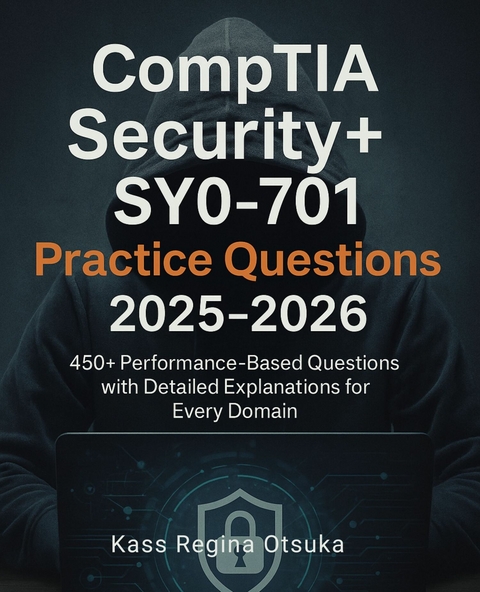
CompTIA Security+ SY0-701 Practice Questions 2025-2026 -  Kass Regina Otsuka

CompTIA Security+ SY0-701 Practice Questions 2025-2026 (eBook)

450+ Performance-Based Questions with Detailed Explanations for Every Domain
eBook Download: EPUB
2025 | 1. Auflage
335 Seiten
Isohan Publishing (Verlag)
978-0-00-096578-3 (ISBN)
Systemvoraussetzungen
8,61 inkl. MwSt
(CHF 8,40)
Der eBook-Verkauf erfolgt durch die Lehmanns Media GmbH (Berlin) zum Preis in Euro inkl. MwSt.
  • Download sofort lieferbar
  • Zahlungsarten anzeigen

Pass CompTIA Security+ SY0-701 on Your First Attempt - Master Performance-Based Questions with 450+ Practice Problems


Are you struggling with performance-based questions (PBQs) - the most challenging aspect of the Security+ exam? StationX This comprehensive practice guide specifically addresses the #1 reason candidates fail: inadequate PBQ preparation. Quizlet


Why This Book Delivers Real Results: Unlike generic study guides that barely touch on PBQs, this focused practice resource provides 450+ expertly crafted questions with detailed explanations designed to mirror the actual SY0-701 exam experience. Every question includes in-depth analysis explaining not just why answers are correct, but why others are wrong - building the critical thinking skills essential for exam success.


Complete Coverage of All Security+ Domains:


General Security Concepts (12% of exam) - Master fundamental principles


Threats, Vulnerabilities, and Mitigations (22%) - Identify and counter real-world attacks


Security Architecture (18%) - Design secure systems and networks


Security Operations (28%) - Implement practical security solutions


Security Program Management (20%) - Develop comprehensive security policies CertBlaster


What Makes This Book Different:


Performance-Based Question Mastery - Dedicated PBQ section with step-by-step solving strategies for simulation questions that trip up most candidates StationXQuizlet


100% Updated for SY0-701 - Covers latest exam objectives including zero trust, AI-driven security, and hybrid cloud environments (not recycled SY0-601 content) Quizlet


Real-World Scenarios - Questions based on actual cybersecurity challenges you'll face on the job Quizlet


Time Management Training - Practice exams with built-in timing to master the 90-minute constraint Crucial Examsctfassets


Weak Area Identification - Domain-specific practice sets to pinpoint and strengthen knowledge gaps


Mobile-Friendly Format - Study anywhere with clear formatting optimized for digital devices


Exam Day Strategy Guide - Proven techniques for managing PBQs and maximizing your score


Who This Book Is For:


Entry-level cybersecurity professionals seeking their first certification


IT administrators transitioning to security roles


DoD personnel meeting 8570 compliance requirements ctfassets


Career changers entering the lucrative cybersecurity field

Network Security Configuration (Questions 1-50)
Question 1 (PBQ) You are configuring a pfSense firewall for a small medical practice. Create firewall rules that:
  • Allow HTTPS traffic from internal network (192.168.1.0/24) to external websites
  • Block all HTTP traffic to prevent unencrypted web browsing
  • Allow DNS queries from internal network to Google DNS (8.8.8.8)
  • Log all denied traffic attempts
Answer:
  1. Create rule: Source 192.168.1.0/24, Destination Any, Port 443, Protocol TCP, Action Allow
  2. Create rule: Source 192.168.1.0/24, Destination Any, Port 80, Protocol TCP, Action Block, Log Yes
  3. Create rule: Source 192.168.1.0/24, Destination 8.8.8.8, Port 53, Protocol UDP, Action Allow
  4. Enable logging on default deny rule
Explanation: This configuration enforces encrypted web browsing while allowing necessary DNS resolution. Blocking HTTP prevents accidental transmission of sensitive medical data over unencrypted connections, which is crucial for HIPAA compliance.
Question 2 (PBQ) Configure a Cisco ASA firewall to implement a DMZ network. The topology includes:
  • Outside interface: 203.0.113.1/24 (Internet)
  • DMZ interface: 10.1.1.1/24 (Web servers)
  • Inside interface: 192.168.1.1/24 (Internal network)
Create access-lists that allow:
  • Internet users to access web servers on ports 80 and 443
  • Internal users to access DMZ web servers
  • Internal users to access the Internet
  • Block all other traffic
Answer:
access-list OUTSIDE_IN permit tcp any host 10.1.1.10 eq 80
access-list OUTSIDE_IN permit tcp any host 10.1.1.10 eq 443
access-list INSIDE_IN permit tcp 192.168.1.0 255.255.255.0 10.1.1.0 255.255.255.0
access-list INSIDE_IN permit tcp 192.168.1.0 255.255.255.0 any
access-group OUTSIDE_IN in interface outside
access-group INSIDE_IN in interface inside
Explanation: DMZ configuration creates a buffer zone between Internet and internal networks. Web servers in DMZ can be accessed from Internet while internal network remains protected. This follows defense-in-depth principles.
Question 3 (PBQ) You discover that users on VLAN 10 (192.168.10.0/24) can communicate with users on VLAN 20 (192.168.20.0/24), but they should be isolated. Configure inter-VLAN access control to:
  • Block all traffic between VLAN 10 and VLAN 20
  • Allow both VLANs to access the Internet
  • Allow both VLANs to access DNS server at 192.168.1.10
  • Maintain access to default gateway
Answer:
ip access-list extended VLAN10_ACL
deny ip 192.168.10.0 0.0.0.255 192.168.20.0 0.0.0.255
permit tcp 192.168.10.0 0.0.0.255 host 192.168.1.10 eq 53
permit udp 192.168.10.0 0.0.0.255 host 192.168.1.10 eq 53
permit ip 192.168.10.0 0.0.0.255 any
ip access-list extended VLAN20_ACL
deny ip 192.168.20.0 0.0.0.255 192.168.10.0 0.0.0.255
permit tcp 192.168.20.0 0.0.0.255 host 192.168.1.10 eq 53
permit udp 192.168.20.0 0.0.0.255 host 192.168.1.10 eq 53
permit ip 192.168.20.0 0.0.0.255 any
Explanation: Access control lists prevent lateral movement between VLANs while maintaining necessary services. DNS access is explicitly permitted before the general Internet access rule to ensure name resolution works properly.
Question 4 (PBQ) Configure a Windows Defender Firewall with Advanced Security to secure a web server. Create rules that:
  • Allow HTTP (port 80) and HTTPS (port 443) inbound from any source
  • Allow RDP (port 3389) inbound from management network (10.0.0.0/8) only
  • Block all other inbound traffic
  • Allow all outbound traffic for updates and DNS
Answer:
  1. Create Inbound Rule: Port 80, TCP, Allow, All Programs, Any IP
  2. Create Inbound Rule: Port 443, TCP, Allow, All Programs, Any IP
  3. Create Inbound Rule: Port 3389, TCP, Allow, All Programs, Scope: 10.0.0.0/8
  4. Set Default Inbound Action: Block
  5. Set Default Outbound Action: Allow
Explanation: This configuration follows the principle of least privilege by allowing only necessary services while restricting administrative access to the management network. Default deny for inbound traffic prevents unauthorized access attempts.
Question 5 (PBQ) A company needs to segment their network to comply with PCI DSS requirements. Configure network segmentation for:
  • Cardholder Data Environment (CDE): 10.10.10.0/24
  • Corporate network: 192.168.1.0/24
  • Guest network: 172.16.1.0/24
Requirements:
  • CDE should only communicate with specific payment processing servers
  • Corporate network cannot access CDE
  • Guest network cannot access any internal networks
  • All networks can access Internet through proxy at 192.168.1.100
Answer:
# CDE ACL
access-list CDE_OUT permit tcp 10.10.10.0 0.0.0.255 host 203.0.113.50 eq 443
access-list CDE_OUT permit tcp 10.10.10.0 0.0.0.255 host 192.168.1.100 eq 8080
access-list CDE_OUT deny ip 10.10.10.0 0.0.0.255 any
# Corporate ACL
access-list CORP_OUT deny ip 192.168.1.0 0.0.0.255 10.10.10.0 0.0.0.255
access-list CORP_OUT permit ip 192.168.1.0 0.0.0.255 any
# Guest ACL
access-list GUEST_OUT deny ip 172.16.1.0 0.0.0.255 10.0.0.0 0.255.255.255
access-list GUEST_OUT deny ip 172.16.1.0 0.0.0.255 192.168.0.0 0.0.255.255
access-list GUEST_OUT permit tcp 172.16.1.0 0.0.0.255 host 192.168.1.100 eq 8080
Explanation: PCI DSS requires strict network segmentation to protect cardholder data. The CDE is isolated with only necessary payment processing communication allowed. This reduces the scope of PCI compliance requirements.
Question 6 (PBQ) Configure NAT (Network Address Translation) on a router to:
  • Translate internal network 192.168.100.0/24 to public IP 203.0.113.10
  • Create static NAT for internal web server 192.168.100.50 to public IP 203.0.113.11
  • Create port forwarding for internal SSH server at 192.168.100.20:22 to public IP 203.0.113.10:2222
Answer:
# Dynamic NAT pool
ip nat pool PUBLIC_POOL 203.0.113.10 203.0.113.10 netmask 255.255.255.0
ip nat inside source list 100 pool PUBLIC_POOL overload
# Static NAT for web server
ip nat inside source static 192.168.100.50 203.0.113.11
# Port forwarding for SSH
ip nat inside source static tcp 192.168.100.20 22 203.0.113.10 2222
# Access list for internal network
access-list 100 permit ip 192.168.100.0 0.0.0.255 any
# Interface configuration
interface FastEthernet0/0
ip nat outside
interface FastEthernet0/1
ip nat inside
Explanation: NAT configuration provides Internet access for internal hosts while hiding internal network structure. Static NAT enables external access to specific servers while port forwarding allows secure remote administration on non-standard ports.
Question 7 (PBQ) Configure a site-to-site VPN between two offices using IPSec. Configure the following parameters:
  • Office A: 192.168.1.0/24, Public IP: 203.0.113.1
  • Office B: 192.168.2.0/24, Public IP: 203.0.113.2
  • Use PSK authentication with key "SecureVPN123!"
  • Use AES-256 encryption and SHA-256 hashing
  • Create appropriate tunnel and transport policies
Answer:
# IKE Policy
crypto isakmp policy 10
encryption aes 256
hash sha256
authentication pre-share
group 14
# Pre-shared key
crypto isakmp key SecureVPN123! address 203.0.113.2
# IPSec transform set
crypto ipsec transform-set VPN_SET esp-aes 256 esp-sha256-hmac
# Access list for interesting traffic
access-list 101 permit ip 192.168.1.0 0.0.0.255 192.168.2.0 0.0.0.255
# Crypto map
crypto map VPN_MAP 10 ipsec-isakmp
set peer 203.0.113.2
set transform-set VPN_SET
match address 101
# Apply to interface
interface Serial0/0
crypto map VPN_MAP
Explanation: Site-to-site VPN creates secure communication between offices over the Internet. Strong encryption (AES-256) and hashing (SHA-256) ensure data confidentiality and integrity during transmission.
Question 8 (PBQ) Configure Quality of Service (QoS) on a router to prioritize...

Erscheint lt. Verlag 10.7.2025
Sprache englisch
Themenwelt Informatik Netzwerke Sicherheit / Firewall
ISBN-10 0-00-096578-2 / 0000965782
ISBN-13 978-0-00-096578-3 / 9780000965783
Informationen gemäß Produktsicherheitsverordnung (GPSR)
Haben Sie eine Frage zum Produkt?
EPUBEPUB (Adobe DRM)
Größe: 823 KB

Kopierschutz: Adobe-DRM
Adobe-DRM ist ein Kopierschutz, der das eBook vor Mißbrauch schützen soll. Dabei wird das eBook bereits beim Download auf Ihre persönliche Adobe-ID autorisiert. Lesen können Sie das eBook dann nur auf den Geräten, welche ebenfalls auf Ihre Adobe-ID registriert sind.
Details zum Adobe-DRM

Dateiformat: EPUB (Electronic Publication)
EPUB ist ein offener Standard für eBooks und eignet sich besonders zur Darstellung von Belle­tristik und Sach­büchern. Der Fließ­text wird dynamisch an die Display- und Schrift­größe ange­passt. Auch für mobile Lese­geräte ist EPUB daher gut geeignet.

Systemvoraussetzungen:
PC/Mac: Mit einem PC oder Mac können Sie dieses eBook lesen. Sie benötigen eine Adobe-ID und die Software Adobe Digital Editions (kostenlos). Von der Benutzung der OverDrive Media Console raten wir Ihnen ab. Erfahrungsgemäß treten hier gehäuft Probleme mit dem Adobe DRM auf.
eReader: Dieses eBook kann mit (fast) allen eBook-Readern gelesen werden. Mit dem amazon-Kindle ist es aber nicht kompatibel.
Smartphone/Tablet: Egal ob Apple oder Android, dieses eBook können Sie lesen. Sie benötigen eine Adobe-ID sowie eine kostenlose App.
Geräteliste und zusätzliche Hinweise

Buying eBooks from abroad
For tax law reasons we can sell eBooks just within Germany and Switzerland. Regrettably we cannot fulfill eBook-orders from other countries.

Mehr entdecken
aus dem Bereich
Technische und organisatorische Schutzmaßnahmen gegen Datenverlust …

von Thomas H. Lenhard

eBook Download (2025)
Springer Vieweg (Verlag)
CHF 34,15
Methodische Kombination von IT-Strategie und IT-Reifegradmodell

von Markus Mangiapane; Roman P. Büchler

eBook Download (2024)
Springer Fachmedien Wiesbaden (Verlag)
CHF 45,90
Das Praxishandbuch zu Krisenmanagement und Krisenkommunikation

von Holger Kaschner

eBook Download (2024)
Springer Fachmedien Wiesbaden (Verlag)
CHF 38,95