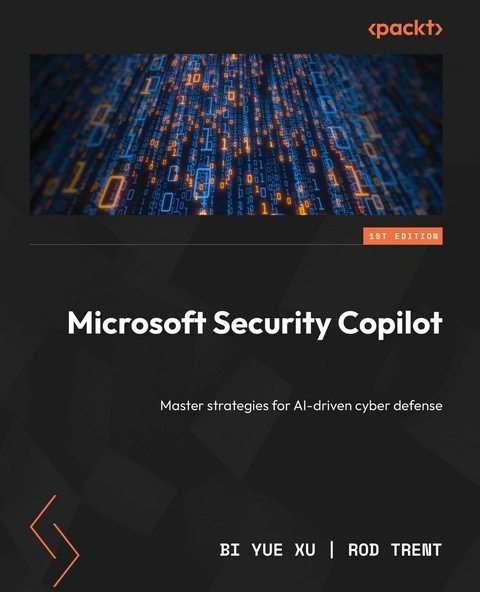
Microsoft Security Copilot (eBook)
576 Seiten
Packt Publishing (Verlag)
978-1-83588-453-9 (ISBN)

Be at the forefront of cybersecurity innovation with Microsoft Security Copilot, where advanced AI tackles the intricate challenges of digital defense. This book unveils Security Copilot's powerful features, from AI-powered analytics revolutionizing security operations to comprehensive orchestration tools streamlining incident response and threat management. Through real-world case studies and frontline stories, you'll learn how to truly harness AI advancements and unlock the full potential of Security Copilot within the expansive Microsoft ecosystem.
Designed for security professionals navigating increasingly sophisticated cyber threats, this book equips you with the skills to accelerate threat detection and investigation, refine your security processes, and optimize cyber defense strategies.
By the end of this book, you'll have become a Security Copilot ninja, confidently crafting effective prompts, designing promptbooks, creating custom plugins, and integrating logic apps for enhanced automation.
Become a Security Copilot expert and harness the power of AI to stay ahead in the evolving landscape of cyber defenseKey FeaturesExplore the Security Copilot ecosystem and learn to design effective prompts, promptbooks, and custom pluginsApply your knowledge with real-world case studies that demonstrate Security Copilot in actionTransform your security operations with next-generation defense capabilities and automationAccess interactive learning paths and GitHub-based examples to build practical expertiseBook DescriptionBe at the forefront of cybersecurity innovation with Microsoft Security Copilot, where advanced AI tackles the intricate challenges of digital defense. This book unveils Security Copilot's powerful features, from AI-powered analytics revolutionizing security operations to comprehensive orchestration tools streamlining incident response and threat management. Through real-world case studies and frontline stories, you'll learn how to truly harness AI advancements and unlock the full potential of Security Copilot within the expansive Microsoft ecosystem. Designed for security professionals navigating increasingly sophisticated cyber threats, this book equips you with the skills to accelerate threat detection and investigation, refine your security processes, and optimize cyber defense strategies. By the end of this book, you ll have become a Security Copilot ninja, confidently crafting effective prompts, designing promptbooks, creating custom plugins, and integrating logic apps for enhanced automation.What you will learnNavigate and use the complete range of features in Microsoft Security CopilotUnlock the full potential of Security Copilot's diverse plugin ecosystemStrengthen your prompt engineering skills by designing impactful and precise promptsCreate and optimize promptbooks to streamline security workflowsBuild and customize plugins to meet your organization's specific needsSee how AI is transforming threat detection and response for the new era of cyber defenseUnderstand Security Copilot's pricing model for cost-effective solutionsWho this book is forThis book is for cybersecurity professionals at all experience levels, from beginners seeking foundational knowledge to seasoned experts looking to stay ahead of the curve. While readers with basic cybersecurity knowledge will find the content approachable, experienced practitioners will gain deep insights into advanced features and real-world applications.]]>
1
Elevating Cyber Defense with Security Copilot
Welcome to Microsoft Security Copilot! In this book, you’ll embark on an exciting journey into the world of next-generation cyber defense powered by AI. This opening chapter takes you to the fascinating world of Artificial Intelligence (AI) and illustrates how it has evolved over time. You’ll gain insights into the technological advancements that have shaped AI, starting with the foundational principles of machine learning and progressing to more sophisticated technologies, including deep learning, generative AI, and large language models (LLMs). These technological breakthroughs have contributed to the powerful AI capabilities we use today.
By exploring the core concepts behind AI, you’ll gain a clearer understanding of how it operates behind the scenes. This deeper insight will enhance your knowledge and confidence in using AI tools such as Microsoft Security Copilot, allowing you to apply your understanding of AI principles to effectively utilize these tools.
You’ll also gain a comprehensive view of how Microsoft is harnessing AI through its suite of Copilot solutions to drive the development of innovation and practical applications, as well as its significant role in enhancing cybersecurity to protect your digital assets and infrastructure.
We will cover these topics through the following sections in this chapter:
- AI evolution – core principles and generative advances
- Introducing Microsoft Security Copilot
- Discovering Microsoft Security Copilot
Getting the most out of this book – get to know your free benefits
Unlock exclusive free benefits that come with your purchase, thoughtfully crafted to supercharge your learning journey and help you learn without limits.
Here’s a quick overview of what you get with this book:
Next-gen reader
| Figure 1.1: Illustration of the next-gen Packt Reader’s features | Our web-based reader, designed to help you learn effectively, comes with the following features: Multi-device progress sync: Learn from any device with seamless progress sync. Highlighting and notetaking: Turn your reading into lasting knowledge. Bookmarking: Revisit your most important learnings anytime. Dark mode: Focus with minimal eye strain by switching to dark or sepia mode. |
Interactive AI assistant (beta)
| Figure 1.2: Illustration of Packt’s AI assistant | Our interactive AI assistant has been trained on the content of this book, to maximize your learning experience. It comes with the following features: Summarize it: Summarize key sections or an entire chapter. AI code explainers: In the next-gen Packt Reader, click the Explain button above each code block for AI-powered code explanations. Note: The AI assistant is part of next-gen Packt Reader and is still in beta. |
DRM-free PDF or ePub version
| Figure 1.3: Free PDF and ePub | Learn without limits with the following perks included with your purchase: Learn from anywhere with a DRM-free PDF copy of this book. Use your favorite e-reader to learn using a DRM-free ePub version of this book. |
Unlock this book’s exclusive benefits nowScan this QR code or go to packtpub.com/unlock, then search for this book by name. Ensure it’s the correct edition. |
| Note: Keep your purchase invoice ready before you start. |
AI evolution – core principles and generative advances
AI is the grand umbrella term that encompasses all forms of computational systems that can perform tasks that normally require human intelligence. AI encompasses a wide range of subfields, including machine learning, deep learning, neural networks, Natural Language Processing (NLP), and robotics. Its applications are diverse, ranging from medical diagnosis and financial analysis to self-driving cars and virtual personal assistants.
The term artificial intelligence was first introduced by John McCarthy in 1956 during the Dartmouth Conference, marking the birth of AI as a field of study. AI gained momentum with the rise of machine learning, which focused on developing algorithms that allow computers to learn from data and make predictions or decisions without being explicitly programmed for specific tasks. The availability of large datasets and advances in computing power facilitated the development of more complex machine learning models.
The mid-2000s marked a significant breakthrough in AI with the advent of deep learning. Deep learning, a branch of machine learning, is characterized by neural networks with multiple layers. It began to gain prominence around 2006, largely driven by Geoffrey Hinton’s groundbreaking work in developing techniques that enabled AI systems to learn in a human-like manner. Deep learning models achieved remarkable success in tasks such as image and speech recognition, NLP, and gaming. This era’s progress was propelled by the availability of large datasets, powerful GPUs, and improved algorithms, all of which facilitated the training of increasingly complex models.
Generative AI, which can generate content that closely resembles human creation, saw significant advancements in 2014. It began with the capability to create realistic images from noise maps. Over time, it has evolved to craft an extensive variety of content, spanning from textual compositions and imagery to video clips, musical pieces, and synthesized speech.
The early 2020s were marked by an AI boom, particularly with the advancements in deep learning and the development of LLMs. These models are capable of summarizing, reading, or generating text in a manner similar to human communication, which has led to a substantial expansion of generative AI systems. Advanced chatbots such as ChatGPT, Copilot, and LLaMA have contributed greatly to the AI landscape, transforming our interaction with technology and unlocking unprecedented levels of efficiency and creative potential.
AI continues to advance at an unprecedented pace. However, its core components are deeply interconnected, starting with the broad foundation of AI and progressing to more specialized areas such as machine learning, deep learning, and, ultimately, specialized models such as generative AI and LLMs. The core components of AI and their relationships are outlined next, illustrating how each one is interconnected within the broader AI ecosystem:
- AI is the broad field – the “umbrella”
- Machine learning is a core component of AI – it’s a method within AI
- Deep learning is a specialized subcomponent of machine learning
- Generative AI is an application area (or functional branch) of deep learning
- LLMs are a specific type of generative AI – very specialized components built on top of deep learning architectures
The following diagram offers a visual guide to these core AI components:
Figure 1.4 – Visual guide illustrating the layers within AI systems
Note that this visual guide depicts the core components of AI in layers, with each component in an inner layer being a subset of the component in the outer layer. Each layer also builds upon the capabilities of the outer layer, illustrating how each foundational technology, such as machine learning, paved the way for more advanced developments, such as deep learning.
As AI continues to advance, its transformative impact is being felt across a wide range of industries. In healthcare, AI is revolutionizing the sector by helping doctors with diagnoses, creating personalized treatment plans, and accelerating the pace of drug discovery. Banks and financial institutions are leveraging AI’s power to detect fraudulent activities, execute algorithmic trades, and manage risks. In the automotive industry, AI is behind the wheel of self-driving cars and boosting safety with advanced driver-assistance systems. Retailers are tapping into AI to tailor customer recommendations, streamline inventory management, and automate client services. In the manufacturing sphere, AI is used to optimize supply...
| Erscheint lt. Verlag | 24.7.2025 |
|---|---|
| Sprache | englisch |
| Themenwelt | Informatik ► Netzwerke ► Sicherheit / Firewall |
| ISBN-10 | 1-83588-453-9 / 1835884539 |
| ISBN-13 | 978-1-83588-453-9 / 9781835884539 |
| Informationen gemäß Produktsicherheitsverordnung (GPSR) | |
| Haben Sie eine Frage zum Produkt? |
 EPUB (Ohne DRM)
Digital Rights Management: ohne DRM
Dieses eBook enthält kein DRM oder Kopierschutz. Eine Weitergabe an Dritte ist jedoch rechtlich nicht zulässig, weil Sie beim Kauf nur die Rechte an der persönlichen Nutzung erwerben.
Dateiformat: EPUB (Electronic Publication)
EPUB ist ein offener Standard für eBooks und eignet sich besonders zur Darstellung von Belletristik und Sachbüchern. Der Fließtext wird dynamisch an die Display- und Schriftgröße angepasst. Auch für mobile Lesegeräte ist EPUB daher gut geeignet.
Systemvoraussetzungen:
PC/Mac: Mit einem PC oder Mac können Sie dieses eBook lesen. Sie benötigen dafür die kostenlose Software Adobe Digital Editions.
eReader: Dieses eBook kann mit (fast) allen eBook-Readern gelesen werden. Mit dem amazon-Kindle ist es aber nicht kompatibel.
Smartphone/Tablet: Egal ob Apple oder Android, dieses eBook können Sie lesen. Sie benötigen dafür eine kostenlose App.
Geräteliste und zusätzliche Hinweise
Buying eBooks from abroad
For tax law reasons we can sell eBooks just within Germany and Switzerland. Regrettably we cannot fulfill eBook-orders from other countries.
aus dem Bereich