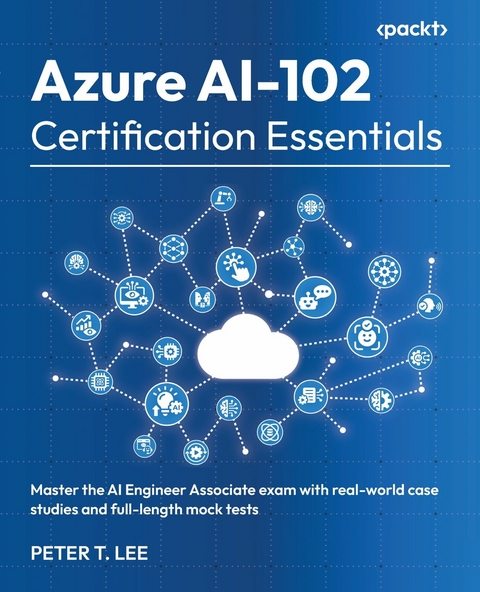
Azure AI-102 Certification Essentials (eBook)
388 Seiten
Packt Publishing (Verlag)
978-1-83620-526-5 (ISBN)
Written by a seasoned solutions architect and Microsoft AI professional with over 25 years of IT experience, Azure AI-102 Certification Essentials will help you gain the skills and knowledge needed to confidently pass the Azure AI-102 certification exam and advance your career. This comprehensive guide covers all of the exam objectives, from designing AI solutions to integrating AI models into Azure services. By combining theoretical concepts with visual examples, hands-on exercises, and real-world use cases, the chapters teach you how to effectively apply your new-found knowledge.
The book emphasizes responsible AI practices, addressing fairness, reliability, privacy, and security, while guiding you through testing AI models with diverse data and navigating legal considerations. Featuring the latest Azure AI tools and technologies, each chapter concludes with hands-on exercises to reinforce your learning, culminating in Chapter 11's comprehensive set of 45 mock questions that simulate the actual exam and help you assess your exam readiness.
By the end of this book, you'll be able to confidently design, implement, and integrate AI solutions on Azure, while achieving this highly sought-after certification.
Go beyond AI-102 certification by mastering the foundations of Azure AI concepts and services-reinforced through practical labs and real-world examples.Key FeaturesSolidify your understanding with targeted questions at the end of each chapterAssess your knowledge of key concepts with over 45 exam-style questions, complete with detailed explanationsGet hands-on experience with GitHub projects, along with ongoing support from the author on GitHubPurchase of the print or Kindle book includes a free PDF eBookBook DescriptionWritten by a seasoned solutions architect and Microsoft AI professional with over 25 years of IT experience, Azure AI-102 Certification Essentials will help you gain the skills and knowledge needed to confidently pass the Azure AI-102 certification exam and advance your career. This comprehensive guide covers all of the exam objectives, from designing AI solutions to integrating AI models into Azure services. By combining theoretical concepts with visual examples, hands-on exercises, and real-world use cases, the chapters teach you how to effectively apply your new-found knowledge. The book emphasizes responsible AI practices, addressing fairness, reliability, privacy, and security, while guiding you through testing AI models with diverse data and navigating legal considerations. Featuring the latest Azure AI tools and technologies, each chapter concludes with hands-on exercises to reinforce your learning, culminating in Chapter 11's comprehensive set of 45 mock questions that simulate the actual exam and help you assess your exam readiness. By the end of this book, you'll be able to confidently design, implement, and integrate AI solutions on Azure, while achieving this highly sought-after certification.What you will learnLearn core concepts relating to AI, LLMs, NLP, and generative AIBuild and deploy with Azure AI Foundry, CI/CD, and containersManage and secure Azure AI services with built-in toolsApply responsible AI using Azure AI Content SafetyPerform OCR and analysis with Azure AI VisionBuild apps with the Azure AI Language and Speech servicesExplore knowledge mining with Azure AI Search and Content UnderstandingImplement RAG and fine-tuning with Azure OpenAIBuild agents using Azure AI Foundry Agent Service and Semantic KernelWho this book is forIf you're preparing for the Azure AI-102 certification exam, this book is for you. Developers, engineers, and career transitioners moving from traditional software development to AI-focused roles can use this guide to deepen their understanding of AI within the Azure ecosystem. This book is also beneficial for students and educators looking to apply AI/ML concepts using Azure. No prior experience in AI/ML is required as this book provides comprehensive coverage of exam topics with detailed explanations, practical examples, and hands-on exercises to build your confidence and expertise.]]>
Preface
The timing for Artificial Intelligence (AI) could not be better. As an AI/data solution architect at Microsoft, I have witnessed firsthand the transformative power of AI, especially since the advent of OpenAI. The world is evolving rapidly, and traditional processes are being reimagined.
Take, for example, one of my insurance clients. They used to deal with vast amounts of unstructured data, such as PDFs and emails. Teams of hundreds of people manually extracted information from thousands of files, entered it into the custom structured format of Excel, validated the data, and passed it to business analysts to generate reports. Decision-makers would then rely on these reports to make critical choices.
Now, with AI, this entire workflow is automated. AI extracts data from structured, semi-structured, and unstructured sources, stores it in a database, and generates analytic reports. It even enables users to interact with their data conversationally. The result? Millions of dollars saved and a significant boost in productivity.
If you’re excited to be part of this transformative journey, you’ve come to the right place. This book not only focuses on helping you pass the AI-102: Azure AI Engineer Associate Certification but also equips you with real-world project experience (Chapter 10). My goal is for you to walk away with both the confidence of a certified professional and practical skills that open doors to new opportunities.
Whether you’re considering a career switch to AI or enhancing your current skill set, I welcome you to this exciting moment. Let this book be your gateway to a rewarding and dynamic future. I hope you enjoy the journey.
Who this book is for
This book is designed for anyone preparing for the AI-102: Azure AI Engineer Associate Certification exam, regardless of their background. It’s an excellent resource for developers and engineers looking to expand their knowledge of AI within the Azure ecosystem. For those transitioning from traditional software development roles to AI-focused careers, this book provides the tools and insights needed to thrive in AI projects using Azure. Students and educators will also find it valuable, offering practical ways to connect AI concepts with real-world applications.
While some familiarity with AI/ML concepts or development practices can be helpful, it’s not a requirement. The book includes a clear, comprehensive summary of the exam topics and provides additional resources to support your learning journey. Through practical examples, hands-on exercises, and straightforward explanations, this book aims to give you the confidence to pass the Azure AI-102 exam and apply your skills to real-world AI projects.
What this book covers
This book is structured to closely follow the official Microsoft study guide for Exam AI-102, ensuring comprehensive coverage of the certification objectives. You may notice that some of the latest Azure AI services or features are either not included or only briefly mentioned. That’s intentional—I focused on what’s required for the exam rather than trying to chase every new release. However, as long as you understand the foundational concepts—the principles that power both current and future services—you’ll be well-prepared to adapt to whatever comes next. Think of this book as a cornerstone for your AI career. That’s also why I included Chapter 10, which goes beyond the exam content to showcase real-world use cases and project examples. These are designed to not only reinforce your knowledge but also help you transition from passing the exam to confidently applying AI in practical scenarios. This book will help you earn your certification—but more importantly, it will prepare you to think and operate like a real AI professional from day one.
Let’s look at what is covered in each chapter.
Chapter 1, Understanding AI, ML, and Azure’s AI Services, introduces key AI and ML basic concepts, including advanced topics such as deep learning and generative AI, foundational elements such as Large Language Models (LLMs), Natural Language Processing (NLP), and prompt engineering, and an overview of Azure’s AI services, equipping you with a foundational understanding to build on in later chapters.
Chapter 2, Getting Started with Azure AI: Studios, Pipelines, and Containerization, introduces key Azure development environments (Azure AI Foundry, Azure OpenAI, Machine Learning Studio, and Copilot Studio) along with Visual Studio Code (VS Code), explores their roles in AI development, and covers CI/CD integration, resource management, and container deployment strategies for flexible and secure AI model hosting.
Chapter 3, Managing, Monitoring, and Securing Azure AI Services, focuses on managing and monitoring Azure AI services by covering diagnostic logging, performance metrics, cost management, secure key handling, network security, authentication mechanisms, and private communications, providing the tools to ensure smooth and secure AI deployments.
Chapter 4, Implementing Content Moderation Solutions, emphasizes the importance of responsible AI principles (fairness, transparency, accountability, and more) in developing ethical AI systems, addresses the unique risks of generative AI, and explores mitigation strategies such as Azure AI Content Safety and the Responsible Innovation framework to ensure secure and reliable AI deployment.
Chapter 5, Exploring Azure AI Vision Solutions, explores Azure AI Vision’s capabilities for image and video analysis, including object detection, face recognition, Optical Character Recognition (OCR), custom model development, and video insights such as scene detection and real-time spatial analysis, equipping you to extract meaningful data from visual content.
Chapter 6, Implementing Natural Language Processing Solutions, covers advanced text and speech analysis using Azure AI Language and Speech services, including NLP techniques, speech-to-text, text-to-speech, custom speech solutions, and translation capabilities, enabling the development of intelligent, multilingual, voice-enabled applications.
Chapter 7, Implementing Knowledge Mining, Document Intelligence, and Content Understanding, teaches you how to use Azure AI Search and Document Intelligence tools to extract, organize, and analyze unstructured data, transforming it into actionable insights and automating data processing workflows.
Chapter 8, Working on Generative AI Solutions, explores the practical use of generative AI with Azure OpenAI Service, covering text, code, and image generation, model deployment, API usage, fine-tuning, and integrating data with Retrieval-Augmented Generation (RAG) to create customized AI-driven solutions.
Chapter 9, Implementing Agentic Solutions with Azure AI Agent Service, explores how to design, build, and deploy intelligent AI agents using Azure tools and frameworks such as Azure AI Agent Service, Semantic Kernel, and AutoGen. It explores core agent components and real-world use cases and compares development approaches through hands-on exercises. The chapter also covers collaborative agent orchestration, deployment best practices, and strategies for monitoring and securing agents in production.
Chapter 10, Practical AI Implementation: Industry Use Cases, Technical Patterns, and Hands-On Projects, explores AI’s transformative impact through technical patterns such as custom Copilot, chat with your own data, and document processing, real-world applications in various industries, RAG patterns, and advanced tools for data extraction and AI search, supported by hands-on projects.
Chapter 11, Preparing for the AI-102: Azure AI Engineer Associate Certification Exam, prepares you for the AI-102 certification by outlining the exam framework, key focus areas, and preparation strategies, and providing a comprehensive practice exam to assess your readiness.
The following diagram outlines the recommended flow for navigating this book. Chapter 1 provides an overview of all the key concepts covered throughout the chapters, serving as a foundation. You can always revisit relevant concepts while working through Chapters 3 to 9. One suggested approach is to focus on an AI service that interests you most, read through the relevant section, and then dive into the corresponding chapter instead of going through all the details in Chapter 1 upfront. Chapter 2 comes next, as it covers the essential service setup and provides information such as service endpoints and keys needed for exercises in later...
| Erscheint lt. Verlag | 14.8.2025 |
|---|---|
| Sprache | englisch |
| Themenwelt | Informatik ► Theorie / Studium ► Künstliche Intelligenz / Robotik |
| Informatik ► Weitere Themen ► Zertifizierung | |
| ISBN-10 | 1-83620-526-0 / 1836205260 |
| ISBN-13 | 978-1-83620-526-5 / 9781836205265 |
| Informationen gemäß Produktsicherheitsverordnung (GPSR) | |
| Haben Sie eine Frage zum Produkt? |
 EPUB (Adobe DRM)
Größe: 17,0 MB
Kopierschutz: Adobe-DRM
Adobe-DRM ist ein Kopierschutz, der das eBook vor Mißbrauch schützen soll. Dabei wird das eBook bereits beim Download auf Ihre persönliche Adobe-ID autorisiert. Lesen können Sie das eBook dann nur auf den Geräten, welche ebenfalls auf Ihre Adobe-ID registriert sind.
Details zum Adobe-DRM
Dateiformat: EPUB (Electronic Publication)
EPUB ist ein offener Standard für eBooks und eignet sich besonders zur Darstellung von Belletristik und Sachbüchern. Der Fließtext wird dynamisch an die Display- und Schriftgröße angepasst. Auch für mobile Lesegeräte ist EPUB daher gut geeignet.
Systemvoraussetzungen:
PC/Mac: Mit einem PC oder Mac können Sie dieses eBook lesen. Sie benötigen eine
eReader: Dieses eBook kann mit (fast) allen eBook-Readern gelesen werden. Mit dem amazon-Kindle ist es aber nicht kompatibel.
Smartphone/Tablet: Egal ob Apple oder Android, dieses eBook können Sie lesen. Sie benötigen eine
Geräteliste und zusätzliche Hinweise
Buying eBooks from abroad
For tax law reasons we can sell eBooks just within Germany and Switzerland. Regrettably we cannot fulfill eBook-orders from other countries.
aus dem Bereich