


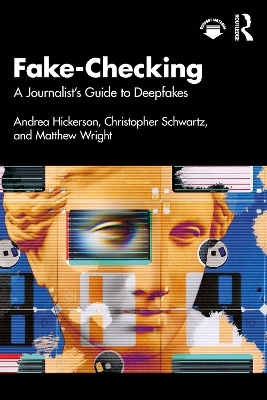
Fake-Checking
A Journalist’s Guide to Deepfakes
Seiten
2025
Routledge (Verlag)
978-1-032-74132-1 (ISBN)
Routledge (Verlag)
978-1-032-74132-1 (ISBN)
Designed to help journalists keep pace with the rapid evolution of deepfakes as well as integrate “fake-checking” methods into their routine reporting practices, this book offers a concise and accessible guide for reporters navigating this evolving challenge.
Designed to help journalists keep pace with the rapid evolution of deepfakes as well as integrate ‘fake-checking’ methods into their routine reporting practices, this book offers a concise and accessible guide for reporters navigating this evolving challenge.
This guide aims to assist journalists in understanding the complexities of deepfakes from a number of angles including philosophical, historical, technical, and methodological. Rather than approaching deepfakes as a ‘journalistic apocalypse,’ this book contextualises them in the larger historical practice of fact-checking and on a continuum of technological advances in image and video manipulation. Encouraging readers to view fact-checking as a multimodal process, it stresses the importance of combining philosophical and technical tools, especially ones based in epistemology and artifical intelligence (AI), in addition to the ‘pavement pounding’ essentials of good journalism. The book concludes with a chapter addressing how to explain deepfakes to a public progressively more concerned about the realities and consequences of AI and misinformation.
Fake-Checking serves as a practical reference for journalists and advanced media students who are increasingly required to identify and verify potential deepfakes and their future iterations.
This book is supported by online resources which can be accessed at www.routledge.com/9781032741321.
Designed to help journalists keep pace with the rapid evolution of deepfakes as well as integrate ‘fake-checking’ methods into their routine reporting practices, this book offers a concise and accessible guide for reporters navigating this evolving challenge.
This guide aims to assist journalists in understanding the complexities of deepfakes from a number of angles including philosophical, historical, technical, and methodological. Rather than approaching deepfakes as a ‘journalistic apocalypse,’ this book contextualises them in the larger historical practice of fact-checking and on a continuum of technological advances in image and video manipulation. Encouraging readers to view fact-checking as a multimodal process, it stresses the importance of combining philosophical and technical tools, especially ones based in epistemology and artifical intelligence (AI), in addition to the ‘pavement pounding’ essentials of good journalism. The book concludes with a chapter addressing how to explain deepfakes to a public progressively more concerned about the realities and consequences of AI and misinformation.
Fake-Checking serves as a practical reference for journalists and advanced media students who are increasingly required to identify and verify potential deepfakes and their future iterations.
This book is supported by online resources which can be accessed at www.routledge.com/9781032741321.
Andrea Hickerson is Professor and Dean of the School of Journalism and New Media at the University of Mississippi, USA. Christopher Schwartz is Research Scientist at the Department of Cybersecurity, Rochester Institute of Technology, USA. Matthew Wright is Kevin O’Sullivan Professor and Chair of Cybersecurity at Rochester Institute of Technology, USA.
Foreword
Acknowledgements
Introduction: From Fact-Checking to Fake-Checking
Chapter 1: Fact-Checking Confronts the Challenge of Deepfakes
Chapter 2: The Evolution of Fakery and Deepfakes
Chapter 3: Detection Practices and Tools
Chapter 4: Deepfake Uses, Ethics, and Emerging Challenges
Chapter 5: Helping Audiences Make Sense of Deepfakes
Conclusion: Journalism in the Matrix?
Glossary
Index
| Erscheinungsdatum | 11.12.2025 |
|---|---|
| Zusatzinfo | 2 Tables, black and white; 23 Halftones, black and white; 23 Illustrations, black and white |
| Verlagsort | London |
| Sprache | englisch |
| Maße | 138 x 216 mm |
| Gewicht | 300 g |
| Themenwelt | Informatik ► Theorie / Studium ► Künstliche Intelligenz / Robotik |
| Sozialwissenschaften ► Kommunikation / Medien ► Journalistik | |
| Sozialwissenschaften ► Kommunikation / Medien ► Medienwissenschaft | |
| ISBN-10 | 1-032-74132-5 / 1032741325 |
| ISBN-13 | 978-1-032-74132-1 / 9781032741321 |
| Zustand | Neuware |
| Informationen gemäß Produktsicherheitsverordnung (GPSR) | |
| Haben Sie eine Frage zum Produkt? |
Mehr entdecken
aus dem Bereich


aus dem Bereich
Künstliche Intelligenz, Macht und das größte Dilemma des 21. …
Buch | Softcover (2025)
C.H.Beck (Verlag)
CHF 25,20
Buch | Softcover (2025)
Reclam, Philipp (Verlag)
CHF 11,20
Eine kurze Geschichte der Informationsnetzwerke von der Steinzeit bis …
Buch | Hardcover (2024)
Penguin (Verlag)
CHF 39,95


