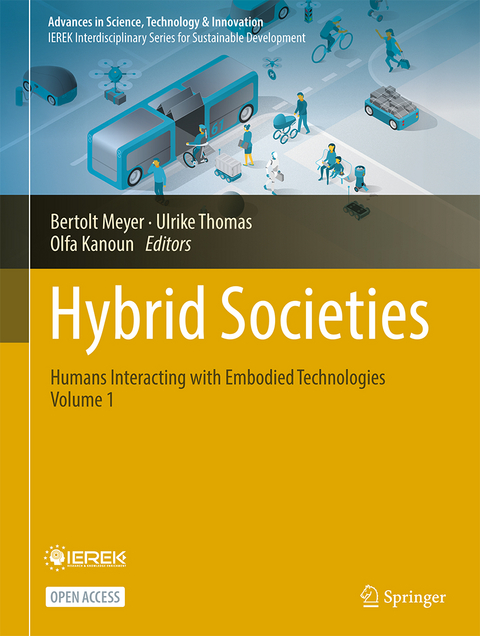
Hybrid Societies
Springer International Publishing (Verlag)
978-3-032-03487-8 (ISBN)
- Noch nicht erschienen - erscheint am 16.02.2026
- Versandkostenfrei
- Auch auf Rechnung
- Artikel merken
Bertolt Meyer:
Bertolt Meyer is a full professor for Work and Organizational Psychology at Chemnitz University of Technology in Germany and was the Speaker of the CRC 1410 "Hybrid Societies from 2022 - 2024. His research focuses on the impact of technology on social systems including the psychological effects of human body augmentation, the digital transformation of the workplace, and diversity. Meyer is an associate editor for Frontiers in Psychology: Organizational Psychology and at Small Group Research. He received his Ph.D. in 2007 from Humboldt University Berlin and worked as postdocoral researcher at the Institute of Psychology at the University of Zurich, Switzerland, from 2008 2014. He was voted German Professor of the Year 2024 by the German Association of University Professors and Lecturers (Deutscher Hochschulverband).
Ulrike Thomas:
Ulrike Thomas received her Diploma degree in Computer Science in 2000 and her Ph.D. in Robotics in 2008, both from the Institute of Robotics and Process Control at the Technical University of Braunschweig, Germany. She worked at the German Aerospace Center (DLR) at the Remote Sensing Institute (from 2007 to 2009) and the Institute of Robotics and Mechatronics (from 2009 to 2015) in Oberpfaffenhofen, Germany. Since 2015, she has been Professor and Head of the Robotics and Human-Machine Interaction Lab at Chemnitz University of Technology. Her research focuses on production and service robotics, the development of humanoid robots, human robot interaction, automated assembly planning, machine learning, and computer vision for robotics. She is the author of more than 100 scientific publications and patents and has received several outstanding paper awards. From 2020 to 2022, she served as Vice Speaker and part of the core leadership team of the Collaborative Research Center 1014 Hybrid Societies .
Olfa Kanoun:
Olfa Kanoun graduated in electrical engineering and information technology from the Technical University of Munich, Munich, Germany, in 1996. She received in 2001 the Ph.D. from the University of the Bundeswehr Munich, Munich. Since 2007, she has been a full professor in measurement and sensor technology with the Chemnitz University of Technology, Chemnitz, Germany. Her research interests in on the design of sensor systems including embedded impedance spectroscopy, flexible sensors, and energy aware wireless sensors. She received in 2022 the IEEE IM Technical Award. Following standardized citation indicators, she has been classified among the world top 2% scientist since 2019.
Part 1. Autonomous Vehicle & Urban Robotics.- 1. Hybrid Societies: Concepts, Challenges, and Research Agenda.- 2. A mixed methods approach for capturing interactions of cyclists with mobility space.- 3. Implicit driving cues for coordinating actions when sharing spaces.- 4. Experiencing automated vehicles in real-life affects central aspects of drivers User Experience.- 5. What are you: Social displays of autonomous machines.- 6. Influence of an innovative HMI for highly automated driving on trust.- 7. Challenges in modeling mental simulations of human drivers.- Part 2. Embodied Technologies.- 8. A preliminary evaluation of a body-attached multisensor measurement framework for hand gesture recognition.- 9. Understanding the Capabilities of FMG and EMG Sensors in Recognizing Basic Gesture Components.- 10. Feature Selection for Hand Gesture Recognition using Six FSR Sensors Bracelet.- 11. Design and Preliminary Testing of a Shoulder Exoskeleton based on a Soft Bellow Actuator.- 12. Observational Learning in Humans and Machines.- 13.Using Eye Tracking to Aid the Design of Human Machine Interfaces (HMIs) in Industrial Applications.- Part 3. Motion Tracking & Prediction.- 14. Predicting Object Weights from Giver s Kinematics in Handover Actions.- 15. A Parametric Model to Assess Minnesota Dexterity Test with IMU.- 16. A novel Framework for the Generation of Synthetic Datasets with Applications to Hand Detection and Segmentation.- 17. A Computational Study on Supervised and Unsupervised Gait Data Segmentation.- 18. Radar based gait analysis.- 19. Deep Learning for Human Activity Recognition with Plantar Pressure and Movement Data from an Instrumented Smart Sock System.- 20. Avoidance of collisions through prospective path planning.- Pasrt 4.Social Perception and Anthropomorphism.- 21. Sociomorphic Technologies On the Typology of Artificial Actors.- 22. Towards Hybrid Personae?.- 23. Make it more Human! A Systematic Literatur Review of the anthropomorphic processes on empathy.- 24. Towards TechnoSapiens: Experiencing Embodied Technologies in Augmented Reality.- Part 5. Robotics & Teleoperation.- 25. Human-Robot Interaction in Telemanipulation - An Overview.- 26. Grasp Pose Generation for Human-to-Robot Handovers using Simulation-to-Reality Transfer.- 27. Flip of a Switch: Designing a kinetic dialogue system for switch interfaces.- 28. Where am I? How to measure and support spatial orientation in teleoperation.- 29. Towards Smooth Human-Robot Interaction using Potential Gradient-Based Sampling.- Part 6. Artificial Intelligence.- 30. Human-Machine Teaming Agents: A Future Perspective.- 31. Proposals for Communicative and Cooperative AI to Promote Synergies in Hybrid AI-Augmented Socio-Technical Arrangements A Humanities Perspective.- 32. Nadaraya-Watson Time Series Early Classification for Gesture Recognition.- 33. Person detection and differentiation in shopping scenarios.- Part 7. Communication & Multimodality.- 34. Modelling intentional complexity in hybrid interaction scenarios beyond explicit and implicit communication.- 35. Designing Computer-mediated Communication with Affective Technology to Increase Feedback Acceptance.- Part 8. Research Environments & Methods.- 36. RDMflow: Managing Research Data Workflows with Micro-Frontends.- 37. Facilitating Ethics Application and Review for Interdisciplinary Human-Participant Research via Software-Based Guidance and Standardization.- 38. Gyro Gearloose or Little Helper? - Two Perspectives of AI and Patent Law.- 39. Advanced Methodological Approach for Designing Innovative Business Models for Hybrid Mobility Technologies.
| Erscheint lt. Verlag | 16.2.2026 |
|---|---|
| Reihe/Serie | Advances in Science, Technology & Innovation |
| Zusatzinfo | II, 534 p. 134 illus., 115 illus. in color. |
| Verlagsort | Cham |
| Sprache | englisch |
| Maße | 210 x 279 mm |
| Themenwelt | Informatik ► Theorie / Studium ► Künstliche Intelligenz / Robotik |
| Schlagworte | Artificial Intelligence • Artificial Intelligence • Cognition • Embodied Technologies • Embodied Technologies • human machine interaction • Human Machine Interaction • human movements • Human Movements • human robot interaction • Human Robot Interaction • multi-modal communication • Multi-Modal Communication • open access |
| ISBN-10 | 3-032-03487-6 / 3032034876 |
| ISBN-13 | 978-3-032-03487-8 / 9783032034878 |
| Zustand | Neuware |
| Informationen gemäß Produktsicherheitsverordnung (GPSR) | |
| Haben Sie eine Frage zum Produkt? |
aus dem Bereich