


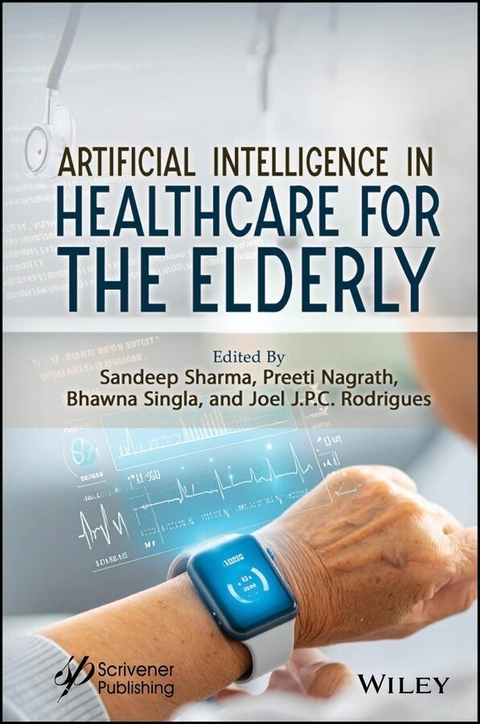
Artificial Intelligence in Healthcare for the Elderly (eBook)
589 Seiten
Wiley-Scrivener (Verlag)
978-1-394-27537-3 (ISBN)
Artificial Intelligence in Healthcare for the Elderly provides valuable insights into how artificial intelligence can transform healthcare through personalized monitoring, ethical considerations, and real-world applications.
Artificial intelligence has the potential to revolutionize healthcare for the elderly by providing efficient and personalized monitoring and care. Though this technology has the potential to revolutionize care, there is currently little information on the potential of this technology in elderly healthcare. Artificial Intelligence in Healthcare for the Elderly explores AI algorithms that can transform health monitoring for older adults by analyzing data from wearable devices, electronic health records, and other sources that provide real-time data analysis, detect early warning signs of diseases, and offer personalized treatment. This book addresses the critical ethical, societal, and practical aspects of elderly care that are often overlooked with insights from various disciplines, including healthcare, technology, ethics, and sociology, to offer a holistic perspective on AI's impact on aging. Artificial Intelligence in Healthcare for the Elderly offers an all-encompassing perspective on AI technologies employed in elderly healthcare by examining the specific types of technology used and delineating its role in elderly healthcare, drawing insights from existing research and case studies.
Sandeep Sharma, PhD is an assistant professor in Bharati Vidyapeeth's College of Engineering. He has published more than 15 research papers in reputed journals and one patent. His main area of focus is the use of heuristic techniques for finding the optimal parameters of FACTS devices in power systems.
Preeti Nagrath, PhD is an associate professor in Bharati Vidyapeeth's College of Engineering with more than 20 years of academic experience. She has published over 80 research papers in international journals and international conferences, four books, and two patents. His research interests include network security, delay-tolerant networks, machine learning, and deep learning.
Bhawna Singla, PhD is a professor in the Computer Science and Engineering Department at the Panipat Institute of Engineering and Technology. She has published two edited books, three patents, and 30 research articles in international journals and conferences. His research interests include artificial intelligence, machine learning, data science, and networking
Joel J.P.C. Rodrigues is a professor in the College of Computer Science and Technology at the China University of Petroleum, a senior researcher at the Instituto de Telecomunicações in Portugal, and a collaborator for the post-graduation program on teleinformatics engineering at the Federal University of Ceará in Brazil. He has authored and co-authored over 950 papers in refereed international journals and conferences, three books, and two patents. His research interests include sensor networks, Internet of Things, eHealth, vehicular networks, and cloud computing.
Artificial Intelligence in Healthcare for the Elderly provides valuable insights into how artificial intelligence can transform healthcare through personalized monitoring, ethical considerations, and real-world applications. Artificial intelligence has the potential to revolutionize healthcare for the elderly by providing efficient and personalized monitoring and care. Though this technology has the potential to revolutionize care, there is currently little information on the potential of this technology in elderly healthcare. Artificial Intelligence in Healthcare for the Elderly explores AI algorithms that can transform health monitoring for older adults by analyzing data from wearable devices, electronic health records, and other sources that provide real-time data analysis, detect early warning signs of diseases, and offer personalized treatment. This book addresses the critical ethical, societal, and practical aspects of elderly care that are often overlooked with insights from various disciplines, including healthcare, technology, ethics, and sociology, to offer a holistic perspective on AI s impact on aging. Artificial Intelligence in Healthcare for the Elderly offers an all-encompassing perspective on AI technologies employed in elderly healthcare by examining the specific types of technology used and delineating its role in elderly healthcare, drawing insights from existing research and case studies.
1
Smart Aging: Harnessing Artificial Intelligence in Elderly Healthcare
S.C. Vetrivel1*, V. Sabareeshwari2, Ramya Ambikapathi3, V.P. Arun4 and K.C. Sowmiya5
1Department of Management Studies, Kongu Engineering College, Perundurai, India
2Department of Soil Science and Agricultural Chemistry, Amrita Vishwa Vidyapeetham, Coimbatore, India
3Department of Environmental and Biological Sciences, University of Eastern Finland, Yliopistonranta 1 E, Kuopio, Finland
4Department of Business Administration, JKKN College of Engineering and Technology, Kumarapalayam, Tamil Nadu, India
5Research Department of Physics, Sri Vasavi College, Erode, India
Abstract
With the world’s population getting older, healthcare systems are facing unprecedented problems that call for creative solutions to fulfill the complex healthcare needs of the elderly. This chapter provides an in-depth analysis of artificial intelligence’s (AI) application in the healthcare of the elderly. Its purpose is to look into how AI technologies are now being used and how they affect many aspects of senior healthcare, such as health management, remote monitoring, individualized treatment plans, and diagnostics. First, the investigation looks closely at how AI is used in illness diagnosis and detection, with a focus on developments in machine learning techniques, natural language processing, picture and signal processing, and more. Medical imaging techniques like MRIs and CT scans that use AI are showing encouraging results in the early identification and accurate diagnosis of age-related diseases like dementia. The chapter also discusses the possibilities of AI-driven personalized medicine for the elderly, explaining how algorithms use lifestyle factors, genetic data, and individual health records to create personalized treatment programs that are specific to the needs and characteristics of senior patients. This strategy seeks to maximize therapeutic efficacy, reduce side effects, and boost overall health results. The research also explores AI’s potential applications in home-based healthcare for the elderly and remote patient monitoring. Wearables, smart home technology, and AI-powered sensors provide continuous health tracking by providing real-time data to healthcare providers and alerting them to possible problems. By encouraging early intervention and reducing problems and hospitalizations, this proactive monitoring can help. Examined are the difficulties and ethical issues surrounding the use of AI in senior healthcare, including data privacy concerns, algorithmic bias, lack of human oversight, accessibility challenges, and the potential for reduced human interaction in caregiving.
Keywords: Remote monitoring, assistive technologies, predictive analytics, telehealth, wearable devices, ambient intelligence, cognitive computing
1.1 Introduction
1.1.1 Overview of AI Applications in Healthcare
In the healthcare industry, artificial intelligence (AI) has become a disruptive force that is changing how patients receive care and how medical personnel provide it. AI is being used in healthcare in a wide range of contexts and at different phases of the healthcare process. One prominent field is diagnostics, where AI algorithms evaluate medical images, including CT, MRI, and X-rays, with amazing precision. This helps to enable faster and more accurate diagnoses, as well as early identification of diseases like cancer [1]. AI is essential to personalized medicine because it can analyze large datasets, including genomic data, and customize treatment regimens according to each patient’s distinct genetic composition. Predictive analytics is another crucial application in which AI systems analyze patient data to predict illness patterns and identify high-risk people. Additionally, chatbots and virtual health aides driven by AI are improving patient outcomes by increasing patient engagement, delivering timely information, and enabling remote monitoring. AI solutions also help with administrative activities, improving operational efficiency, decreasing paperwork, and optimizing workflows. Unprecedented advances in healthcare are brought about by the integration of AI, but there are also issues with data privacy, ethics, and the requirement for strong regulatory frameworks. Despite these obstacles, the continuous advancement of AI applications has enormous potential to change the healthcare industry and make it a more patient-centered, effective, and accessible system.
1.1.2 Importance of AI in Addressing Healthcare Challenges for the Elderly
The importance of artificial intelligence (AI) in addressing healthcare challenges for the elderly cannot be overstated, as it represents a groundbreaking approach to revolutionizing the provision of medical services for this vulnerable demographic. The elderly population has a multitude of complicated health problems, from chronic illnesses to cognitive decline, which calls for creative solutions to raise the standard of care and boost general well-being. Predictive analytics and machine learning algorithms are two examples of AI technologies that are essential to early disease detection and individualized treatment regimens. Artificial intelligence (AI) can detect patterns and trends in large datasets, which helps medical practitioners foresee possible health problems and take preventative measures [3, 4]. AI-enabled gadgets and software help with remote patient monitoring, enabling medical professionals to monitor vital signs and act promptly to prevent hospitalizations and improve the general treatment of chronic illnesses. Additionally, AI makes it easier to design assistive technologies like smart home systems and robotic companions, which enhance the independence, safety, and well-being of elderly individuals by providing real-time monitoring, personalized assistance, and proactive healthcare support. This enables elders to age in place with dignity and lessens the load on caretakers. AI expedites the development of new medicines and customizes interventions based on unique patient features, maximizing efficacy and reducing negative effects in the fields of drug discovery and personalized medicine. The application of AI to healthcare for the elderly offers a paradigm shift that tackles the particular difficulties brought on by aging and provides a more effective, individualized, and humane method of providing care for the elderly.
1.2 Demographics and Aging Population
1.2.1 Statistics on the Aging Population
Individuals all throughout the world are living longer, and most now expect to live into their sixties and beyond [2]. Every country is seeing an increase in the number and percentage of older people living in its population. One in six people on the planet will be 60 years of age or older by 2030. The number of people in the 60+ age group is expected to increase throughout this time, from 1 billion in 2020 to 1.4 billion [5–7]. It is projected that the number of people in the world who are 60 years of age or over will quadruple to 2.1 billion by 2050. In addition, it is anticipated that the number of people 80 years of age or older would treble to 426 million by 2050 [8].
The term “population aging” refers to the trend of a country’s population moving toward older age groups. This trend started in high-income countries but is currently most noticeable in low- and middle-income countries [9]. These regions are predicted to host two thirds of the world’s population aged 60 and over by 2050. Aging is the biological consequence of much molecular and cellular damage that accumulates over time. This results in a slow deterioration of mental and physical capacities, a higher chance of illness, and ultimately death. The changes are not consistent or linear, and they have only a tenuous relationship with an individual’s actual age. Aside from physical changes, aging is frequently associated with life transitions such as retirement, moving, and losing friends and companions.
Common conditions that affect the elderly include osteoarthritis, diabetes, depression, dementia, hearing loss, cataracts, back and neck discomfort, and chronic obstructive pulmonary disease. People are more likely to experience many ailments at once as they get older. Geriatric syndromes, a term for complex health conditions associated with aging, include falls, pressure ulcers, dementia, frailty, and urine incontinence. These conditions are frequently caused by a variety of underlying reasons [10]. While living longer offers benefits to elderly people, their families, and society as a whole, achieving these benefits is highly dependent on one’s health. Research suggests that the percentage of life spent in good health has stayed largely stable, implying that living longer typically entails living in bad health [11]. If people are able to spend these additional years in excellent health and in encouraging surroundings, their capacity to pursue their passions, contribute to society, and maintain a high quality of life will be significantly enhanced, fostering both personal fulfillment and societal well-being. On the other hand, there are more detrimental effects on elderly people and society if these extra years are accompanied by a loss of physical and mental ability. Some variations in the health of older adults can be attributed to genetic factors, but the majority are shaped by their physical and social environment, including their houses, neighborhoods, and communities, as well as their...
| Erscheint lt. Verlag | 14.7.2025 |
|---|---|
| Sprache | englisch |
| Themenwelt | Mathematik / Informatik ► Informatik ► Theorie / Studium |
| Schlagworte | aging • Artificial Intelligence • disease detection • elderly • end of life care • Healthcare • Health Monitoring • Wearable Devices |
| ISBN-10 | 1-394-27537-4 / 1394275374 |
| ISBN-13 | 978-1-394-27537-3 / 9781394275373 |
| Informationen gemäß Produktsicherheitsverordnung (GPSR) | |
| Haben Sie eine Frage zum Produkt? |
 EPUB (Adobe DRM)
Kopierschutz: Adobe-DRM
Adobe-DRM ist ein Kopierschutz, der das eBook vor Mißbrauch schützen soll. Dabei wird das eBook bereits beim Download auf Ihre persönliche Adobe-ID autorisiert. Lesen können Sie das eBook dann nur auf den Geräten, welche ebenfalls auf Ihre Adobe-ID registriert sind.
Details zum Adobe-DRM
Dateiformat: EPUB (Electronic Publication)
EPUB ist ein offener Standard für eBooks und eignet sich besonders zur Darstellung von Belletristik und Sachbüchern. Der Fließtext wird dynamisch an die Display- und Schriftgröße angepasst. Auch für mobile Lesegeräte ist EPUB daher gut geeignet.
Systemvoraussetzungen:
PC/Mac: Mit einem PC oder Mac können Sie dieses eBook lesen. Sie benötigen eine
eReader: Dieses eBook kann mit (fast) allen eBook-Readern gelesen werden. Mit dem amazon-Kindle ist es aber nicht kompatibel.
Smartphone/Tablet: Egal ob Apple oder Android, dieses eBook können Sie lesen. Sie benötigen eine
Geräteliste und zusätzliche Hinweise
Buying eBooks from abroad
For tax law reasons we can sell eBooks just within Germany and Switzerland. Regrettably we cannot fulfill eBook-orders from other countries.
aus dem Bereich


