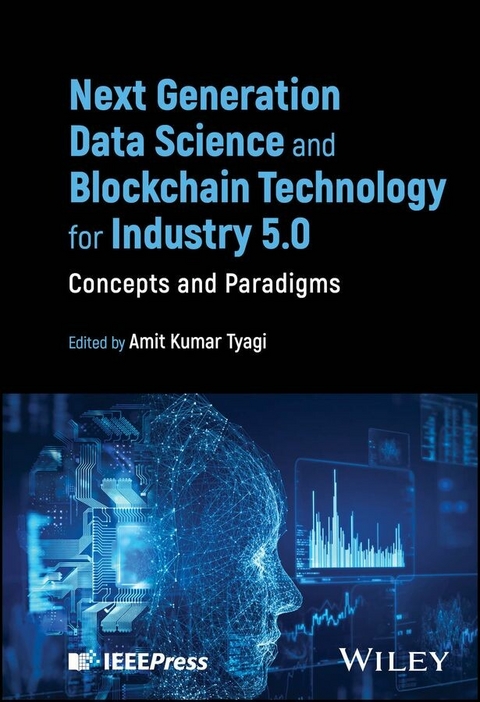
Next Generation Data Science and Blockchain Technology for Industry 5.0 (eBook)
780 Seiten
Wiley-IEEE Press (Verlag)
978-1-394-24519-2 (ISBN)
A groundbreaking view of the industrial models of the future
Industry 5.0 is an increasingly widespread term for the coming business paradigm, which will combine humans, robotics, and smart technology to create the industrial processes of the future. Technological innovations like smart factories, networked processes, data science, blockchain, and more will be combined to revolutionize industry and drive innovation at an unprecedented pace.
Next Generation Data Science and Blockchain Technology for Industry 5.0 offers an overview of these most important questions, their early answers, and the most promising paths forward. Incorporating practical case studies grounded in real-world data, the book emphasizes a hands-on approach combining numerous analytical tools. With a broad view of the historical role of industrial revolutions and a cutting-edge grasp of the key technologies, this book is an indispensable window into the future of business.
Next Generation Data Science and Blockchain Technology for Industry 5.0 readers will also find:
- Incorporation of tools including statistical analysis, machine learning, graph analysis, and more
- Detailed treatment of cutting-edge technologies like additive manufacture (3D printing), edge computing, and many others
- Self-assessment tools to facilitate understanding
Next Generation Data Science and Blockchain Technology for Industry 5.0 is ideal for academics, researchers, and advanced students in computer science and computer technology, as well as professionals and researchers working in data science or any other area of industrial technology.
Amit Kumar Tyagi, PhD, is Assistant Professor in the Department of Fashion Technology, National Institute of Fashion Technology, New Delhi, India. He has published widely on blockchain, deep learning, artificial intelligence, and other cutting-edge technologies and their industrial applications.
Chapter 1
Introduction to Industry 5.0 and Society 5.0
Richa1, Utkarsh Kumar2, Amit Kumar Tyagi3, Tanuj Surve4
1 Department of Computer Science and Engineering, Birla Institute of Technology, Mesra, India
2 Engineer Technical, Energy Efficiency Services Ltd., India
3 Department of Fashion Technology, National Institute of Fashion Technology, New Delhi, India
4 University of California, Berkeley, California USA
1.1 Introduction
1.1.1 Evolution of Industrial Revolutions
The term “Industrial Revolution” describes a sequence of recent developments in society, industry, and technology that brought about profound transformations in the political, cultural, and economic spheres. Throughout history, there have been multiple industrial revolutions, each marked by unique advances in technology and changes in society. Four basic phases can be used to broadly categorize the evolution of industrial revolutions:
First Industrial Revolution: During this time, the iron and coal industries emerged, the textile industry became mechanized, and the steam engine was developed. The transition from manual labor-intensive, rural economies to industrial, machine-driven output. The basis for contemporary industrial societies was established by this revolution.
Second Industrial Revolution: It saw the development of the telegraph and telephone networks, the use of electricity, the growth of the railway network, and the emergence of the steel industry. Large-scale industries, mass production, and urbanization all increased during this time. Connecting distant markets required significant advancements in communication and transportation.
Third Industrial Revolution: The emergence of computers, electronics, automation, and the broad application of information technology marked the Third Industrial Revolution. This revolution was largely fueled by the growth of the internet and telecommunications. Manufacturing processes were revolutionized by automation and digitization, which boosted productivity and facilitated globalization. The information and service sectors took precedence over heavy industry.
Fourth Industrial Revolution: The integration of digital technology, big data, artificial intelligence (AI), the Internet of Things (IoT), 3D printing, and sophisticated robotics comprise the Fourth Industrial Revolution. The distinctions between the digital, biological, and physical domains are becoming less clear. Smart technology is transforming our way of working, living, and interacting. Intelligent systems that are networked are the focus of concepts such as Industry 4.0.
Fifth Industrial Revolution: Many countries are currently having serious discussions about the “Fifth Industrial Revolution,” which builds upon the Fourth Industrial Revolution. In addition to the Fourth Industrial Revolution’s discussion of the use of AI, IoT, big data, etc., to revolutionize the industrial structure, the Fifth Industrial Revolution involves themes such as “sustainability,” “human-centeredness,” and “issues for the environment” (refer to Figure 1.1 for industrial revolution).
Figure 1.1 Evolution of industrial revolution.
1.2 Industry 5.0: The Next Industrial Revolution
The next stage of the Industrial Revolution will emerge soon, even if most businesses are still having difficulty digitizing their operations through the integration of cloud computing, AI, IoT, and other advanced technologies. The rapid advancement of technology and shifting integration of human processes will usher in Industry 5.0 in day-to-day operations. In Industry 5.0, human-smart systems like robots will work together more, particularly in manufacturing settings. At this point, all repetitive, tedious jobs are taken over by machines, and humans use their creativity to assume greater responsibility and oversight of the systems to improve the overall quality of production. But as evidenced by Accenture’s global study of 512 manufacturing executives, this concept is not new. Because by 2020, 85% of participants expected their factories to have a joint production line with people and robots [1, 2]. It is commonly acknowledged that the introduction of automation and robotics throughout earlier industrial revolutions caused paradigm shifts in the global manufacturing sector. From the first to the fourth industrial revolutions, the main drivers of change in product conception, design, and manufacturing were scientific and technological advancements, capital, and training [3–5].
1.3 Key Technology Involved in Industry 5.0
The digital, information, and operations technologies that make up Industry 5.0’s enabling technologies are what will ultimately lead to the current and impending digital transformation [6] (refer to Table 1.1). Clusters of emerging technologies and facilitating technologies are subcategories of enabling technologies.
Table 1.1 Basic features of Industry 5.0.
| Key technology | Implications and benefits | Applications |
|---|
| Industry 5.0 | Cognitive Artificial Intelligence | Innovation and New Business Models | Smart Hospital |
| Human Interaction and Recognition Technologies | Workforce Skill Development | Manufacturing Industry |
| Extended Reality | Human–Machine Collaboration | Supply Chain Management |
| Industrial Smart Wearable | Supply Chain Optimization | Smart Education |
| Intelligent or Adaptive Robots | Customization and Flexibility | Cloud Manufacturing |
| Intelligent Energy Management System | Advanced Data Analytics | Smart Education |
| Smart Product Lifecycle Management | Increased Efficiency and Productivity | Smart Environment |
Cognitive Cyber-Physical Systems (CCPS): In addition to recognizing the importance of humans CCPS, particularly in terms of communication, it gains from a certain level of machine consciousness [7].
Cognitive Artificial Intelligence (CAI): Data mining, and pattern recognition, trying to extract qualia from the abundance of exploratory sensory input, will enable CAI to better comprehend its surroundings and think, retrain, and behave like a person. Industry 5.0 would not be possible without CAI’s technology contributions, which improve health and safety, lower errors, minimize information overload, and enable users to make better decisions [8, 9].
Human Interaction and Recognition Technologies (HIRT): The goal of Industry 5.0’s developing HIRT is to connect and integrate humans and machines as best as possible, enabling safer, more efficient, and enjoyable physical and cognitive work because of human–machine interaction [10].
Extended Reality (XR): The phrase “extended reality” (XR) refers to a broad category of immersive technologies, such as emergent and conventional augmented, virtual, and mixed reality technologies. XR implications for Industry 5.0 include enhanced customer experience, sophisticated industrial and academic training, real-time immersive fault diagnostics of industrial operations, and increased safety and efficiency of industrial processes [11].
Industrial Smart Wearable (ISW): Businesses can choose from an expanding and varied selection of emerging ISW that provide a range of features in accordance with Industry 5.0 objectives [12].
Intelligent or Adaptive Robots: Intelligent (adaptive) robots are highly productive machines that can adapt to complex environments and unique scenarios while performing a wider range of complex activities. They can be thought of as an evolution of traditional and collaborative robots [13].
Intelligent Energy Management System (IEMS): IEMS has significant ramifications for sustainability and energy efficiency. The development of renewable energy resources and their integration into industrial and commercial operations are aided by IEMS and complementary technologies like microgrids, blockchain-based peer-to-peer electricity trading, smart storage, intelligent charging technologies, cloud demand response systems, and microgrids [14].
Smart Product Lifecycle Management (SPLM): By building digital models of the production, supply chain, service, and product processes, SPLM enables process networking and integration effectively. To provide total control over early-to-end stage product data, SPLM can interact with cloud services, corporate backend systems, Internet of Services, and smart product-embedded software [15].
1.4 Implications and Benefits of Industry 5.0: Overview and Key Concepts
Few of the implications and benefits of Industry 5.0 are as follows:
Increased Efficiency and Productivity: Automation and smart technologies lead to more efficient production processes, reducing the time and resources required for manufacturing.
Advanced Data Analytics: The ability to collect and analyze large volumes of data provides valuable information for decision-making, predictive maintenance, and process optimization.
Customization and...
| Erscheint lt. Verlag | 11.7.2025 |
|---|---|
| Sprache | englisch |
| Themenwelt | Mathematik / Informatik ► Informatik ► Theorie / Studium |
| Schlagworte | 3D Printing • Big Data • Blockchain • Education 4.0 • Healthcare 4.0 • Industry 5.0 • Information Security • internet of things • Process Optimization • Smart environment • Smart factories • Smart Technology • Society 5.0 • Supply Chain Management |
| ISBN-10 | 1-394-24519-X / 139424519X |
| ISBN-13 | 978-1-394-24519-2 / 9781394245192 |
| Informationen gemäß Produktsicherheitsverordnung (GPSR) | |
| Haben Sie eine Frage zum Produkt? |
 EPUB (Adobe DRM)
Kopierschutz: Adobe-DRM
Adobe-DRM ist ein Kopierschutz, der das eBook vor Mißbrauch schützen soll. Dabei wird das eBook bereits beim Download auf Ihre persönliche Adobe-ID autorisiert. Lesen können Sie das eBook dann nur auf den Geräten, welche ebenfalls auf Ihre Adobe-ID registriert sind.
Details zum Adobe-DRM
Dateiformat: EPUB (Electronic Publication)
EPUB ist ein offener Standard für eBooks und eignet sich besonders zur Darstellung von Belletristik und Sachbüchern. Der Fließtext wird dynamisch an die Display- und Schriftgröße angepasst. Auch für mobile Lesegeräte ist EPUB daher gut geeignet.
Systemvoraussetzungen:
PC/Mac: Mit einem PC oder Mac können Sie dieses eBook lesen. Sie benötigen eine
eReader: Dieses eBook kann mit (fast) allen eBook-Readern gelesen werden. Mit dem amazon-Kindle ist es aber nicht kompatibel.
Smartphone/Tablet: Egal ob Apple oder Android, dieses eBook können Sie lesen. Sie benötigen eine
Geräteliste und zusätzliche Hinweise
Buying eBooks from abroad
For tax law reasons we can sell eBooks just within Germany and Switzerland. Regrettably we cannot fulfill eBook-orders from other countries.
aus dem Bereich