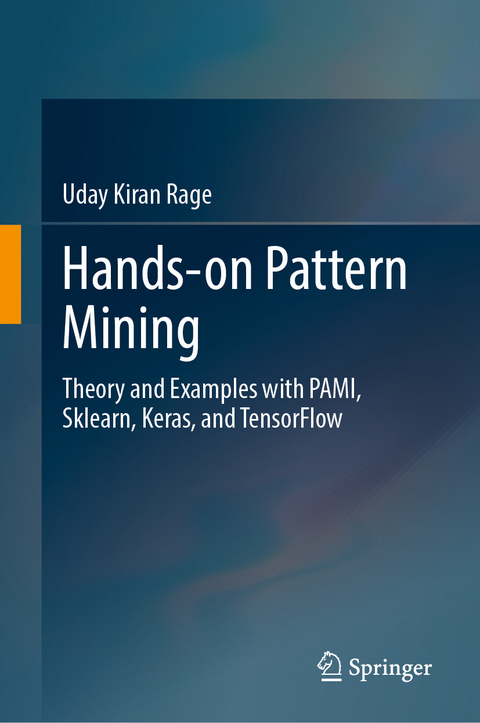
This book introduces pattern mining by presenting various pattern mining techniques and giving hands-on experience with each technique. Pattern mining is a popular data mining technique with many real-world applications, and involves discovering all user interest-based patterns that may exist in a database. Several models and numerous algorithms were described in the literature to find these patterns in binary databases, quantitative databases, uncertain databases, and streams. Since the lack of a Python toolkit containing these algorithms has limited the wide adaptability of pattern-mining techniques, the author developed Pattern Mining (PAMI) Python library, which currently contains 80+ algorithms to discover useful patterns in transactional databases, temporal databases, quantitative databases, and graphs.
The book consists of three main parts:
· Introduction: The first chapter introduces big data, types of learning techniques, and the importance of pattern mining. The second chapter introduces the PAMI library, its organizational structure, installation, and usage.
· Pattern mining algorithms and examples: The following chapters present the state-of-the-art techniques for discovering user interest-based patterns in (1) transactional databases, (2) temporal databases, (3) quantitative databases, (4) uncertain databases, (5) sequential databases, and (6) graphs.
· Applications: The book concludes with several applications, where the predicted knowledge using TensorFlow and PyTorch was transformed into a database to discover future trends or patterns.
This book introduces pattern mining by presenting various pattern mining techniques and giving hands-on experience with each technique. Pattern mining is a popular data mining technique with many real-world applications, and involves discovering all user interest-based patterns that may exist in a database. Several models and numerous algorithms were described in the literature to find these patterns in binary databases, quantitative databases, uncertain databases, and streams. Since the lack of a Python toolkit containing these algorithms has limited the wide adaptability of pattern-mining techniques, the author developed Pattern Mining (PAMI) Python library, which currently contains 80+ algorithms to discover useful patterns in transactional databases, temporal databases, quantitative databases, and graphs.The book consists of three main parts:· Introduction: The first chapter introduces big data, types of learning techniques, and the importance of pattern mining. The second chapter introduces the PAMI library, its organizational structure, installation, and usage.· Pattern mining algorithms and examples: The following chapters present the state-of-the-art techniques for discovering user interest-based patterns in (1) transactional databases, (2) temporal databases, (3) quantitative databases, (4) uncertain databases, (5) sequential databases, and (6) graphs.· Applications: The book concludes with several applications, where the predicted knowledge using TensorFlow and PyTorch was transformed into a database to discover future trends or patterns.
| Erscheint lt. Verlag | 10.7.2025 |
|---|---|
| Sprache | englisch |
| Themenwelt | Informatik ► Datenbanken ► Data Warehouse / Data Mining |
| Informatik ► Theorie / Studium ► Künstliche Intelligenz / Robotik | |
| Mathematik / Informatik ► Mathematik ► Statistik | |
| ISBN-10 | 981-96-6791-7 / 9819667917 |
| ISBN-13 | 978-981-96-6791-8 / 9789819667918 |
| Informationen gemäß Produktsicherheitsverordnung (GPSR) | |
| Haben Sie eine Frage zum Produkt? |
 PDF (Wasserzeichen)
Größe: 17,5 MB
DRM: Digitales Wasserzeichen
Dieses eBook enthält ein digitales Wasserzeichen und ist damit für Sie personalisiert. Bei einer missbräuchlichen Weitergabe des eBooks an Dritte ist eine Rückverfolgung an die Quelle möglich.
Dateiformat: PDF (Portable Document Format)
Mit einem festen Seitenlayout eignet sich die PDF besonders für Fachbücher mit Spalten, Tabellen und Abbildungen. Eine PDF kann auf fast allen Geräten angezeigt werden, ist aber für kleine Displays (Smartphone, eReader) nur eingeschränkt geeignet.
Systemvoraussetzungen:
PC/Mac: Mit einem PC oder Mac können Sie dieses eBook lesen. Sie benötigen dafür einen PDF-Viewer - z.B. den Adobe Reader oder Adobe Digital Editions.
eReader: Dieses eBook kann mit (fast) allen eBook-Readern gelesen werden. Mit dem amazon-Kindle ist es aber nicht kompatibel.
Smartphone/Tablet: Egal ob Apple oder Android, dieses eBook können Sie lesen. Sie benötigen dafür einen PDF-Viewer - z.B. die kostenlose Adobe Digital Editions-App.
Buying eBooks from abroad
For tax law reasons we can sell eBooks just within Germany and Switzerland. Regrettably we cannot fulfill eBook-orders from other countries.
 EPUB (Adobe DRM)
Kopierschutz: Adobe-DRM
Adobe-DRM ist ein Kopierschutz, der das eBook vor Mißbrauch schützen soll. Dabei wird das eBook bereits beim Download auf Ihre persönliche Adobe-ID autorisiert. Lesen können Sie das eBook dann nur auf den Geräten, welche ebenfalls auf Ihre Adobe-ID registriert sind.
Details zum Adobe-DRM
Dateiformat: EPUB (Electronic Publication)
EPUB ist ein offener Standard für eBooks und eignet sich besonders zur Darstellung von Belletristik und Sachbüchern. Der Fließtext wird dynamisch an die Display- und Schriftgröße angepasst. Auch für mobile Lesegeräte ist EPUB daher gut geeignet.
Systemvoraussetzungen:
PC/Mac: Mit einem PC oder Mac können Sie dieses eBook lesen. Sie benötigen eine
eReader: Dieses eBook kann mit (fast) allen eBook-Readern gelesen werden. Mit dem amazon-Kindle ist es aber nicht kompatibel.
Smartphone/Tablet: Egal ob Apple oder Android, dieses eBook können Sie lesen. Sie benötigen eine
Geräteliste und zusätzliche Hinweise
Buying eBooks from abroad
For tax law reasons we can sell eBooks just within Germany and Switzerland. Regrettably we cannot fulfill eBook-orders from other countries.
aus dem Bereich