Ethical Decision-Making Using Artificial Intelligence (eBook)
425 Seiten
Wiley-Scrivener (Verlag)
978-1-394-27530-4 (ISBN)
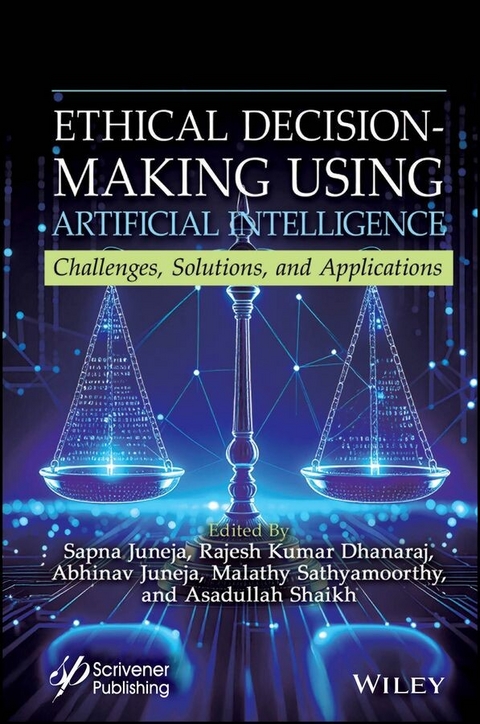
Ethical Decision-Making Using Artificial Intelligence: Challenges, Solutions, and Applications gives invaluable insights into the ethical complexities of artificial intelligence, empowering the navigation of critical decisions that shape our future in an era where AI's influence on society is rapidly expanding.
The significant impact of artificial intelligence on society cannot be overstated in a time of lightning-fast technical development and growing integration of AI into our daily lives. A new frontier of human potential has emerged with the development and application of AI technologies, pushing the limits of what is possible in the areas of innovation and efficiency. AI systems are increasingly trusted with complicated decisions that affect our security, well-being, and the fundamental foundation of our societies as they develop in intelligence and autonomy. These choices have substantial repercussions for both individuals and communities in a wide range of fields, including healthcare, finance, criminal justice, and transportation. The necessity for moral direction and deliberate decision-making procedures is critical as AI systems develop and become more independent.
Ethical Decision-Making Using Artificial Intelligence: Challenges, Solutions, and Applications examines the complex relationship between artificial intelligence and the moral principles that guide its application. This book addresses fundamental concerns surrounding AI ethics, namely what moral standards ought to direct the creation and use of AI systems. In order to promote responsible AI development that is consistent with human values and goals, this book's goal is to equip readers with the knowledge and skills they need to traverse the ethical landscape of AI decision-making.
Sapna Juneja, PhD is a professor and Associate Dean of Research and Development in the Department of Computer Science and Engineering with the KIET Group of Institutions, with over 17 years of experience. She has published six patents and various research articles in renowned journals. Her research interests include software engineering, computer networks, operating systems, database management systems, and artificial intelligence.
Rajesh Kumar Dhanaraj, PhD is a professor at Symbiosis International University. He has authored and edited over 50 books, numerous book chapters, and over 100 articles in refereed international journals, in addition to 21 patents. His research interests include machine learning, cyber-physical systems, and wireless sensor networks.
Abhinav Juneja, PhD is a professor and the Head of the Department of Computer Science and Information Technology with the KIET Group of Institutions, with over 21 years of teaching experience. He has edited two books and has over 55 publications in books, journals, and conferences. His research focuses on machine learning and Internet of Things.
Malathy Sathyamoorthy, PhD is an assistant professor in the Department of Information Technology at the KPR Institute of Engineering and Technology. She has published over 25 research papers in international journals. 22 papers in international conferences, two patents, four book chapters, and one book. His research interests include wireless sensor networks, networking, security, and machine learning.
Asadullah Shaikh, PhD is a professor, the Head of Research and Graduate Studies, and the coordinator for seminars and training with the College of Computer Science and Information Systems, at Najran University. He has over 170 publications in international journals and conferences. His research interests include Unified Modeling Language model verification and class diagrams verification with Object Constraint Language constraints for complex models, formal verification, and feedback techniques for unsatisfiable UML and OCL class diagrams.
Ethical Decision-Making Using Artificial Intelligence: Challenges, Solutions, and Applications gives invaluable insights into the ethical complexities of artificial intelligence, empowering the navigation of critical decisions that shape our future in an era where AI s influence on society is rapidly expanding. The significant impact of artificial intelligence on society cannot be overstated in a time of lightning-fast technical development and growing integration of AI into our daily lives. A new frontier of human potential has emerged with the development and application of AI technologies, pushing the limits of what is possible in the areas of innovation and efficiency. AI systems are increasingly trusted with complicated decisions that affect our security, well-being, and the fundamental foundation of our societies as they develop in intelligence and autonomy. These choices have substantial repercussions for both individuals and communities in a wide range of fields, including healthcare, finance, criminal justice, and transportation. The necessity for moral direction and deliberate decision-making procedures is critical as AI systems develop and become more independent. Ethical Decision-Making Using Artificial Intelligence: Challenges, Solutions, and Applications examines the complex relationship between artificial intelligence and the moral principles that guide its application. This book addresses fundamental concerns surrounding AI ethics, namely what moral standards ought to direct the creation and use of AI systems. In order to promote responsible AI development that is consistent with human values and goals, this book s goal is to equip readers with the knowledge and skills they need to traverse the ethical landscape of AI decision-making.
| Erscheint lt. Verlag | 9.7.2025 |
|---|---|
| Sprache | englisch |
| Themenwelt | Mathematik / Informatik ► Informatik ► Theorie / Studium |
| ISBN-10 | 1-394-27530-7 / 1394275307 |
| ISBN-13 | 978-1-394-27530-4 / 9781394275304 |
| Informationen gemäß Produktsicherheitsverordnung (GPSR) | |
| Haben Sie eine Frage zum Produkt? |
 PDF (Adobe DRM)
Kopierschutz: Adobe-DRM
Adobe-DRM ist ein Kopierschutz, der das eBook vor Mißbrauch schützen soll. Dabei wird das eBook bereits beim Download auf Ihre persönliche Adobe-ID autorisiert. Lesen können Sie das eBook dann nur auf den Geräten, welche ebenfalls auf Ihre Adobe-ID registriert sind.
Details zum Adobe-DRM
Dateiformat: PDF (Portable Document Format)
Mit einem festen Seitenlayout eignet sich die PDF besonders für Fachbücher mit Spalten, Tabellen und Abbildungen. Eine PDF kann auf fast allen Geräten angezeigt werden, ist aber für kleine Displays (Smartphone, eReader) nur eingeschränkt geeignet.
Systemvoraussetzungen:
PC/Mac: Mit einem PC oder Mac können Sie dieses eBook lesen. Sie benötigen eine
eReader: Dieses eBook kann mit (fast) allen eBook-Readern gelesen werden. Mit dem amazon-Kindle ist es aber nicht kompatibel.
Smartphone/Tablet: Egal ob Apple oder Android, dieses eBook können Sie lesen. Sie benötigen eine
Geräteliste und zusätzliche Hinweise
Buying eBooks from abroad
For tax law reasons we can sell eBooks just within Germany and Switzerland. Regrettably we cannot fulfill eBook-orders from other countries.
aus dem Bereich