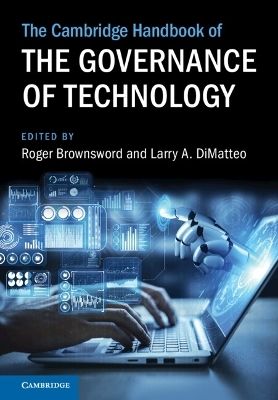
The Cambridge Handbook of the Governance of Technology
Cambridge University Press (Verlag)
978-1-009-52253-3 (ISBN)
In recent years, the use of AI has skyrocketed. The introduction of widely available generative AI, such as ChatGPT, has reinvigorated concerns for harm caused to users. Yet so far government bodies and scholarly literature have failed to determine a governance structure to minimize the risks associated with AI and big data. Despite the recent consensus among tech companies and governments that AI needs to be regulated, there has been no agreement regarding what a framework of functional AI governance should look like. This volume assesses the role of law in governing AI applications in society. While exploring the intersection of law and technology, it argues that getting the mix of AI governance structures correct-both inside and outside of the law-while balancing the importance of innovation with risks to human dignity and democratic values, is one of the most important legal-social determination of our times.
Roger Brownsword holds part-time professorial positions at King's College London and Bournemouth University. He has published many books and articles including, most recently, Technology, Humans, and Discontent with the Law: The Quest for Better Governance (Routledge, 2024), and The Future of Governance: A Radical Introduction to Law (Routledge, 2025). Larry A. DiMatteo is the Huber Hurst Professor of Contact Law, Warrington College of Business & Levin College of Law at the University of Florida. He is the author, or coauthor, and coeditor of more than 160 publications, including eighteen books. Some of his books are Principles of Contract Law and Theory (2024), The Cambridge Handbook of Artificial Intelligence (2022), Judicial Control over Arbitral Awards (2021), and The Cambridge Handbook of Smart Contracts, Blockchain Technology and Digital Platforms (2020).
Part I. Discontent with Law's Governance: 1. Law's imperfect governance Roger Brownsword; 2. Technology's self-governance Iris Eisenberger; 3. On law's governance of technology Ugo Pagallo; 4. Tech law: local and global governance Andrew Murray; Part II. Discontent with Governance by Technological Management: 5. Technology's ability to escape the legal system Colin Gavaghan and Andrew Charlesworth; 6. Problems of technological management: on automated extraction of mental goods Przemysław Pałka; 7. Agency in the face of artificial intelligence William Lucy; Part III. Technology's Disruptive Effects on Law: 8. Governance of lawyering and lawyering governance of AI Larry DiMatteo and Francisco de Elizalde; 9. Adapting consumer to new technologies Christian Twigg-Flesner and Geraint Howells; 10. Detecting disruption: implications for law's classifications Lan Luh Luh and Kelvin FK Low; 11. Contract law and technological disruption: blenders to AI Eliza Mik; 12. Law of private remedies in the governance of AI Sergio García Long; Part IV. Evolution of LawTech: 13. Developing artificially intelligent justice Jiaying Jiang, Sidney Thomas and Seth Frye; 14. Regulating legal tech for digital systems Georgios Dimitropoulos; Part V. Governance by Technology: 15. Incomplete interaction of public/private governance in the AI act Hans Micklitz; 16. Technologies in environmental governance: two scenarios Han Somsen.
| Erscheinungsdatum | 01.11.2025 |
|---|---|
| Reihe/Serie | Cambridge Law Handbooks |
| Zusatzinfo | Worked examples or Exercises |
| Verlagsort | Cambridge |
| Sprache | englisch |
| Maße | 178 x 254 mm |
| Gewicht | 829 g |
| Themenwelt | Mathematik / Informatik ► Informatik |
| Recht / Steuern ► Allgemeines / Lexika | |
| Recht / Steuern ► EU / Internationales Recht | |
| Recht / Steuern ► Öffentliches Recht | |
| Recht / Steuern ► Privatrecht / Bürgerliches Recht ► IT-Recht | |
| ISBN-10 | 1-009-52253-1 / 1009522531 |
| ISBN-13 | 978-1-009-52253-3 / 9781009522533 |
| Zustand | Neuware |
| Informationen gemäß Produktsicherheitsverordnung (GPSR) | |
| Haben Sie eine Frage zum Produkt? |
aus dem Bereich