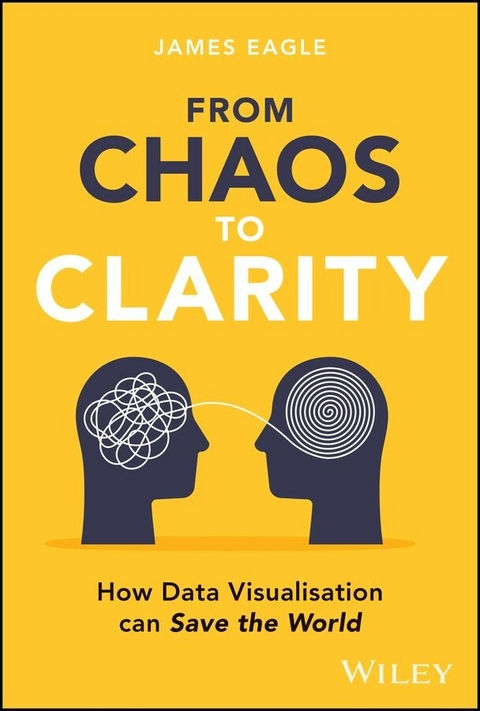
From Chaos to Clarity (eBook)
367 Seiten
Wiley (Verlag)
978-1-394-29300-1 (ISBN)

A radical wake up call for world overloaded with data and how data visualisation could be the answer
In From Chaos to Clarity: How Data Visualisation Can Save the World, celebrated data visualisation creator James Eagle reveals how our data-saturated age harbours hidden dangers that places humanity in peril. He looks at how masterful visual storytelling might be our salvation. Through vivid examples and profound insights, James Eagle exposes the data pollution clouding modern life, whilst demonstrating how thoughtful, human-centred data visuals can cut through the noise, sharpen our collective understanding and light the path toward a more discerning future.
Inside the book:
- How to unlock the human side of data visualisation by using empathy and storytelling
- Understanding our brain's deep connection to pictures and stories, and why this matters in this digital age
- Ways data visualisation can restore our human understanding of this world and tackle misinformation
This is a must-read urgent message on how data visualisation is needed to confront data overload and misuse. From Chaos to Clarity is perfect for professionals in finance, engineering, science, mathematics and health, as well as journalists, writers, data scientists, and anyone interested in visual storytelling, reclaiming truth and sharpening our collective thinking to tackling some of the biggest challenges we face in this world.
JAMES EAGLE is the founder of Eeagli, which combines innovative data visualisation and storytelling for many renowned institutions around the world. He is a LinkedIn Top Voice and regularly speaks at conferences and writes about issues that shape the world today.
Chapter 1
Data Visualisation Is Written in Our DNA
As the dig entered its sixth month, Hormuzd Rassam's team had unearthed thousands of clay tablets. Most contained mundane economic records. But his instincts, honed through years of excavations at Nimrud and Nineveh, told him they were onto something and so he persisted. On one sweltering day in July 1881, under the scorching Iraqi sun, a very special tablet was unearthed (Persia and Babylonia 2019).
Rassam could not have known what it was. It was catalogued and packed away with the rest of the tablets, destined for the British Museum. Once there, in the months that followed, scholars painstakingly deciphered the cuneiform inscriptions on these tablets.
Then they came to this particular tablet. Excitement rippled through the halls of the museum. Sir Henry Rawlinson and his colleagues were looking at something quite extraordinary. It was an ancient Babylonian map of the world from the seventh or eighth century BCE.
Now you might wonder what this story has to do with data visualisation. It has everything to do with it. Let me explain.
The importance lies in the origins of human civilisation. In fact, this tablet is intrinsically linked to answers related to our evolution, the workings of our human minds and what drives human civilisation forward.
In this book, I passionately explain why mankind needs data visualisation and how it might save us in the world we have created. It begin with our desire for exploration and discovery, which this ancient clay tablet represents. This is true for both the Babylonians who created this map and the Victorian archaeologists who found it in Iraq.
We as human beings have a deep‐rooted curiosity that pushes us to explore and understand the world we are in, driving us to uncover its mysteries and beauty. Data visualisation is very much a part of this endeavour, as it requires us to see what's hidden within data to reveal it mysteries.
You do not always know what you will find or where you will end up when you try to visualise data. It is an adventure! And that's exactly what happened when Hormuzd Rassam and Sir Henry Rawlinson uncovered those hidden secrets in that 2,800‐year‐old ancient clay tablet.
That tablet would eventually become known as the Imago Mundi, which in Latin translates as ‘Image of the World’. It would rewrite what we knew at the time about the history of mankind by offering us an unprecedented look into how ancient civilisations viewed their place in the cosmos. It also raised many questions, like why did people back then feel the need to create maps?
Those people who created Imago Mundi also had an unquenchable thirst for voyage and discovery just like us. They wanted to understand how their world looked and functioned, which is why they created that map. It wasn't simply about navigation. That map represented a view of an earlier economic system that had developed with mankind's first civilisations. There is also a lot more to the Imago Mundi than that meets the eye. To appreciate this, we need to go back even further in human history.
Picture a Palaeolithic landscape, where our ancestors once roamed, their lives dictated by the harsh environment that they lived in and where food was scare. From archaeological evidence, we know that humans first added wild grains to their diet about 100,000 years ago (Mercader 2009).
Life back then was radically different world from today. We lived as nomadic hunter‐gatherers in small groups, battling for survival in an environment dominated by untamed nature, where large animals such as mammoths, sabre‐toothed cats and woolly rhinoceroses roamed the earth.
This was the Ice Age. We used stone tools to hunt, prepare food and build shelters, which were essential for our survival. Fire provided warmth, allowed us to cook food and offered protection from predators, significantly enhancing our ability to survive.
However, this was still a very harsh environment. Life expectancy was low, with many individuals not surviving past 30 due to disease, injury and malnutrition. Despite these challenges, our ancestors showed incredible adaptability and developed complex language, created art and used symbols to communicate. Believe it or not, this would eventually help lay the foundation for developing modern‐day data visualisation thousands of years later.
The Dawn of Maps and Abstract Thought
Around 12,000 years ago, we reached a revolutionary point in human history – the arrival of agriculture. This event is thought to have first occurred in the Fertile Crescent, irrevocably altering the course of human history and laying the foundations for the emergence of the world's first civilisations (Naithani 2021).
As wheat and barley sprouted from deliberately sown fields, so did the first seeds of economic development. These first crops, nurtured by human hands, represented more than just reliable sustenance; they ushered in a new world order, where humans became the most resourceful species the planet had ever seen.
Agriculture had brought with its emergence the world's first economic systems where resources could be marshalled to serve and sustain us, whether this came in the form of crops grown, animals tamed or raw materials like metal extracted from the ground to make tools and weapons.
After this, populations in newly formed cities grew and societal complexity flourished in ways our nomadic ancestors could scarcely have imagined.
These developments meant that we needed to comprehend and navigate an increasingly complex economic environment. This is what gave birth to extraordinary innovations such as the map and the wheel. Trade routes could develop over vast distances this way, and humans could travel further and quicker than ever with greater certainty of where they were.
What is more amazing is that this wasn't a development limited to early Indo‐European civilisations. In other parts of the world, early Mesoamerican civilisations were doing the same. They were recording their territorial boundaries and trade paths in their own symbolic forms (Batalla 2009). The Inca of South America employed quipus, which was an intricate system of knotted cords that recorded numerical information (Cartwright 2016). Australian Aboriginal groups had their own methods, navigating the lands they travelled through songlines that encoded their geographical knowledge (Cairns and Harney 2004).
These diverse approaches for recording information applied by ancient societies reveal a universal human drive to visualise and interpret the world. We have always visualised data whether that has been through knots, songs or symbols, which has served as a bridge between abstract concepts and our human understanding.
These examples, along with the Imago Mundi, were the first innovations we had developed for data visualisation. Over time far more complex developments in information management would propel mankind even further. The most important of these is still used heavily today – the written word.
Before we discuss the miracle of writing, however, let's look back to what life was like before words were written. It is the only way we can truly appreciate how wonderful this innovation is and why we were always destined to discover it. Let's go back to that Stone Age scene again.
The Roots of Visual Communication
Imagine a caveman telling his son how he hunted and killed a mammoth. Would he give him a 10‐point plan for getting the job done? Would he explain the workflow required to carry out such an activity, from sharpening the spear to taking an ethical shot? Would he give him a boring PowerPoint slideshow on how to do it?
No! The answer is no. If you are a dad, you would never do this even now. That is not how you make kids listen. You would tell your son a wild story. You would do this probably while sitting by the campfire for maximum dramatic effect, and this wouldn't be just any story. This would be the most insane, terrifying and yet exciting story you could possibly tell.
Your son's eyes would be bulging out. He would be hanging on to every word you spoke.
This is a story that he will probably remember for the rest of his life. Moreover, it could potentially save his life. Years from now, he might be hunting a mammoth himself as an adult, and the information you gave him through your own heroic saga might prevent him from being trampled or gored to death.
This is the oral tradition that I'm describing, and it has been with us since the dawn of humanity. It is what allowed the art of storytelling to develop, where valuable information could be transferred from one generation to the next, ensuring the survival of our species. These stories also enriched our language and allowed us to transfer not just words but visual imagery and human emotion to anyone who listened. Storytelling is undoubtedly the most powerful communication tool our species ever created and perhaps even more miraculous than the written word. Our ability to tell stories is literally written into our DNA. It is part of our evolution so it cannot be ignored.
Human Minds Are Pattern‐Seeking Machines
One of the reasons why stories work so well is because they feed directly into our natural human ability to recognise patterns. By presenting events and characters in a sequence, a good story helps our brains...
| Erscheint lt. Verlag | 8.7.2025 |
|---|---|
| Sprache | englisch |
| Themenwelt | Mathematik / Informatik ► Informatik |
| Schlagworte | Cognitive Bias • data literacy • data pollution • data stories • Data storytelling • Data visualisation book • data visualisation history • data visualisation strategies • Data viz • disinformation • misinformation |
| ISBN-10 | 1-394-29300-3 / 1394293003 |
| ISBN-13 | 978-1-394-29300-1 / 9781394293001 |
| Informationen gemäß Produktsicherheitsverordnung (GPSR) | |
| Haben Sie eine Frage zum Produkt? |
 EPUB (Adobe DRM)
Kopierschutz: Adobe-DRM
Adobe-DRM ist ein Kopierschutz, der das eBook vor Mißbrauch schützen soll. Dabei wird das eBook bereits beim Download auf Ihre persönliche Adobe-ID autorisiert. Lesen können Sie das eBook dann nur auf den Geräten, welche ebenfalls auf Ihre Adobe-ID registriert sind.
Details zum Adobe-DRM
Dateiformat: EPUB (Electronic Publication)
EPUB ist ein offener Standard für eBooks und eignet sich besonders zur Darstellung von Belletristik und Sachbüchern. Der Fließtext wird dynamisch an die Display- und Schriftgröße angepasst. Auch für mobile Lesegeräte ist EPUB daher gut geeignet.
Systemvoraussetzungen:
PC/Mac: Mit einem PC oder Mac können Sie dieses eBook lesen. Sie benötigen eine
eReader: Dieses eBook kann mit (fast) allen eBook-Readern gelesen werden. Mit dem amazon-Kindle ist es aber nicht kompatibel.
Smartphone/Tablet: Egal ob Apple oder Android, dieses eBook können Sie lesen. Sie benötigen eine
Geräteliste und zusätzliche Hinweise
Buying eBooks from abroad
For tax law reasons we can sell eBooks just within Germany and Switzerland. Regrettably we cannot fulfill eBook-orders from other countries.
aus dem Bereich