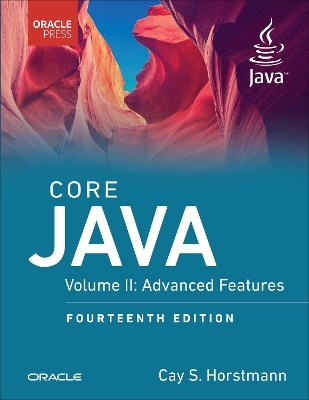
Core Java, Volume II
Addison Wesley (Verlag)
978-0-13-555869-0 (ISBN)
Core Java is the leading no-nonsense tutorial and reference for experienced programmers who want to write robust Java code for real-world applications. Now, Core Java, Volume II: Advanced Features, Fourteenth Edition, has been revised to cover the new features and enhancements in the Java 25 long-term support release. As always, all chapters have been completely updated, outdated material has been removed, and the new APIs are covered in detail.
This volume focuses on the advanced topics that a programmer needs to know for professional software development and includes authoritative coverage of fi le processing, networking, databases, security, internationalization, compiling and scripting, and foreign functions, as well as complete chapters on the Streams, XML, and Date and Time APIs. In addition, the chapters on Swing and Graphics cover techniques that are applicable to both client-side user interfaces and server-side generation of graphics and images.
Cay S. Horstmann clearly explains sophisticated new features with depth and completeness and demonstrates how to use them to build professional-quality applications. Horstmann's thoroughly tested sample code reflects modern Java style and best practices. The examples are carefully crafted for easy understanding and maximum practical value, so you can rely on them to jump-start your own programs.
Effectively use Java streams, including new Java 25 features such as stream gatherers
Master advanced techniques, idioms, and best practices for writing reliable Java code
Make the most of enhanced Java I/O APIs, object serialization, and regular expressions
Connect to network services, harvest web data with the HTTP/2 client, and serve data with the built-in web server or implement your own server
Process code via the Scripting and Compiler APIs, and generate code with the new Class File API
Leverage the Java security model, user authentication, and the security library's cryptographic functions
Learn powerful new APIs for accessing foreign functions and memory
"This is the definitive reference and instructional work for Java and the Java ecosystem."
--Andrew Binstock, Java Magazine
See Core Java, Volume I: Fundamentals, Fourteenth Edition, for expert coverage of Java programming fundamentals, including objects, generics, collections, lambda expressions, concurrency, modularity, and functional programming.
Register your book for convenient access to downloads, updates, and/or corrections as they become available. See inside book for details.
Cay S. Horstmann is author of Modern JavaScript for the Impatient (2020), Core Java(R) for the Impatient, Third Edition (2022), Scala for the Impatient, Second Edition (2016), and Java SE 8 for the Really Impatient (2014), all from Addison-Wesley. He has written more than a dozen books for professional programmers and computer science students. He is an emeritus professor of computer science at San Jose State University and a Java Champion.
Preface xiii
Acknowledgments xvii
Chapter 1: Streams 1
1.1 From Iterating to Stream Operations 1
1.2 Stream Creation 4
1.3 The filter, map, and flatMap Methods 10
1.4 Extracting Substreams and Combining Streams 12
1.5 Other Stream Transformations 13
1.6 Simple Reductions 14
1.7 The Optional Type 16
1.8 Collecting Results 24
1.9 Collectors 25
1.10 Reduction Operations 43
1.11 Gatherers 45
1.12 Primitive Type Streams 52
1.13 Parallel Streams 58
Chapter 2: Input and Output 63
2.1 Input/Output Streams 63
2.2 Reading and Writing Binary Data 87
2.3 Working with Files 96
2.4 Memory-Mapped Files 113
2.5 File Locking 123
2.6 Object Input/Output Streams and Serialization 126
2.7 Regular Expressions 150
Chapter 3: XML 167
3.1 Introducing XML 167
3.2 The Structure of an XML Document 169
3.3 Parsing an XML Document 172
3.4 Validating XML Documents 181
3.5 Locating Information with XPath 199
3.6 Using Namespaces 203
3.7 Streaming Parsers 206
3.8 Generating XML Documents 215
3.9 XSL Transformations 225
Chapter 4: Networking 237
4.1 Connecting to a Server 237
4.2 Implementing Servers 245
4.3 Getting Web Data 259
4.4 The HTTP Client 277
4.5 The Simple HTTP Server 286
4.6 Sending E-Mail 290
Chapter 5: Database Programming 293
5.1 The Design of JDBC 293
5.2 The Structured Query Language 296
5.3 JDBC Configuration 302
5.4 Working with JDBC Statements 307
5.5 Query Execution 317
5.6 Scrollable and Updatable Result Sets 328
5.7 Row Sets 334
5.8 Metadata 338
5.9 Transactions 345
5.10 Connection Management in Web and Enterprise Applications 351
Chapter 6: The Date and Time API 353
6.1 The Time Line 353
6.2 Local Dates 357
6.3 Date Adjusters 362
6.4 Local Time 364
6.5 Zoned Time 365
6.6 Formatting and Parsing 369
6.7 Interoperating with Legacy Code 375
Chapter 7: Internationalization 377
7.1 Locales 377
7.2 Number Formats 384
7.3 Date and Time 393
7.4 Collation and Normalization 397
7.5 Message Formatting 402
7.6 Text Boundaries 407
7.7 Text Input and Output 408
7.8 Resource Bundles 411
7.9 A Complete Example 415
Chapter 8: Compiling and Scripting 421
8.1 The Compiler API 421
8.2 Scripting for the Java Platform 430
Chapter 9: Security 441
9.1 Class Loaders 442
9.2 User Authentication 455
9.3 Digital Signatures 465
9.4 Encryption 480
Chapter 10: Graphical User Interface Programming 491
10.1 A History of Java User Interface Toolkits 491
10.2 Displaying Frames 493
10.3 Displaying Information in a Component 499
10.4 Event Handling 520
10.5 The Preferences API 544
Chapter 11: User Interface Components with Swing 551
11.1 Swing and the Model-View-Controller Design Pattern 551
11.2 Introduction to Layout Management 556
11.3 Text Input 562
11.4 Choice Components 569
11.5 Menus 588
11.6 The Grid Bag Layout 606
11.7 Custom Layout Managers 616
11.8 Dialog Boxes 620
Chapter 12: Advanced Swing and Graphics 645
12.1 Tables 645
12.2 Working with Rows and Columns 653
12.3 Cell Rendering and Editing 669
12.4 Trees 680
12.5 Advanced AWT 719
12.6 Raster Images 764
12.7 Printing 789
Chapter 13: The Foreign Functions and Memory API 823
13.1 Using JNI to Call C Code from a Java Program 824
13.2 Using FFM to Call a Foreign Function 830
13.3 Arenas 831
13.4 Memory Segments 832
13.5 Memory Layout 834
13.6 Looking Up and Invoking Foreign Functions 837
13.7 Callbacks 844
13.8 Advanced Topics 847
Index 853
| Erscheinungsdatum | 21.10.2025 |
|---|---|
| Reihe/Serie | Oracle Press for Java |
| Verlagsort | Boston |
| Sprache | englisch |
| Maße | 190 x 235 mm |
| Gewicht | 1652 g |
| Themenwelt | Mathematik / Informatik ► Informatik ► Programmiersprachen / -werkzeuge |
| ISBN-10 | 0-13-555869-7 / 0135558697 |
| ISBN-13 | 978-0-13-555869-0 / 9780135558690 |
| Zustand | Neuware |
| Informationen gemäß Produktsicherheitsverordnung (GPSR) | |
| Haben Sie eine Frage zum Produkt? |
aus dem Bereich